
Transporting a Wardrobe – Disassemble or Move It Whole?
The most important decision comes before the first move: take it apart or carry it whole? The rule of thumb, the right securing – and if you would rather not carry it yourself: a van with driver and carrying help is booked in minutes.
- Instant price before booking
- Insured transports
- Carrying help bookable
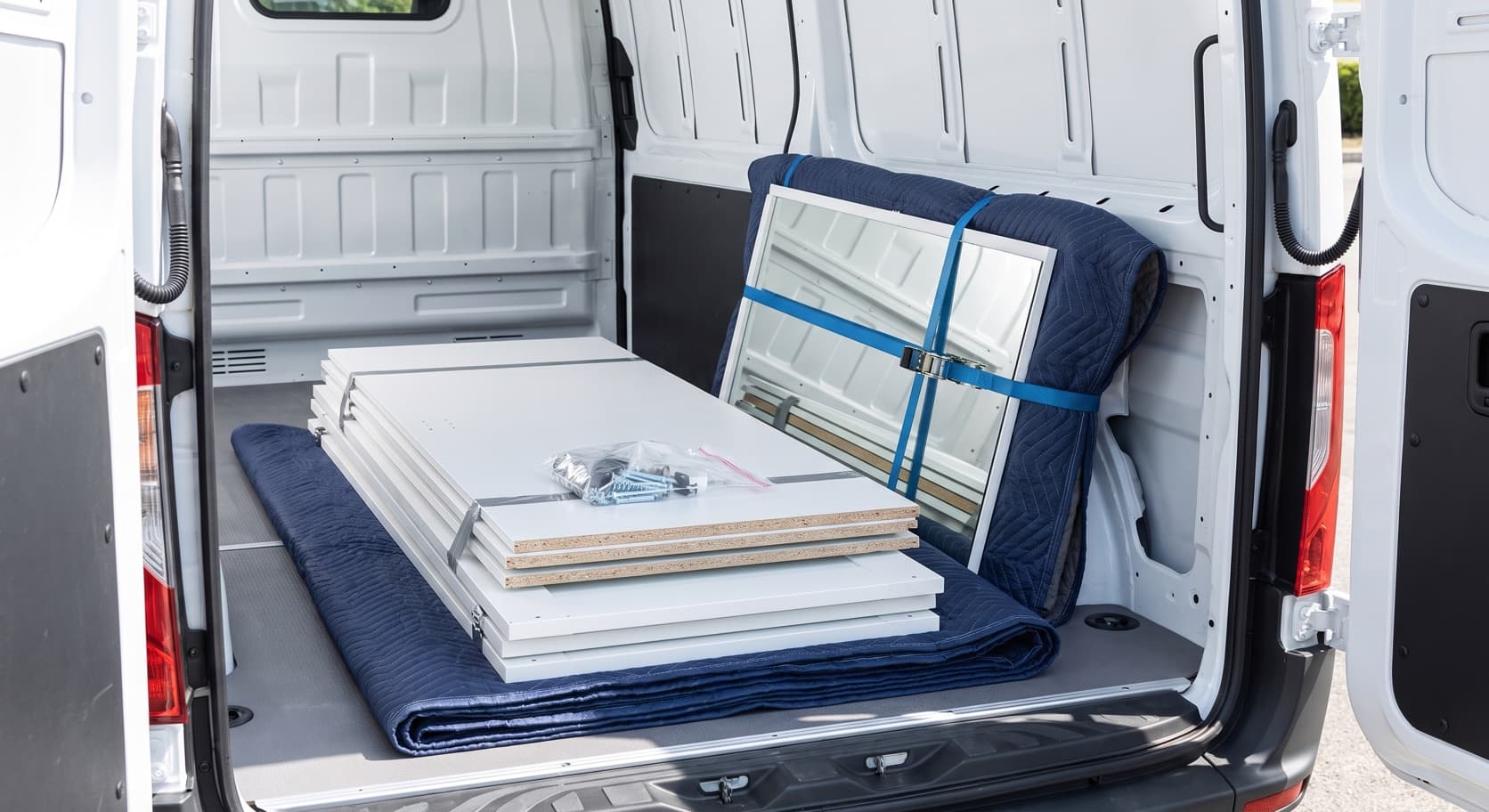
How to Transport a Wardrobe Properly
Empty it and decide
Empty it completely first – including the clothes rail. Then decide: anything over two doors gets disassembled, small wardrobes may travel whole when empty. A full wardrobe cannot be held while carrying and will warp.
Secure doors and back panel – or disassemble
If the wardrobe stays whole: wrap the doors in stretch film so they cannot swing open, and support the thin back panel while carrying. If disassembling: put screws and fittings for each part into a labeled bag.
Load flat on blankets
Stack disassembled side panels and shelves flat on moving blankets and strap them down. A whole small wardrobe travels lying on its back panel or standing firmly strapped – never loose and wobbling.
Which vehicle do you need?
Disassembled, the wardrobe becomes a stack of boards: elements weigh 30–80 kg and side panels run up to 2.4 m – that needs the 2.7 m cargo bed. A small wardrobe moved whole fits standing in a high-roof van. All dimensions and payloads in the van guide →
Transporting a Wardrobe: The Right Preparation
A wardrobe is not heavy furniture in the classic sense – a 2-meter element weighs 30 to 80 kilograms – but it is delicate: large chipboard surfaces, thin back panels, doors with adjusted hinges. Preparation starts with emptying it completely, clothes rail included; take out loose shelves and bundle them separately.
Then comes the core decision: disassemble or carry it whole? If you take it apart, put screws, dowels, and fittings for each part into a labeled bag and tape it to the matching element – otherwise reassembly takes longer than the entire transport.
Disassemble or Transport It Whole?
The rule of thumb: anything over two doors gets disassembled. Large carcasses – the Pax class from 2 meters of width – twist while being carried, because chipboard and cam fittings are not built for load at an angle. Dowels loosen, the back panel tears out of its groove, and the wardrobe never stands straight again.
Small one- or two-door wardrobes may travel whole – but only empty, with film-wrapped doors and a supported back panel. The thin fiberboard at the back is the weak spot: never grip the back-panel edge while carrying; hold the carcass instead.
Disassembling Pax-Style Units Properly – and Saving Mirrored Doors
System wardrobes are built to be taken apart: unhook the doors (quick-release at the hinge), remove shelves and drawers, pull the back panel out of its groove, then undo the cam fittings of the side panels. Photograph the hinge positions beforehand – it saves readjusting everything at reassembly.
Mirrored and glass doors are the most expensive part of the wardrobe: transport them separately, padded in blankets or bubble wrap, standing and slightly angled against the van wall – never lying flat, where glass breaks at the first pothole. Protect the edges with edge guards or folded cardboard.
Carrying a Wardrobe and Getting It Down the Stairs
Disassembled, the stairs are half the battle: one person can carry a single side panel, and it only gets unwieldy with 2.4-meter boards in a narrow stairwell – there it helps to guide the board upright and slightly diagonally. Moved whole, the rule is: always two people, tilt the wardrobe slightly, one person above, one below, and set it down on every landing.
On the cargo floor, board stacks lie on moving blankets and are strapped down; whole wardrobes stand against the van wall. How lashing straps should sit is covered in our glossary article on load securing.
Freight Forwarder, Courier, or Van with Driver?
For a single wardrobe, a classic freight forwarder is rarely worth it: consolidated freight means long delivery windows, and furniture quickly counts as bulky goods with a surcharge. A van with driver takes the wardrobe from where it stands – with Maxmove on the same day if you wish, with carrying help as a second person for stairs and long boards.
You see the binding price in advance in the transport cost calculator. If the wardrobe is moving as part of a relocation, our moving checklist helps you plan from emptying to reassembly.
Frequent Questions About Wardrobe Transport
How much does the transport cost?
Enter the route, choose the vehicle, add carrying help if needed – the price for your wardrobe transport is fixed in seconds.
Calculate the price in seconds