
Transporting a fridge – upright, secure, correctly reconnected
Defrost, load upright, wait after the transport: the three rules – and a van with driver if you want it done comfortably.
- Instant price before booking
- Insured transports
- Carrying help bookable
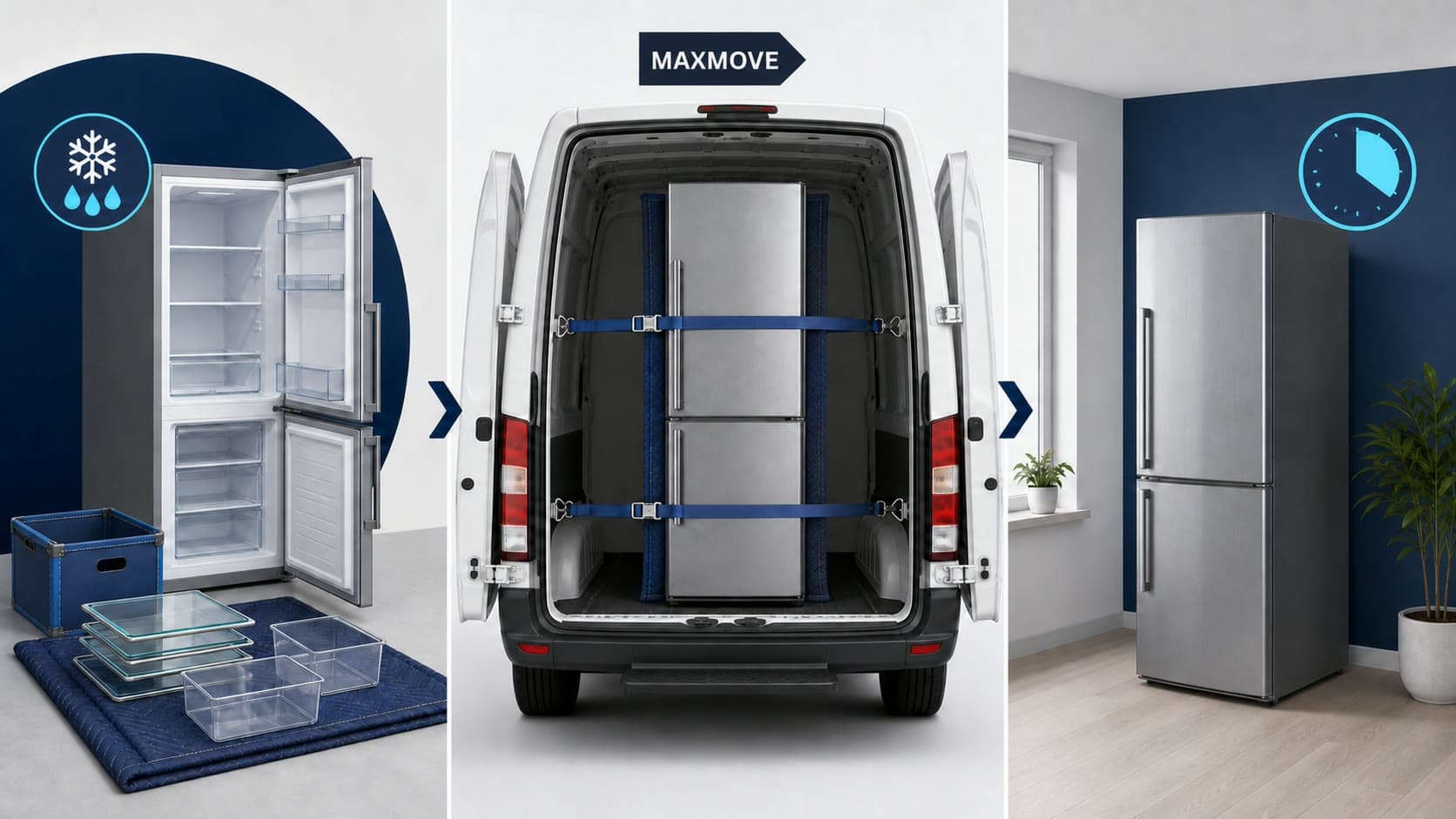
How to transport a fridge correctly
Defrost 24 hours ahead
Empty, defrost, and wipe the appliance dry – otherwise meltwater drips onto the load floor. Secure the doors with a strap or tape, pack loose glass shelves separately.
Transport upright
Oil circulates in the compressor. Laid down, it can flow into the cooling circuit and block it. Upright in a van with load securing is therefore always the first choice.
Wait after the transport
After upright transport Liebherr, for example, recommends waiting two hours; after lying transport at least twelve hours, or 24 hours for older appliances. Only then switch it on – your manufacturer's manual is what counts.
Which vehicle do you need?
Small fridges up to about 1.30 m stand upright in the 2.7 m van class; tall fridge-freezers (1.80–2 m) need the Sprinter with about 1.80 m or the 3.5-tonne box van with about 2.10 m of interior height. Always strap it to the lashing points. All dimensions and payloads in the van guide →
Can you transport a fridge lying down?
The short answer: it works, but it stays the second choice. Oil circulates in every fridge compressor to lubricate the moving parts. If the appliance lies on its side, that oil can escape from the compressor into the cooling lines. Switch the fridge on too early afterwards and the compressor sucks in oil instead of refrigerant – in the worst case the lines clog and the compressor runs dry.
So is it allowed to transport a fridge lying down? It is not forbidden, and many manufacturers explicitly permit it as an exception. What matters is how you do it: lay it on its side, never on its back – the condenser and cooling lines sit on the back and must not carry the appliance's weight. The door hinges point up so the door stays shut, and you drive noticeably gently.
How long must the fridge stand after lying transport?
The most important rule comes after the drive: a fridge that travelled lying down needs time for the compressor oil to collect in the compressor again. Liebherr recommends waiting at least twelve hours afterwards, or 24 hours for older appliances. During that time the cooling lines clear as well.
If the fridge travelled upright, Liebherr says two hours are enough. Rule of thumb: better wait too long than too short – compressor damage is almost always a write-off, because the repair often costs more than a new appliance.
How to transport a fridge, step by step
Defrost the appliance 24 hours ahead, wipe it dry, and secure doors, glass shelves, and drawers. A hand truck with a strap is the best help through the stairwell – always carry with two people and keep the appliance as upright as possible.
In the vehicle the fridge stands upright against the wall of the load area, fixed to the lashing points with straps; pad the edges with blankets. Our glossary article on load securing explains how straps sit correctly.
After setting it up: respect the waiting time, switch it on, and only restock it after a few hours at operating temperature. If the transport is part of a move, our moving checklist helps with the schedule for defrosting and reconnecting.
Van with driver instead of carrying it yourself
A tall fridge only stands upright in a Sprinter or 3.5-tonne box van – in a car or estate it can practically only travel lying down, with all the risks. With Maxmove you book the right vehicle with driver in minutes, with carrying help into the kitchen if you like. The transport cost calculator shows the binding price for the trip up front.
How long to wait after transport? Go by the manufacturer
Plenty of rules of thumb circulate about the resting time – what counts is what the manufacturer says. Liebherr recommends transporting a fridge upright or tilted slightly at most, and gives clear waiting times: after upright transport, two hours' rest is enough. If the appliance was lying down, wait at least twelve hours for modern fridges and 24 hours for older ones. That is longer than some popular rules of thumb – when in doubt, go with the longer time and the manual for your model.
The reason for caution is not only the compressor oil. Liebherr points out that the compressor mounting can, in rare cases, be damaged by sideways loading. In the vast majority of cases a fridge survives lying down, but that is exactly why upright transport is the better choice whenever a suitable vehicle is available.
On moving day this means: if the fridge travelled lying down, do not plan to switch it on that evening but the next morning. Food bridges the gap in cool boxes with ice packs. And only once the appliance has reached its operating temperature after switching on does the food go back in.
A fridge in a car or a van: interior height decides
Whether a fridge can travel upright depends on the vehicle's interior height, not the size of the load floor. An under-counter fridge measures around 85 cm and stands upright in any compact van. A fridge-freezer, on the other hand, is 1.80 to 2.00 m tall – it will not fit upright in any car or low-roof van.
With Maxmove you therefore choose the vehicle by the appliance's height: the 2.7 m class van has around 1.35 m of interior height, the 3.3 m class Sprinter around 1.80 m and the 3.5-tonne box lorry about 2.10 m. A fridge up to a good 1.70 m stands upright in the Sprinter; large fridge-freezers go in the box lorry. Measure the height before booking, including feet and hinge cover.
In a car, large appliances can only go lying down – with the long wait afterwards. And the refrigerant deserves attention: modern fridges mostly use isobutane (R600a), a flammable gas. Manuals require that no part of the refrigerant circuit is damaged while carrying and loading. If refrigerant does escape, keep open flames and ignition sources away and ventilate the room thoroughly. How to keep a load secure in a car is covered in our glossary article on load securing in cars.
Frequently asked questions
How much does the transport cost?
From a single appliance to the whole kitchen in a move: calculate the price in seconds, carrying help bookable.
Calculate the price in seconds