
Transporting a TV – upright means intact
Modern panels are big, thin, and sensitive to bending. With three rules your TV arrives without a crack in the picture.
- Instant price before booking
- Insured transports
- Carrying help bookable
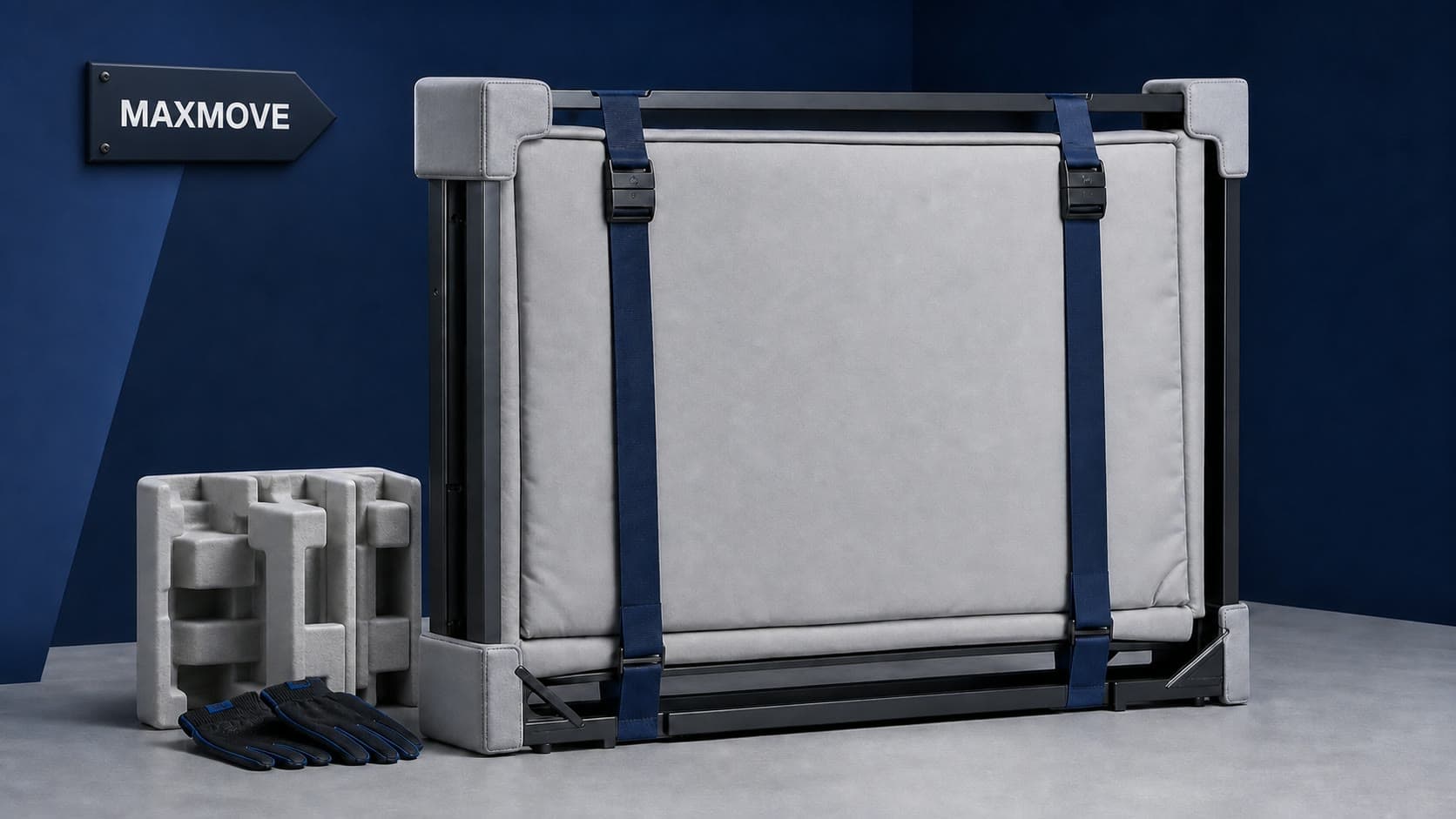
How to transport a TV correctly
Original box or padding
The safest ride is the original box with its molded padding. Without it: a soft blanket around the set, corner protectors on the edges – and never pressure on the display.
Always upright – never flat
Lying flat, even normal road vibrations can crack the panel because it barely tolerates bending. The TV therefore stands upright – just as it stands on the sideboard.
Strap in and acclimatize
Strap it upright between padding so nothing tips against the panel. After a cold ride, give the set one or two hours before switching it on – condensation.
Which vehicle do you need?
A 65-inch set needs almost a metre of height standing and fits, padded, in the compact van; from 75 inches the 2.7 m van class is the safe choice. Always carry large sets with two people, gripping the frame only. All dimensions and payloads in the van guide →
Transporting a TV lying flat: why the panel breaks
A modern TV panel is a large sheet of glass only a few millimeters thick that barely tolerates bending. Lying flat, every bump in the road works like a lever on the unsupported screen – fine cracks or a complete panel break are the typical result, often only visible at the next switch-on.
On top of that: transport damage is not a warranty case. Manufacturers prescribe upright transport in the manual; a TV that broke while lying flat will be neither repaired nor replaced. The TV therefore always travels upright – just as it stands on the sideboard.
Transporting an OLED TV lying down? Absolutely not
For OLED TVs, the no-lying rule counts double: OLED panels work without a backlight and are therefore even thinner and more flexible than LED and LCD panels. At large screen sizes, the glass can sag under its own weight when lying flat – manufacturers such as LG therefore explicitly require upright transport in the original box.
LED and QLED sets are somewhat stiffer thanks to the backlight stack, but not built for lying flat either. The rule is the same for every panel type: upright, padded, secured against tipping.
Getting the TV to its destination safely
The TV travels best in its original box with the molded padding; without the box, wrap it in a thick blanket and protect the corners. In the vehicle it stands upright between soft, stable items of cargo – a mattress and a strapped-down dresser, say – secured so nothing can tip against the panel; the basics are in our glossary article on load securing.
After a cold drive, the set needs one or two hours to acclimatize before being plugged in – otherwise condensation settles on the electronics. The transport cost calculator shows the price for a transport with driver up front; for a full move, the moving checklist helps.
Shipping a TV: parcel, freight forwarder or direct drive
When sending a TV as a parcel, the box dimensions count, not the screen size in inches. DHL accepts parcels up to 120 × 60 × 60 cm as standard, larger ones as bulky items up to 200 cm long and 360 cm in girth – the longest side plus twice the width plus twice the height – each up to 31.5 kg. A TV box is wide and tall: from around 65 inches it usually exceeds the girth limit, and smaller sets only go as bulky items. Measure the original box and work out the girth before heading to the post office.
Then there is the handling. In the parcel network the box runs over conveyor belts and sorting systems, and nobody makes sure it stays upright – yet that is exactly what manufacturers require. LG's manuals state that a TV must be transported upright, never turned on its side or tilted, and that large sets must be carried by at least two people.
A direct drive avoids both problems: the TV is collected from the retailer, the seller or your home, stands upright and strapped in the van and is handed over without reloading – with carrying help if you like. The transport cost calculator shows the binding price up front.
How big is a 55, 65 or 75-inch TV – and which vehicle fits?
The inch figure describes the screen diagonal; one inch is 2.54 cm. For a 16:9 picture, that gives the size of the screen area: a 55-inch set measures around 122 × 69 cm, a 65-inch around 144 × 81 cm, a 75-inch around 166 × 93 cm and an 85-inch around 188 × 106 cm. The bezel and stand come on top, and the original box is considerably bigger again.
That determines the vehicle. Up to 65 inches, the TV stands upright and padded in a compact van. From 75 inches, the screen width alone exceeds the load length we assume for the compact van – the 2.7 m class van is then the right choice, and even an 85-inch set stands upright in it. In a car, a large TV practically only fits lying down, which is exactly what manufacturers rule out.
Before transport, remove the stand or wall-mount plate; the screws go in a labelled bag taped to the set. Hold the TV by its frame, never by the screen, and carry large models with two people. In the vehicle the screen faces a padded surface, and nothing may tip against it.
Frequently asked questions
How much does the transport cost?
New TV from the store or the old one moving with you: price up front, insured on the way.
Calculate the price in seconds