
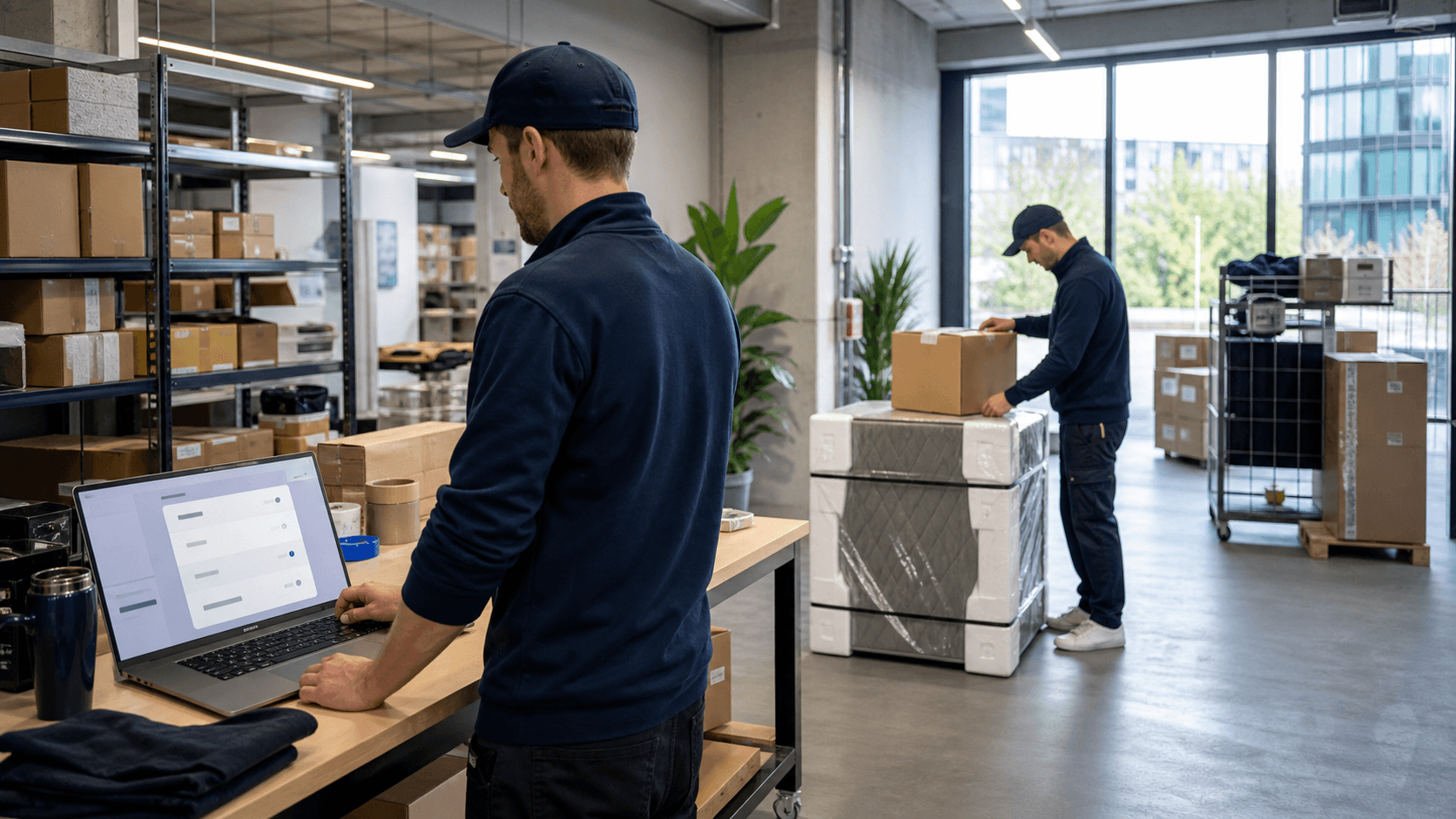
Same-day delivery does not belong on every product page. It belongs in checkout when the shop can decide before payment: this order is inside the right service area, the item is available at the pickup location, it fits the selected vehicle class, the cut-off is still open, and the recipient can accept the delivery today. Only then is the option a reliable checkout promise instead of a support risk.
For Maxmove, this is a strong e-commerce use case: local or regional goods from a store, warehouse, or showroom that should be picked up today, tracked in transit, and completed with proof of delivery. For national parcel shipping, scheduled groupage freight without same-day pressure, or regulated special goods, checkout-based same-day delivery is usually not the default path.
The Short Answer
Offer same-day delivery in checkout only where five conditions can be checked automatically.
| Question | Ready for checkout | Needs operations review first |
|---|---|---|
| Service area | Postcode, distance, or service zone is clear. | Address needs manual clarification. |
| Stock | Product is ready at the stated location. | Item must be sourced, transferred, or assembled first. |
| Time | Cut-off and recipient window fit today's transport. | Customer selects "today", but the destination cannot accept. |
| Shipment | Weight, dimensions, and packages are stored in the shop. | Product data is missing or only free text. |
| Proof | Photo, signature, status, and reference can attach to the order. | Evidence is only requested after support asks for it. |
When these points are clean, same-day delivery can improve conversion for suitable local orders and reduce phone coordination. When several points are missing, the shop should show "request delivery" or a planned appointment instead.
Which Products Fit?
Same-day works best when the item is locally available and the customer has a real reason to receive it today.
Typical cases:
- Spare parts that keep a repair or service visit moving.
- Electronics, appliances, or bulky cartons from a retail location.
- Furniture, samples, event material, or showroom goods on a short route.
- B2B replenishment for a practice, office, construction site, or restaurant.
- Exchange deliveries where an old or defective item must go back.
- High-value goods where tracking and proof of delivery matter more than an anonymous parcel label.
Ordinary parcels without urgency often do not need this option. DHL lists German domestic parcel limits such as 120 x 60 x 60 cm and a maximum weight of 31.5 kg (DHL parcel prices). If an item fits that pattern and tomorrow is fine, parcel shipping is often simpler. When size, value, time window, or handover matters more, local same-day transport becomes relevant.
Parcel, Freight, or Same-Day?
The decision is less about the sales channel and more about operational risk.
| Situation | Better path |
|---|---|
| Small parcel, no urgency, standard address | Parcel carrier |
| Bulky goods or pallet, plannable in 1 to 2 business days | Freight or groupage |
| Local goods, needed today, suitable vehicle available | Same-day transport |
| Recipient needs live status and clean completion evidence | Same-day or specialized courier model |
| Unknown dimensions, heavy special goods, dangerous goods, or assembly | Manual feasibility check |
Cargoboard describes German bulky-goods groupage transit times as usually 1 to 2 business days with 24/7 tracking (Cargoboard bulky goods). That is useful for many planned shipments. Same-day checkout is for orders where today's value justifies the extra operational attention.
What Checkout Must Check
Checkout should not display a delivery option that operations has to retract later. Check these points before showing it:
- Pickup location: Which location can actually fulfil the order?
- Delivery zone: Is the destination address inside the served area?
- Product data: Are weight, dimensions, packaging, and package count known?
- Vehicle class: Is a car, estate car, or van enough, or is more needed?
- Cut-off: Can the order still be picked up, driven, and delivered today?
- Payment: Is the customer charged in the shop while delivery cost runs through the business workspace?
- Import rule: Is the Maxmove delivery created automatically or after manual approval?
- Status return: How do tracking, fulfilment status, and proof of delivery return to the shop?
Shopify describes local delivery as a zone- and rule-based setup with pricing and conditions per delivery area (Shopify Help Center). For Maxmove, the shop also needs enough delivery data to make vehicle choice, pricing, and execution reliable.
How Maxmove Fits the Shop Workflow
Maxmove can start small and become automated later.
For individual cases, a team can book deliveries manually in Maxmove: address, vehicle class, instructions, tracking, and proof. That works for shops testing same-day as an internal service first.
For recurring e-commerce flows, integrations make more sense:
- The Shopify app can show suitable delivery options in checkout and pass eligible orders to Maxmove.
- The WooCommerce plugin adds Maxmove as a shipping method in shipping zones and can import orders.
- The Partner API works for custom shop, ERP, or OMS flows with quotes, deliveries, tracking, and webhooks.
The operational value does not come from "today" as a label. It comes from checkout, warehouse, driver assignment, status, and proof describing the same order.
Pricing Without Surprises
Shops usually use one of three models:
- Live price: The customer sees the currently calculated delivery option.
- Fixed price: The shop shows a simple flat rate and absorbs variance internally.
- Subsidy: Same-day becomes cheaper above a cart value, category, or margin threshold.
The important part is not letting the delivery option fight the shop's margin. A heavy item with a narrow window needs different rules than a small parcel. A premium service can remain paid if it reduces support effort, customer questions, and failed handovers.
Where Same-Day Checkout Fails
The most common problems are not technical integration issues. They are wrong promises in the process.
Same-day should not be offered automatically when:
- product weight or packaging dimensions are missing.
- several locations show stock, but none can reliably pick the order.
- the recipient has only entered a billing address.
- no phone number is available for pickup or delivery.
- the job needs stairs, assembly, two-person handling, or special equipment.
- the cut-off is tight and the goods are not ready.
- returns or exchange goods are not described in the order.
In these cases, manual approval is better than an automatic delivery that must be corrected later.
What Customers Should See
Checkout should stay short and concrete:
- delivery option with date or time window.
- price or clear cost rule.
- note when phone number or acceptance is required.
- no blanket guarantee when availability depends on area and capacity.
- tracking after confirmation.
- proof of delivery after completion where the order requires it.
Uber Direct positions same-day and scheduled delivery similarly as options inside an existing order channel, with tracking and proof-of-delivery controls (Uber Direct). That reflects the market pattern: the delivery option should fit the buying flow while still being operationally controlled.
Launch Checklist
Before the first checkout test, these points should be done:
- service area and exclusions are documented.
- every same-day product has weight and, where needed, package dimensions.
- pickup locations have opening hours and a default vehicle.
- cut-off rules are realistic per location.
- payment and cost logic is agreed internally.
- support can see the Maxmove order number, status, and tracking.
- return or exchange cases have their own rules.
- one test order has been checked from checkout through proof of delivery.
In Short
Same-day delivery in an online shop is strong when it is built as an operations rule: right products, clear service area, maintained shipment data, realistic cut-off, tracking, and proof. It is weak when it is only a marketing promise next to standard shipping methods.
Start with a few product groups and a clear area. Test manually or with a controlled integration through Shopify, WooCommerce, or the Maxmove Partner API. Then same-day can expand step by step without support and warehouse teams explaining every order from scratch.