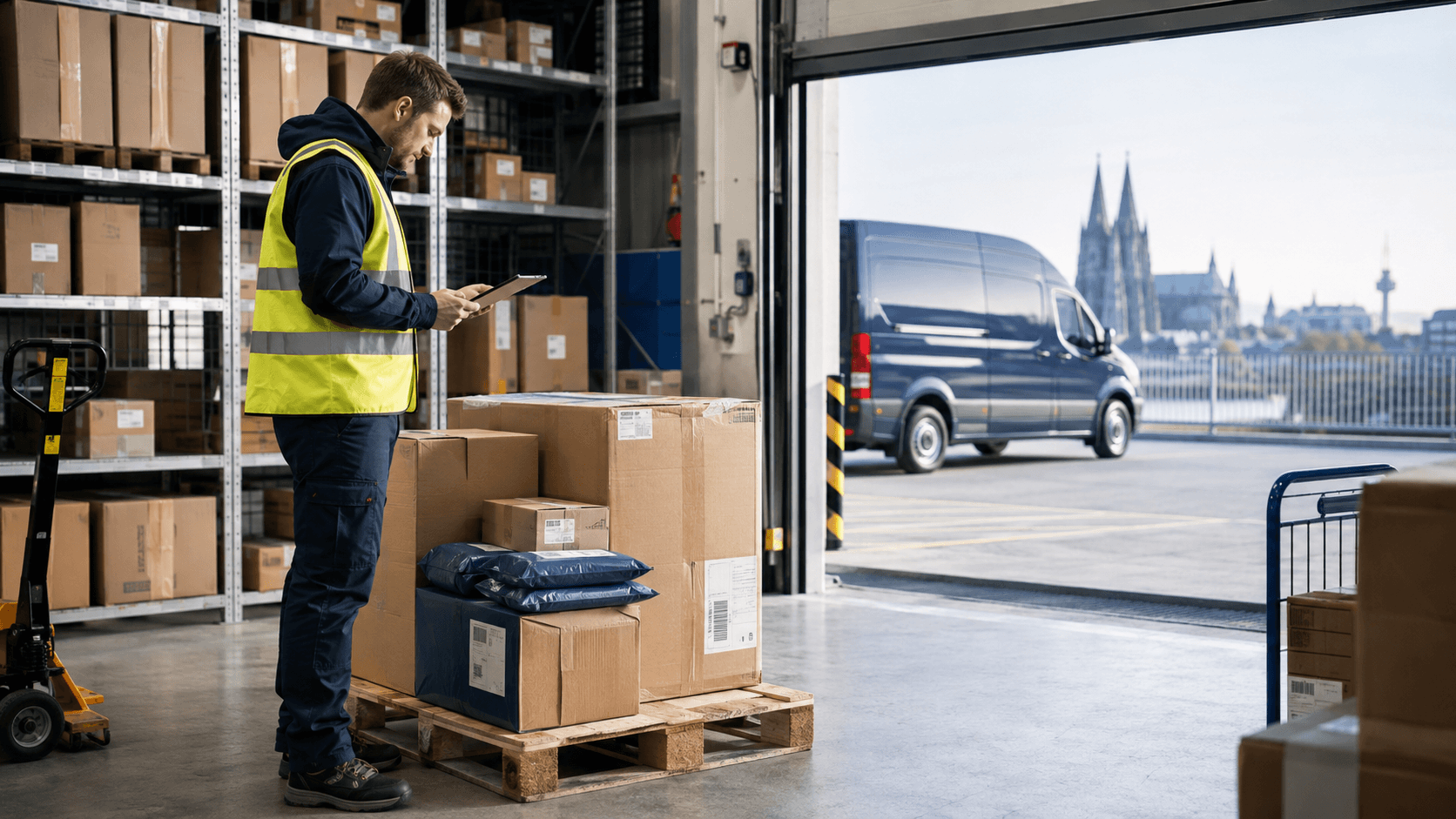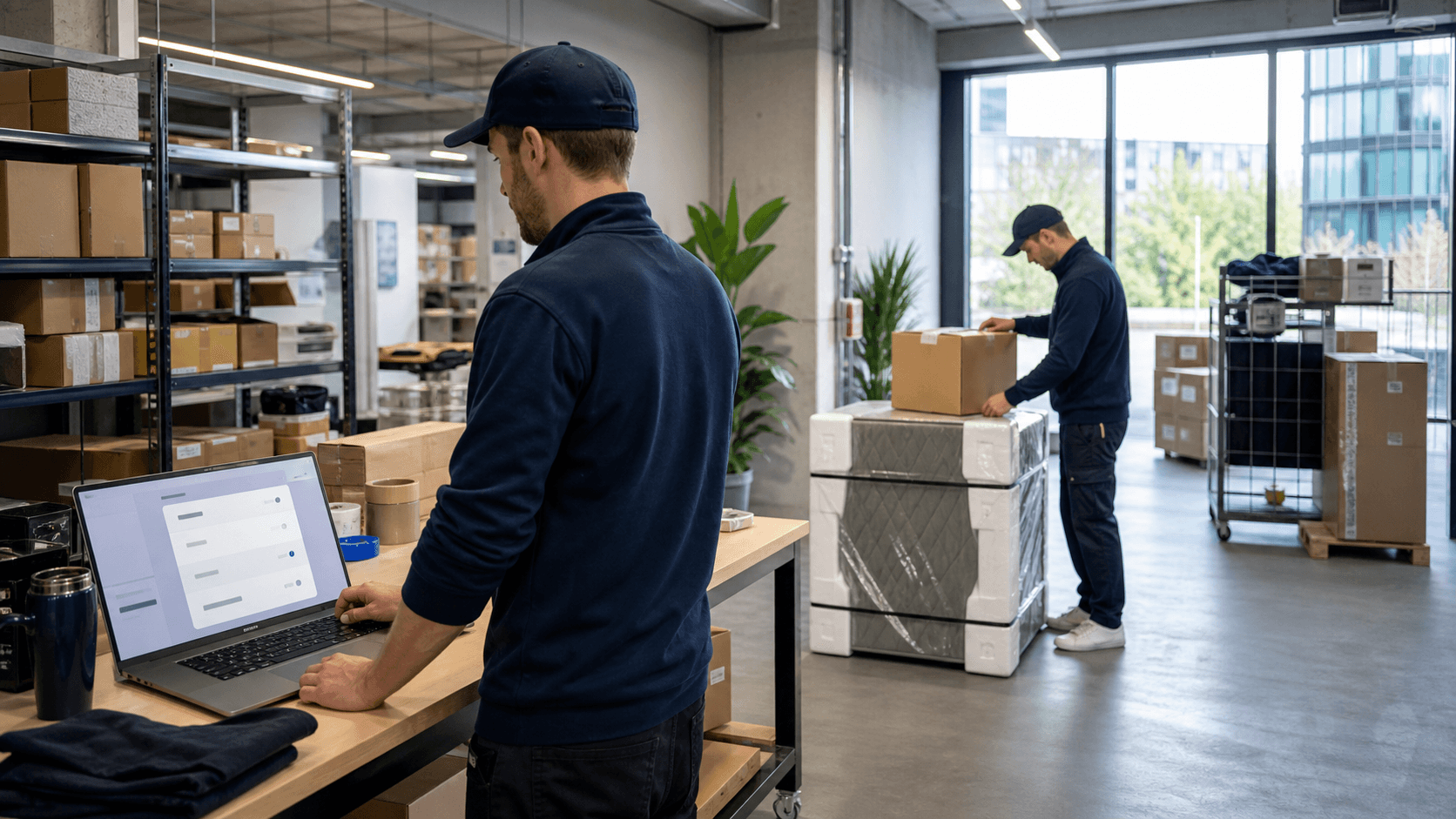

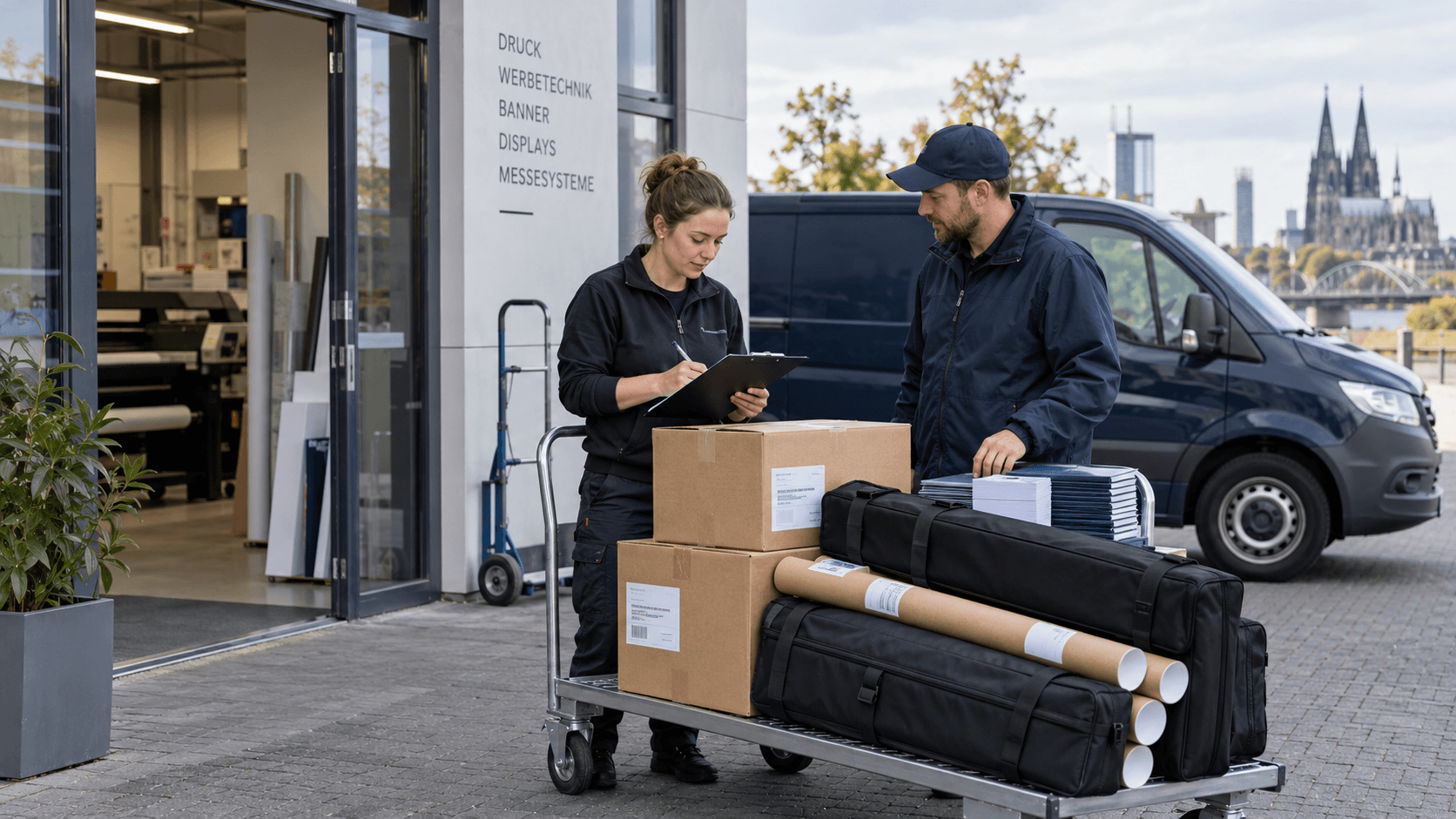
Trade-fair print materials are pickup-ready when every piece is produced, dry, packed, labelled, countable and waiting at the right pickup point. For a same-day run to an exhibition venue, "the job is printed" is not enough. The driver needs piece count, dimensions, weight, contact people, loading notes, destination gate or hall, time window and the required handover proof.
For print shops, agencies, stand builders and event teams, the key rule is simple: confirm pickup readiness before dispatching a driver. Otherwise the courier waits at the wrong door, the roll-up case is missing from the count, or the exhibition access slot no longer matches the trip.
The Short Answer
Before a same-day pickup, eight checks should be clear.
| Check | Pickup-ready means |
|---|---|
| Production | Printing, drying, cutting, laminating or finishing is complete. |
| Pieces | Boxes, poster tubes, roll-up bags and sample folders are counted. |
| Dimensions and weight | The largest items realistically fit the selected vehicle class. |
| Labels | Every piece carries reference, recipient, hall/stand or project name. |
| Pickup point | The driver can find gate, ramp, reception or contact without search time. |
| Venue destination | Delivery address, hall, stand, time window and access rule are known. |
| Proof | Photo, name, signature or handover comment is set before the trip starts. |
| Exception path | Someone can decide if a piece is missing or finishes late. |
If one of these points is still open, the trip should not start automatically. Clarification, a split delivery or a later window is usually safer.
Why Event Material Is Not a Normal Parcel
Print materials for trade fairs and events often have a hard deadline, but many small operational details:
- Brochure boxes are heavier than they look.
- Poster tubes and roll-up bags are long, but not palletized.
- Samples, fabric banners, media equipment and giveaways may sit in different areas.
- Delivery can go to a hall, stand, stand builder, hotel or agency.
- Setup times and venue access are not flexible.
- The on-site recipient may be an agency, builder or exhibitor.
Koelnmesse describes its eSlot system around making materials, exhibits and promotional items available when needed and booking time windows for delivery and collection (Koelnmesse eSlot). Messe Düsseldorf also publishes event-specific traffic rules and setup/dismantling windows through its stand builder portal (Stand Builder Portal). The practical lesson: the drive is only one part of the process. The handover has to fit the venue workflow.
The Readiness Boundary in Print Shops and Agencies
Many problems start because "done" means different things. For pickup, the status should be more precise.
| Internal status | Operational meaning | Transport action |
|---|---|---|
| Artwork approved | Content is final | do not plan the trip yet |
| Production running | Material is being made | only reserve a time window cautiously |
| Print finished | Sheets, banners or brochures exist | check cutting, drying and packing |
| Packing in progress | Team is assembling pieces | piece count is not final yet |
| Pickup-ready | Goods are counted, labelled and at pickup point | driver can be dispatched |
| Partial pickup needed | Deadline is tight, the rest follows | split and label the order deliberately |
A print shop should release the transport order only when the piece list is no longer a guess. That protects the driver, customer and support team from calls during the trip.
What Belongs in the Transport Order
The driver does not need the whole project history. They need executable details.
Include:
- project or order reference that print shop and recipient recognize,
- piece count by type: box, tube, bag, pallet, sample case,
- largest piece with length, width, height and approximate weight,
- handling notes: keep dry, do not bend, do not stack, carry upright or flat,
- pickup address with gate, floor, ramp, reception or production area,
- reachable contact at pickup and destination,
- destination with hall, stand number, gate, loading yard or hotel reception,
- time window, latest arrival and buffer for venue access,
- required proof: photo, name, signature, piece count or comment.
DHL's shipment guidance also asks for sender, receiver, content description, quantity, number of packages, total weight and dimensions in shipment data (DHL Express shipping guidance). For same-day direct transport, the logic is similar, but the cost of missing data is higher: there is less time to recover a forgotten tube or wrong hall.
Decision: Wait, Split or Go?
Not every delay puts the exhibition setup at risk. Dispatch still needs a clear decision.
| Situation | Better next step |
|---|---|
| One brochure box is missing, roll-ups are ready | Start a partial delivery only if destination and piece list clearly say "first delivery". |
| Printing is finished, but goods are still warm or unpacked | Move the pickup; damaged print materials do not save time. |
| Hall is known, stand number is missing | Clarify before driver assignment; venues are not one-address destinations. |
| Venue access slot is booked | Dispatch only if pickup can realistically meet that slot. |
| Recipient cannot be reached | Name a backup contact or do not mark the delivery as low-risk. |
| Goods are longer than expected | Check vehicle class before the wrong van arrives. |
The question is not: "Can somebody leave now?" The better question is: "Can these goods be handed over without search time, phone relays or proof gaps?"
Set Proof of Delivery Before the Trip
For exhibition material, proof of delivery is often more important than usual. If the stand opens the next morning without brochures, a later "it should have arrived" is not enough.
Before dispatch, decide:
- photo of the pieces at pickup?
- photo at the stand, hall or reception?
- signature with recipient name?
- comment for partial quantity, security-desk acceptance or warehouse drop?
- piece count at handover?
- reference that support, billing or the project file can find later?
Uber Direct describes proof-of-delivery verification methods such as signature, barcode, picture, identification or PIN (Uber Direct Proof of Delivery). That is not a Maxmove feature promise, but it shows the market pattern: verification methods should be set before execution, not after the recipient asks.
How Maxmove Fits This Flow
Maxmove is a good fit when the case is a local or regional direct run with clear pickup, destination, vehicle choice, tracking and proof. For print and event teams, the closest website contexts are Print shops and Trade fair logistics.
The workflow stays deliberately simple:
- Create the transport with pickup and destination address.
- Select the vehicle class from the largest pieces.
- Add venue access, stand number, contact and proof notes.
- Dispatch the driver only when the goods are truly pickup-ready.
- Keep status and proof on the order instead of private chat photos.
Maxmove does not replace venue access approval, eSlot booking, stand-building plans or the print shop's production responsibility. If a venue allows vehicles only in certain windows, that window belongs in the transport order.
Checklist for the Next Event Pickup
- Every piece is finished, dry, counted and packed.
- Longest tube, largest box and heaviest piece are known.
- Every piece carries project, recipient and destination note.
- Pickup point is executable: gate, floor, ramp or reception.
- Destination includes hall, stand, loading yard or exact acceptance point.
- Venue or hotel receiving window is checked.
- Driver notes cover fragile goods and no-stacking rules where needed.
- Backup contact is reachable.
- Proof method is set before dispatch.
- Partial deliveries are clearly marked.
When this list is green, a same-day run can do its job: move the material directly from production to the exhibition or event destination without transloading. When several points are still open, a later slot is better than a driver leaving with half the facts. Start single trips through booking or review Maxmove TMS for recurring event and print workflows.