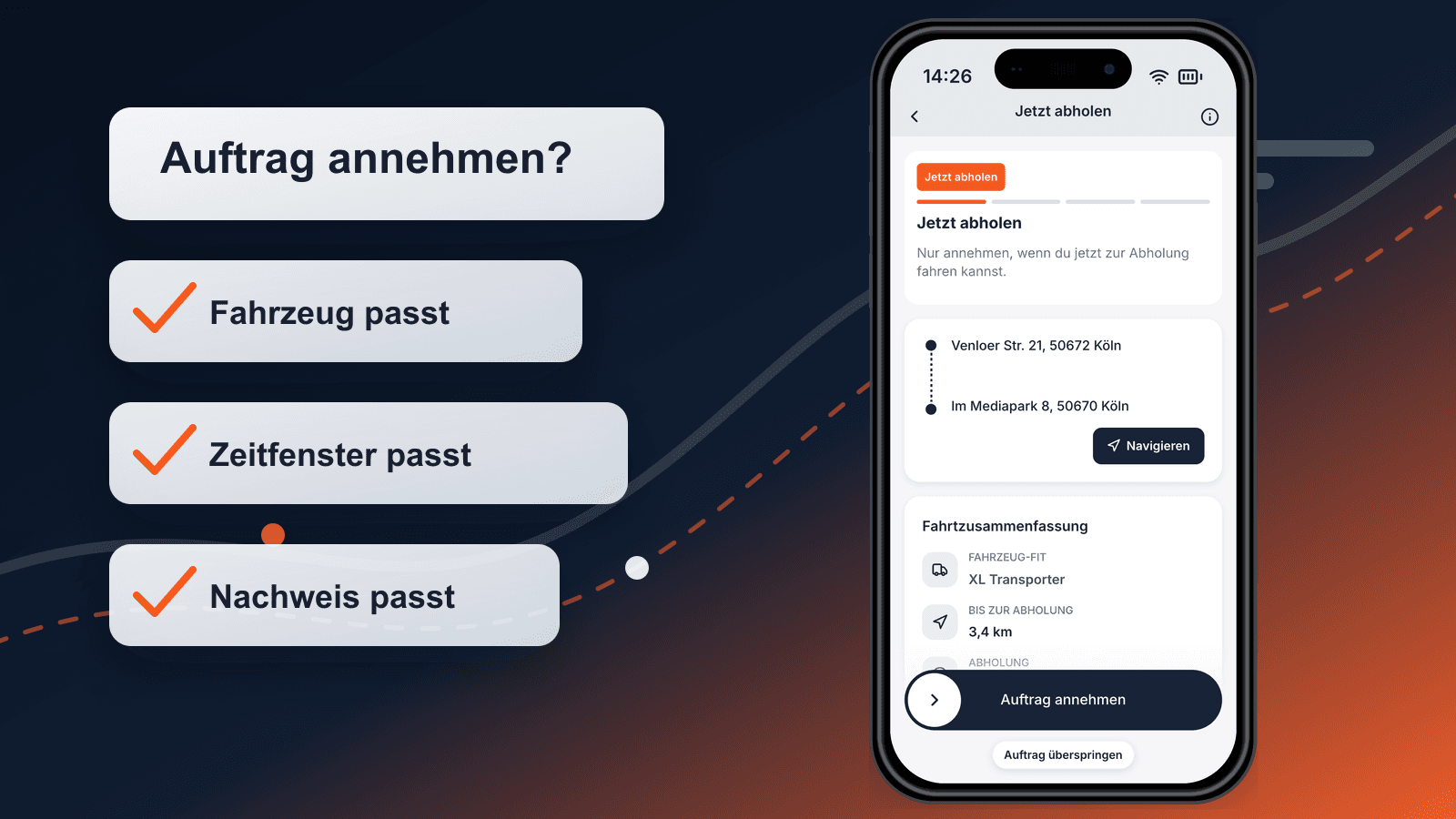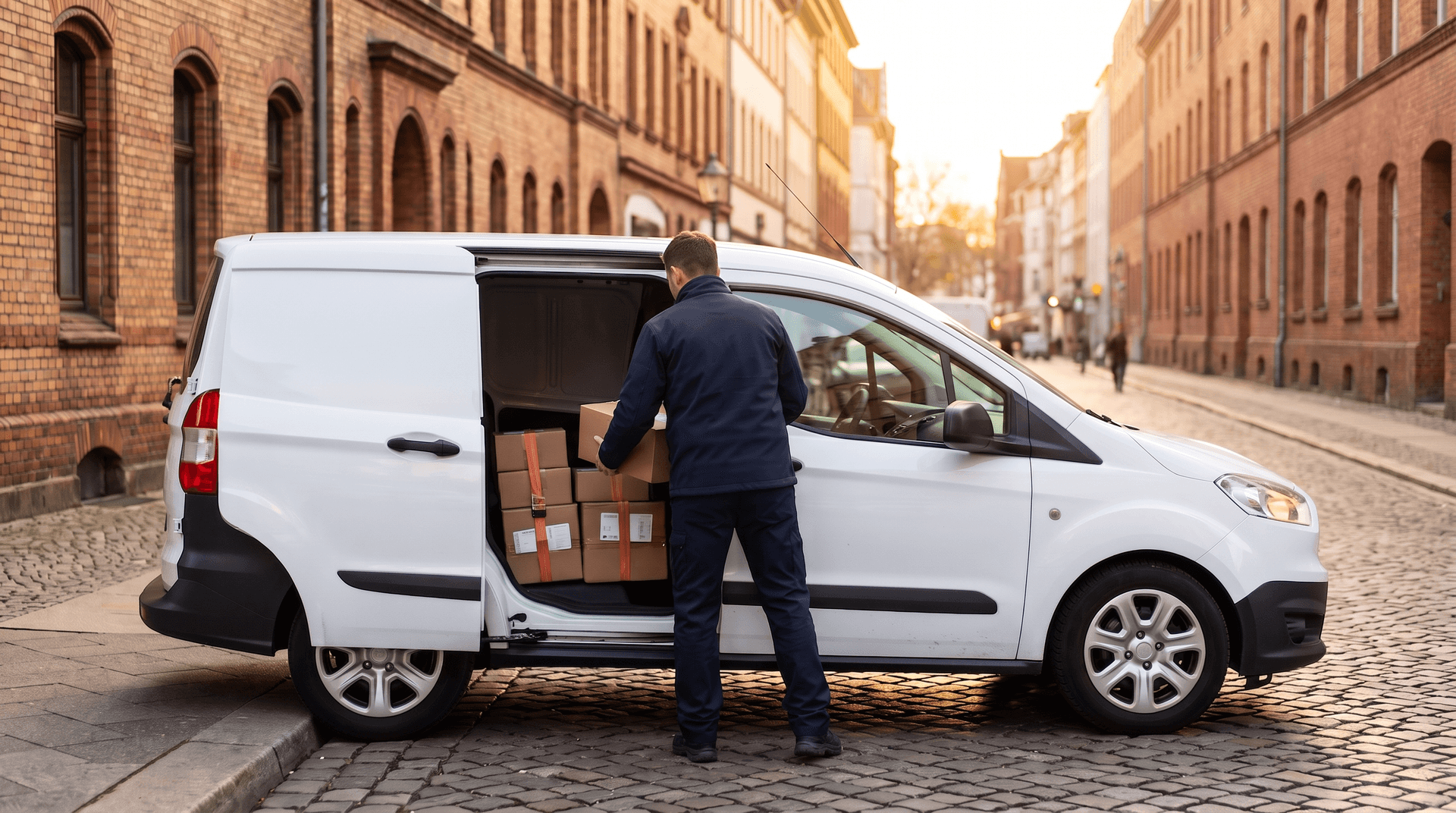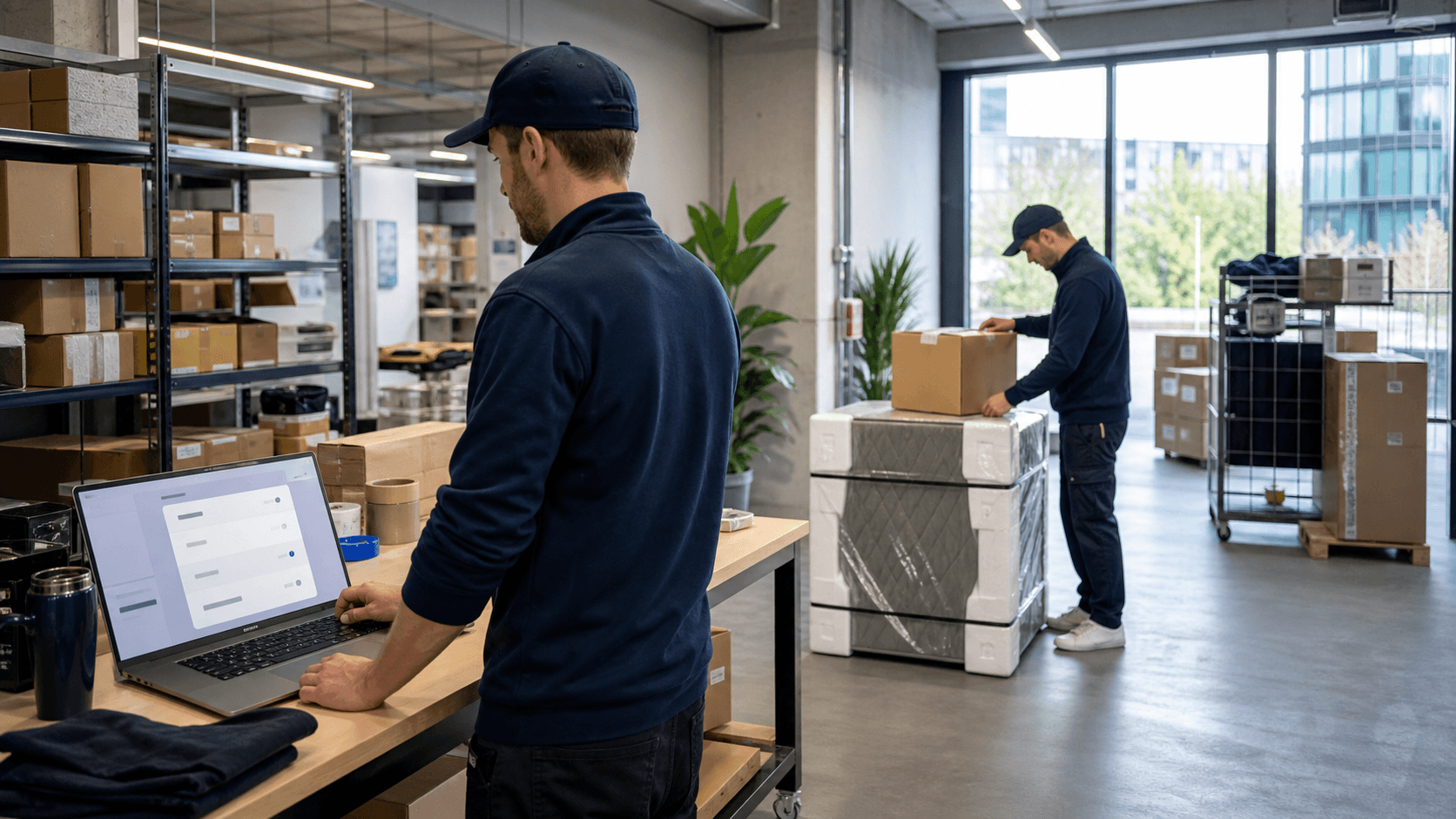


A delivery is pickup-ready when goods, location, time window, contact, vehicle requirement and proof are clear before a driver is assigned. "The order is paid" is not enough. For same-day pickup, the question is whether the driver can load without search time, whether the shipment is transportable and whether the destination can receive the order.
For shops, spare-parts warehouses, branches and B2B teams, that is the operational split: sales confirms that an order exists; logistics decides whether it can be moved today.
The Short Answer
Before a same-day pickup, six checks should be green.
| Check | Pickup-ready means |
|---|---|
| Goods | Picked, complete, packed or deliberately marked as unpacked. |
| Dimensions and weight | Known well enough for a realistic vehicle and handling decision. |
| Pickup point | Address, gate, floor, contact person and loading note are executable. |
| Time window | Goods are ready inside the booked window; waiting is not hidden planning. |
| Recipient | Receiving time, contact, access and required proof are clear. |
| Exceptions | Return, exchange, damage, dangerous goods or two-person handling are named before the trip. |
If one of these points is missing, the order should not start blindly as an immediate run. Clarification, manual review or a later window is usually the better operational choice.
Why Pickup Readiness Is More Than Warehouse Status
Warehouse status answers: "Is the item available?" A pickup decision answers: "Can this exact shipment now be handed to a driver without downstream errors?"
Common gaps:
- The item is reserved but not packed.
- The goods are in another building than the address suggests.
- Dimensions are missing even though the package is bulky.
- The pickup needs a photo, but nobody told the driver.
- The branch closes at 6 p.m., but the order was booked as "today".
- The delivery is an exchange, but the return movement is not on the order.
DHL describes pickup preparation around details such as pickup location, package count, weight, contact details, date and time frame (DHL Express Courier pickup). Lalamove also brings pickup and dropoff locations, timing, vehicle choice, add-on services and notes into its ordering flow (Lalamove Germany order guide). The market pattern is consistent: same-day can be fast, but it cannot be data-free.
The Readiness Boundary in Shop or ERP Workflows
For e-commerce and B2B systems, "pickup-ready" should be its own state. It sits after sale, payment or approval, but before driver assignment.
| System event | Logistics meaning | Transport action |
|---|---|---|
| Order received | Demand exists | do not create a trip yet |
| Payment confirmed | Order can be prepared | check goods, no automatic immediate pickup |
| Picking started | Team is working on it | keep status internal |
| Goods packed | Shipment is physically possible | finalize dimensions, weight and pieces |
| Pickup-ready confirmed | Driver can come | create or activate delivery |
| Driver en route | Execution has started | share status and tracking |
| Pickup confirmed | Goods were handed over | store pickup proof |
For a Shopify, WooCommerce or Shopware integration, this state matters more than the commerce platform name. Without a clear readiness boundary, a retry, wrong order status or early automation job can create a transport order that the warehouse cannot serve yet.
What Drivers Actually Need On Site
A driver does not need a long internal product description. They need executable information.
For pickup, the order should include:
- complete pickup address with company, building section, gate or floor,
- contact person with reachable phone number,
- piece count, approximate size and weight,
- note whether goods are loose, packed, palletized or fragile,
- loading zone, ramp, stairs, lift or waiting-time risk,
- reference number that warehouse and driver both recognize,
- proof requirement: photo, signature, name, barcode, damage note,
- return or exchange note if something must come back.
Uber Direct documents proof-of-delivery methods such as barcode scans at pickup or dropoff to verify that the courier is handling the correct goods (Uber Direct Proof of Delivery). For Maxmove, the practical point is simple: proof does not only start at the recipient's door. For valuable, mix-up-prone or multi-piece shipments, pickup may already need to prove what was handed over.
Decision: Pick Up Now or Prepare First?
Use this matrix before a team clicks "find driver now".
| Situation | Recommendation |
|---|---|
| Goods are packed at the pickup point, recipient is reachable, dimensions fit | Start same-day pickup. |
| Goods are paid for but not picked yet | Choose a later window or activate only after packing approval. |
| Dimensions or weight are missing for bulky goods | Check first; the wrong vehicle class causes waiting or cancellation. |
| Recipient has a narrow receiving window | Check ETA and driving time; do not sell an immediate run if the window is risky. |
| Exchange delivery with return pickup | Put both movements on the order, otherwise the return leg is operationally missing. |
| Packaging is damaged or goods are unpacked | Clarify photo, condition and liability before pickup. |
| Dangerous goods, cold-chain goods or permit-restricted goods may be involved | Do not book automatically; review the special requirement. |
German road traffic rules require cargo to be stowed and secured so it cannot slip, fall over, roll around or fall off even under full braking or evasive movement (Section 22 StVO). That is not only a driver concern inside the vehicle. The team preparing pickup must provide realistic information on pieces, weight, packaging and handling so load securing can be planned at all.
Example: Local Furniture Shop With Same-Day Window
A furniture shop sells online and delivers locally from the branch. A customer buys a shelf, chooses delivery this afternoon and expects a message once the driver is on the way.
A weak process:
- Payment status immediately creates a transport order.
- The shelf is still on the shop floor.
- Dimensions are missing because the product is only tagged as "bulky goods".
- The driver arrives, cannot find a contact person and waits.
- The customer sees "delivery in progress" although nothing was loaded.
A robust process:
- The shop accepts the order and reserves the goods.
- The team confirms piece count, dimensions, weight and condition.
- The goods are placed at the agreed pickup point.
- The order includes loading note, reference and recipient contact.
- Only then does the same-day trip start.
- Pickup status, tracking and digital proof of delivery stay on the same order.
The difference is not extra bureaucracy. The difference is whether speed starts before or after clarification.
What Maxmove Covers in the Workflow
Maxmove fits local and regional transport where order, vehicle, driver status, tracking and proof belong together. A single order can start through booking; e-commerce teams can use Maxmove E-commerce, shop setups or the Partner API. For recurring pickup and delivery patterns, the workflow belongs in a TMS so templates, status and proof do not need to be explained again every time.
The boundary matters: Maxmove does not replace missing product data, packaging decisions or dangerous-goods checks. If the goods are not transportable, the pickup site cannot be reached or the recipient cannot accept the delivery, the order should be corrected first.
Checklist Before Clicking Pickup
Check this before driver assignment:
- Are the goods physically at the pickup point?
- Are they complete and transportable?
- Are dimensions, weight and piece count known?
- Does the vehicle class fit without wishful thinking?
- Is there carrying help, ramp, stairs or restricted access?
- Is an on-site contact reachable?
- Is the recipient window realistic?
- Is a pickup photo, barcode or condition note required?
- Is there a return, exchange or old item?
- Is the same reference number used in shop, warehouse and transport order?
In Short
Same-day pickup works when it is not used as a rescue mechanism for unclear orders. The fastest trip is the one that starts only after goods, data, contact and proof are right.
To begin: book a local delivery with Maxmove, structure recurring flows in the Maxmove TMS, or create e-commerce orders through the Partner API with a controlled readiness step.