German freight moved roughly 4.24 billion tonnes in 2024, 3.34 billion of them by road. A Euro pallet still measures 1,200 × 800 × 144 mm, weighs approximately 25 kg and carries a safe working load of 1,500 kg. Every individual shipment is decided between those two orders of magnitude — and pallet slots alone are not enough: door apertures, wheel arches, body, actual payload and load securing remain binding. This open dataset therefore keeps manufacturer figures, official statistics, Maxmove calculations and Maxmove booking limits strictly apart, and links every source with the date we checked it.
Download the CSV dataset · Version 2.0 · As of 26 July 2026 · CC BY 4.0 · Changelog · Reviewed by Max Valjan, founder of Maxmove
The market: how much of German freight runs on the road
| Metric | Value | Reference year | Source |
|---|---|---|---|
| Road freight volume | 3,340,700 thousand t | 2024 | Destatis |
| Road freight performance | 474,500 million tkm | 2024 | Destatis |
| Road share of volume | 78.9 % | 2024 | Maxmove calculation |
| Road share of performance | 70.7 % | 2024 | Maxmove calculation |
| Lorry stock | 3,896,402 | 1 Jan 2026 | KBA |
Road carries just under four fifths of the tonnage moved and about seven tenths of the transport performance. The gap between those two shares is the actual insight: road journeys are shorter on average than rail or inland waterway journeys, which is why road dominates volume more strongly than performance.
An important methodological limit: the road freight figures are not a census. They come from a sample survey the Federal Motor Transport Authority has run continuously since May 1994, covering both commercial haulage and own-account transport. They are robust estimates with sampling error, not counted individual journeys. The KBA vehicle stock, by contrast, is a reference-date count taken on 1 January.
Pallet and vehicle: key reference values
| Reference | Load area / metric | Euro pallets | Origin |
|---|---|---|---|
| EPAL 1 | 1,200 × 800 × 144 mm; approx. 25 kg | – | EPAL specification |
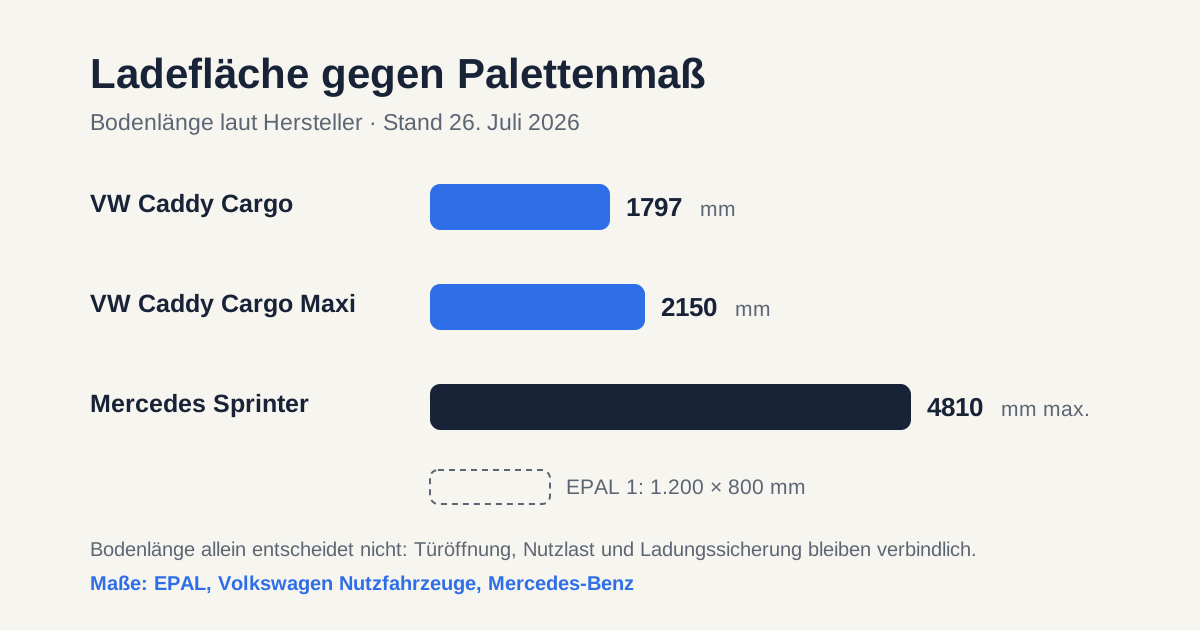
| VW Caddy Cargo | 1,797 mm floor length; at least 1,230 mm load width; 1,234 mm rear aperture | 2 calculated floor slots | Maxmove geometry using VW dimensions |
| VW Caddy Cargo Maxi | 2,150 mm floor length; 3.7 m³ volume | Configuration-dependent | VW specification |
| Mercedes-Benz Sprinter panel van | Up to 4,810 mm floor length; up to 2,593 kg payload | See the note below | Mercedes-Benz |
Direct answer: Two EPAL 1 footprints fit geometrically in a standard Caddy Cargo when the 1,200 mm side runs across the vehicle and two 800 mm sides run along its length. For the Sprinter panel van this dataset deliberately publishes no pallet count — the reasoning is in "What we retracted". Neither figure is approval for every load: payload, doors, body and securing must fit the exact vehicle.
Method
We used only publicly available primary sources:
- EPAL 1 dimensions, approximate tare weight and safe working load come from the European Pallet Association and its product data sheet.
- Load floor length, load width, volume and the rear and sliding door apertures of the Caddy Cargo come from the Volkswagen Commercial Vehicles technical drawing. Maximum payload figures come from the Caddy Cargo flyer.
- Maximum floor length and payload of the Sprinter panel van come from Mercedes-Benz.
- Market figures come from the Federal Statistical Office (freight volume and performance by mode) and the Federal Motor Transport Authority (vehicle stock on 1 January 2026).
- The Maxmove booking classes shown in the payload calculator are platform booking limits, not manufacturer figures.
The Caddy calculation: 1,200 mm of pallet width fits within at least 1,230 mm of load width; two 800 mm pallet lengths need 1,600 mm and therefore stay below the 1,797 mm load floor length. Not accounted for: interior lining, wheel arch intrusion, tie-down hardware and individual bodies.
The door aperture decides too
A matching footprint is worthless if the pallet cannot get in. The VW drawing already cited publishes these dimensions:
| Aperture | Caddy Cargo | Caddy Cargo Maxi |
|---|---|---|
| Rear aperture, width | 1,234 mm | 1,234 mm |
| Rear aperture, height | 1,122 mm (wing doors) | 1,122 mm |
| Sliding door, width | 695 mm | 836 mm |
Concretely: a 1,200 mm pallet passes through a 1,234 mm rear aperture with 34 mm of total clearance — 17 mm per side, before lining, hinges and securing hardware. That is arithmetically possible and practically awkward. Side loading is impossible on the standard Cargo: 695 mm is narrower than the pallet's 800 mm side. The Maxi offers 836 mm, which is exactly why Volkswagen markets its wider sliding door as suitable for Euro pallets.
A slot is not a payload
| Check | Why it is needed | Binding source |
|---|---|---|
| Footprint | Goods must fit the load compartment geometrically | Manufacturer dimension |
| Door aperture | A matching footprint must also be loadable | Manufacturer dimension, see above |
| Payload | Vehicle, people, fuel and cargo count together | Vehicle registration document |
| Centre of gravity | Weight must be distributed safely | Loading and securing plan |
| Load securing | The pallet must not move under braking or evasive action | Responsible loader |
An EPAL 1 can have a safe working load of 1,500 kg. That does not mean a Caddy or Sprinter may carry that mass as vehicle payload. The exact vehicle remains decisive: permissible gross vehicle weight minus actual kerb weight and other chargeable loads.
How old is a number?
Since version 2.0 every row carries two dates: retrieved_at — when we last checked the value against its source — and source_published_at — when the source itself was published. This is not bookkeeping for its own sake. The Caddy Cargo payload figures (744 kg, and 767 kg for the Maxi) come from a flyer stamped "Ausgabe: September 2020". The value is quoted correctly and is nevertheless six years old, and VW itself notes that permissible payload varies by equipment. In version 1 that age was invisible in the data; now it is a column.
Anyone reusing the dataset should re-check manufacturer figures at the source before a procurement or loading decision. For your own vehicle the registration document governs anyway: permissible gross weight (F.1/F.2) minus kerb weight (G).
What we retracted
Version 1 of this dataset listed six Euro pallets for the Sprinter panel van and marked it as a manufacturer figure. We could not reproduce it from any Mercedes-Benz document: the URLs cited at the time are model overview pages that do not state it, and the only Mercedes figure we could find lists five Euro pallets for a configuration with 11.4 m³ and a 3,300 mm interior. The value also contradicted our own published figures in the Sprinter and van guide and in the payload calculator.
The row has therefore been removed without replacement. We deliberately publish no substitute pallet count until we hold a Mercedes technical data sheet stating load width per wheelbase: a missing value can be added later, a second unverified number damages the whole dataset. The corroborated Sprinter values — up to 4,810 mm floor length and up to 2,593 kg payload — remain.
What the dataset contains
| Column | Meaning |
|---|---|
record_type | pallet, vehicle, platform (Maxmove booking class) or market |
value_type | official (unchanged from the source), calculated (Maxmove arithmetic) or platform (booking limit) |
confidence | verified, unverified or superseded — independent of where the value came from |
record_id | Stable per-row identifier so a single value stays citable |
retrieved_at / source_published_at | Check date and source publication date |
value_upper | Upper bound where the source states a range; value stays the conservative figure |
Version 2.0 appends columns only. Anyone reading version 1 by column name or by position 0–7 reads version 2 unchanged. Immutable versions live at -v1.csv and -v2.csv; the stable citation URL remains the file without a version suffix.
Deliberately not included: invented market prices, average pickup times or customer outcomes. A credible German direct-run price index requires a sufficiently large anonymised sample of real quotes with consistent vehicle class, distance definition, region, time window and surcharge logic. Once that foundation exists and is cleared for privacy, it can be published separately with sample size, median and quartiles.
For an actual order, the transport cost calculator returns a complete quote. The payload calculator selects the vehicle class; van dimensions and payloads are explained in the Sprinter and van guide, and pallet dimensions in detail in Euro pallet: dimensions and weight. For a single pallet, book a pallet transport.
Reuse and citation
The dataset is published under CC BY 4.0: you may share, adapt and use it commercially as long as you credit the source. Please cite it as “Maxmove Transport Reference 2026, version 2.0” and retain the value_type, confidence, source_url and retrieved_at columns in analyses so manufacturer figures, official statistics, Maxmove calculations and booking limits remain distinguishable. For media use, further reuse or an updated release, contact Maxmove.