
Short answer: book a second-hand wardrobe pickup only after height, width, depth, weight, floor, lift access and carrying help are clear. Many wardrobes fit a large van; heavy solid-wood wardrobes, narrow staircases or room-of-choice delivery need explicit carrying support in the transport plan.
That prevents the most common marketplace-purchase problem: the furniture is paid for and the seller is waiting, but on site the wardrobe does not fit through the stairwell, the vehicle is too small or nobody is allowed to help carry it.
Measure first, book second
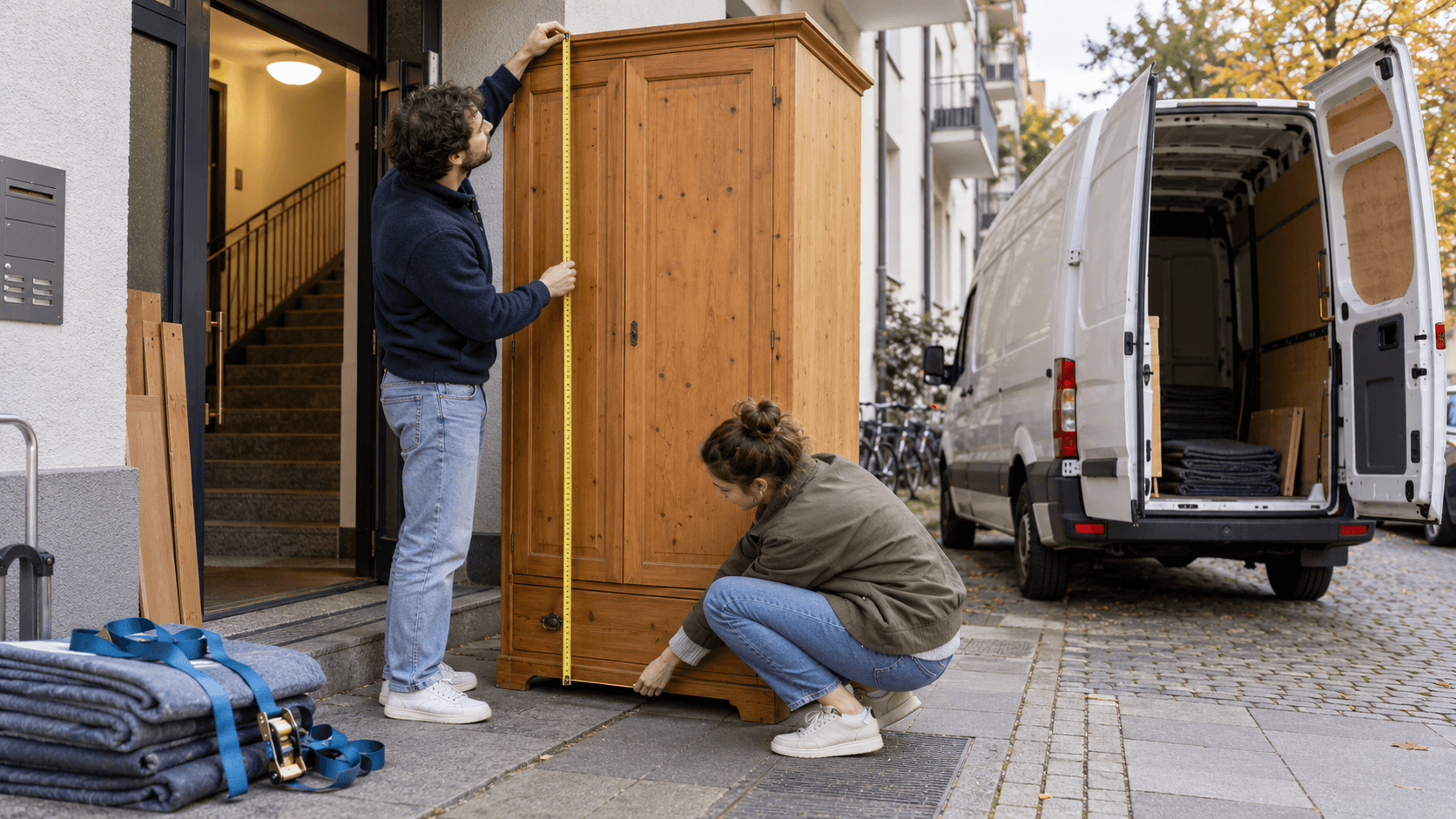
Do not measure only the front of the wardrobe. Three values matter for booking:
- Height: can the wardrobe travel upright, flat or on its side?
- Width and depth: will it fit through the door, hallway, lift and loading opening?
- Weight: can one person carry it safely, or is a second person needed?
Maxmove treats wardrobes in its goods-dimension references as furniture without a standard size: typical measurements are guidance, not a manufacturer norm. Your own measurement matters more than a note saying "normal wardrobe".
Which vehicle class fits?
For Maxmove, the current booking flow is authoritative. The public vehicle guidance says, as orientation, that a 3.3 m van accepts consignments up to 330 × 180 × 170 cm and up to 1,000 kg, and it explicitly lists wardrobes there. A smaller vehicle may work for disassembled or narrow wardrobes; a 3.5 t box lorry can make sense when several furniture pieces, very large parts or tail-lift handling are involved.
| Situation | Likely planning route |
|---|---|
| Disassembled wardrobe, loose boards, ground floor | Check compact van or 2.7 m van |
| Wardrobe stays assembled, around 2 m high, normal home address | Check 3.3 m van |
| Solid wood, several parts, tight access or long carrying route | Larger vehicle, second person and detailed notes |
| Seller can hand over only at the building entrance | Describe curbside or entrance pickup clearly |
| Delivery should go into a room | Book carrying help and destination level before the job starts |
The table does not replace the booking check. It shows which information belongs in the order description before dispatch.
Carrying help is a separate decision
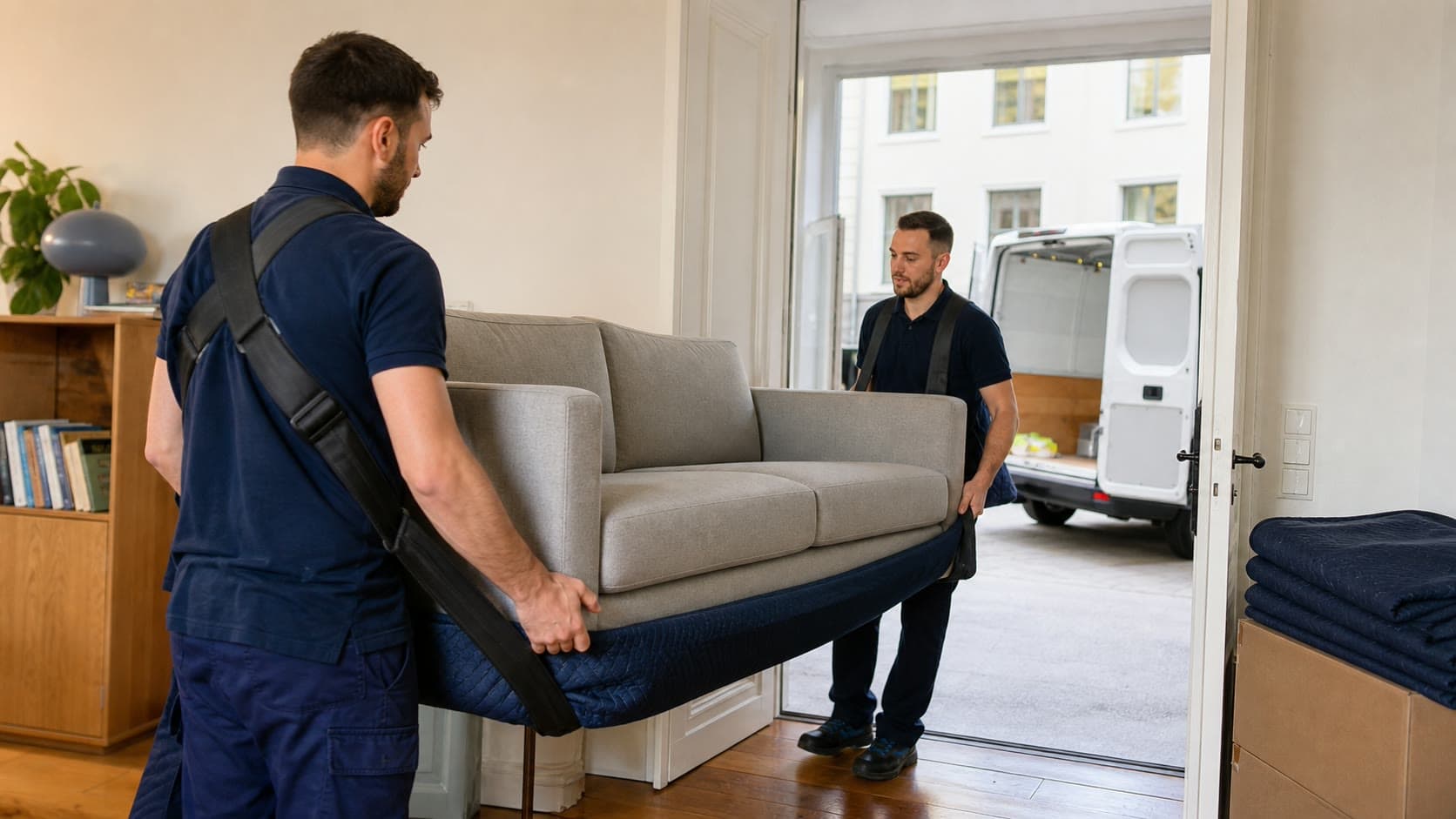
A driver with a van is not automatically a two-person furniture service. If the wardrobe is heavy, has to go over stairs or cannot be disassembled, plan the second person before booking.
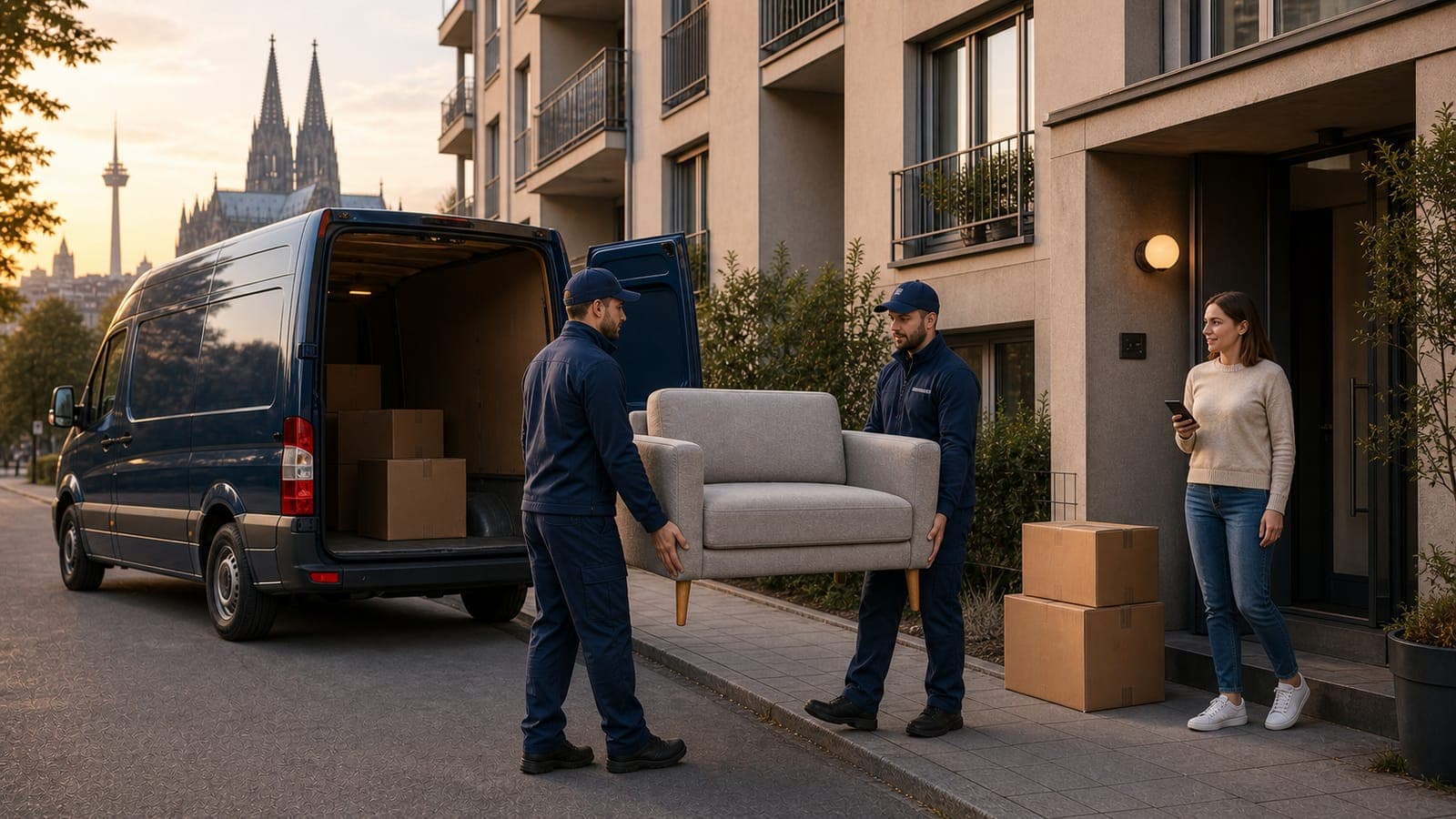
The market separates these services clearly: DHL describes two-person handling for furniture and large appliances to the desired place of use, while Cargoboard names curbside as the standard for bulky-goods shipping. Verbraucherzentrale Brandenburg also points out that curbside delivery or delivery to the place of use must be clarified in advance.
For your private transport, that means: do not write only "pick up wardrobe". Write:
- "Wardrobe 200 × 100 × 60 cm, stays assembled."
- "Pickup 2nd floor, no lift; destination ground floor."
- "Seller will not help carry."
- "Delivery to apartment door" or "to room" only if that is exactly what should be booked.
Prepare protection and load securing
ADAC recommends straps, protective blankets and load securing for furniture moves by car or van, so the load still holds during braking. For a wardrobe, that matters because doors, drawers, mirrors and tall side panels are easy to damage.
Before pickup:
- Empty drawers.
- Remove or secure loose shelves.
- Secure doors without damaging sensitive surfaces.
- Add measurements and photos to the order where possible.
- Note parking, loading zone and doorbell name.
If the wardrobe is disassembled, bundle screws and fittings separately. Maxmove transports the order; assembly, disassembly or installation should not be assumed silently.
Seller and buyer: who must be on site?
Second-hand purchases often involve three parties: seller, buyer and driver. The order runs more smoothly when each person has one clear task.
| Person | Clarify before pickup |
|---|---|
| Seller | Pickup time, doorbell name, floor, whether carrying help is allowed |
| Buyer | Destination address, receiving time, carrying destination, payment or purchase handling separate from transport |
| Driver | Measurements, vehicle class, access, contact person, proof after delivery |
The driver should not have to decide on site whether the wardrobe is being bought, whether it may be disassembled or who is responsible for sales-condition damage. Those points belong between buyer and seller.
When Maxmove fits
Maxmove fits individual private furniture transports that are too large for parcel shipping and too small for a full move: wardrobe, sofa, mattress, washing machine or several boxes. You enter pickup, destination, item, vehicle class, time window and notes, see the price before booking and receive status plus digital completion proof.
Start with book a small transport or check the item page for wardrobe transport. If you are still comparing the general workflow, read the overview on private furniture transport.
Quick check before saying yes
- Is the wardrobe measured, not guessed?
- Is it clear whether it travels assembled or disassembled?
- Do stairwell, lift and doors fit?
- Is the vehicle class large enough?
- Is carrying help booked or clearly not needed?
- Are seller and buyer reachable in the time window?
- Is the handover described as curbside, entrance, apartment door or room?
Once those points are answered, a used wardrobe is no longer a logistics puzzle. It becomes a clear transport order.