
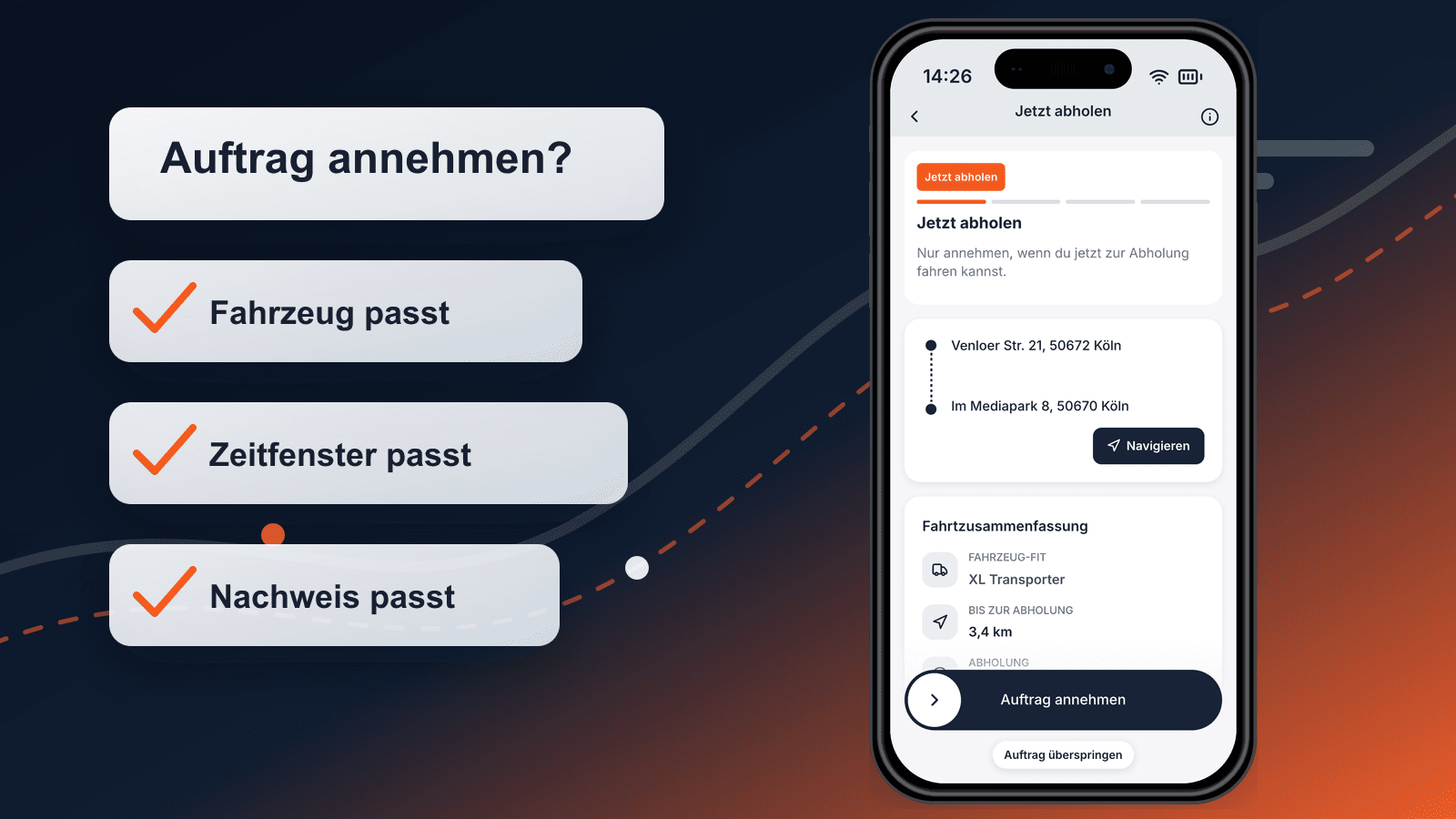
Only accept a transport order when four points are clear before you commit: your vehicle fits the shipment, you can reach pickup and drop-off inside the time window, the required proof is realistic, and the job still works after pickup travel, waiting time and the return leg. If one of those points is open, skip the order or clarify it before accepting.
For drivers with their own van, this matters more than the headline payout. A well-paid job can still be a bad job if pickup must start immediately, the item does not fit through the door, or the drop-off proof asks for something you cannot collect on site.
The 60-second check before accepting
Start with the details that are hard to fix once you have committed:
| Check | Accept when ... | Skip or clarify when ... |
|---|---|---|
| Vehicle fit | Length, width, height, weight and load securing fit your vehicle. | The order only says "bulky goods" or "pallet", but dimensions, weight or access are missing. |
| Time window | Pickup travel, loading, driving, unloading and buffer fit your schedule. | The job says "pick up now", but you cannot leave immediately. |
| Loading access | Pickup and destination are reachable with your vehicle. | Floor, ramp, yard access, loading zone or carrying distance are unclear. |
| Proof | Photo, signature, name, barcode or leave-at-place proof can realistically be captured. | The recipient is not reachable or the order requires proof you cannot get on site. |
| Money and empty miles | Payout, distance and time work with your own costs. | The job only makes sense if an unconfirmed follow-up order happens. |
This order prevents the most common mistakes: accepting first and then noticing the vehicle does not fit; driving first and then finding no contact at the destination; delivering first and then missing clean proof.
Vehicle fit: cargo volume is not payload
A van with plenty of space can still fail on weight. Check not only whether the shipment physically fits, but also:
- permitted gross weight and real payload of your vehicle
- weight of driver, helper, tools, trolley, straps and any goods already loaded
- centre of gravity and load-securing options
- loading height, door width, ramp, lift and carrying distance
If an order names an "XL van" or "pallet", treat that as a signal, not a replacement for dimensions and weight. For payload, your registration document is the deciding reference; our payload calculator helps with the first calculation.
Time window: calculate the whole trip, not just the route
Many acceptance mistakes happen because drivers look only at the kilometres between pickup and drop-off. Your decision needs the whole job:
- travel to pickup
- waiting and loading time
- drive to destination
- unloading, proof and possible questions
- return leg or travel to your next confirmed order
For "pick up now", the start time is part of the order. Accept that kind of job only when you can actually leave immediately. A late start can create problems for the sender, the recipient and your own next job.
Proof: know what the destination requires
Digital proof of delivery is not just admin work. It decides whether a job can later be billed, disputed or defended cleanly. Common delivery workflows use photos, barcodes, signatures, names, PINs or ID checks depending on the goods; Uber Direct describes verification for pickup, drop-off and returns, while Onfleet lists photo, barcode, signature and ID checks as proof-of-delivery options.
For your order, that means:
- Take photos only where they show the goods and handover condition.
- Collect a signature or name only from the authorised person.
- Check the barcode or package number before leaving, not only at the destination.
- For leave-at-place delivery, document the location so it can be recognised later.
- If packaging is damaged, capture status and photos first, then escalate.
Maxmove maps these steps in the driver app as a status and proof flow. The article Driver app for couriers: status and proof explains the workflow.
When you should decline
Declining is professional when the job does not fit your setup. Watch especially for these signals:
- The requested vehicle does not match your real dimensions or payload.
- Pickup requires immediate availability, but you are still on another trip.
- The job needs two people and you are driving alone.
- The goods are fragile, high-value or regulated without clear proof and liability rules.
- Destination contact, floor or unloading access is missing.
- The payout only covers the full route if an unconfirmed follow-up job works out.
A skipped order is better than an accepted trip you have to cancel. Good acceptance quality protects your rating, your margin and the planning of your next jobs.
Legal setup and documents: do not accept without the right operation
This section is not legal advice. As orientation for Germany, the Federal Portal explains that commercial goods transport with motor vehicles above 3.5 tonnes permitted gross weight including trailer generally requires a permit or Community licence; own-account transport is treated differently under certain conditions. Check your specific business, vehicle combination, insurance and order type with the relevant authorities.
Operationally for Maxmove, the rule is simpler: add vehicle and document data so you only take jobs you can complete cleanly. Start with the find transport orders page and the driver requirements.
Short calculation before accepting
Example only, not an earnings promise:
| Item | Value |
|---|---|
| Payout shown in the offer | €72 |
| Travel to pickup | 8 km |
| Pickup to destination | 24 km |
| Return leg or travel to next order | 12 km |
| Total distance | 44 km |
| assumed vehicle cost | €0.45/km |
| distance cost | €19.80 |
| remainder before further costs and taxes | €52.20 |
If loading, driving and unloading tie you up for two hours, you are not calculating "a €72 job"; you are calculating €52.20 before further operating costs and taxes for two hours of work. Your real costs may differ significantly; use your own numbers.
Bottom line
A good transport order is not the one with the largest number in the offer. It is the one you can complete reliably with the right vehicle, a clean time window and complete proof. Check vehicle fit, time, access, proof and total distance before accepting. If everything fits, accept the job. If a core detail is missing, skipping it is often the better operational decision.
Register as a driver or first check which transport orders fit your vehicle.