
Quick answer: The right vehicle class is not defined by the largest item alone. It comes from five checks: does the freight fit through the opening, does the loaded vehicle stay within payload, is ramp/tail-lift/carrying help needed, how tight is the time window, and what proof is required after handover?
For B2B direct deliveries, "a Sprinter will do" is often too rough. A long panel van solves a volume problem, not a weight problem. A 3.5-tonne box body gives more load space but loses payload when it carries a tail lift. A smaller van can be cheaper and easier to park in the city, but it fails when pallets, bulky cartons or unloading equipment enter the job.
This guide helps dispatch, procurement, branch logistics and shop operations narrow down the vehicle class before booking.
The Decision Logic in 60 Seconds
| Question | If the answer is yes | Consequence |
|---|---|---|
| Is one item longer than roughly 2.4 m? | shelving, pipe, event wall, long carton | check at least long van or Sprinter class |
| Is the freight palletised? | euro pallet, half pallet, pallet cage | clarify pallet slots, entry height and forklift/ramp |
| Is total weight above 700-900 kg? | machinery, tiles, paper, beverages | payload matters more than load volume; verify weight or choose a larger class |
| Is there no ramp? | shop, practice, construction site, residential address | plan tail lift, pallet truck or carrying help |
| Must the goods go to the point of use? | office, storage room, floor, exhibition stand | clarify walking route, lift, floor, doors and crew size |
| Is receiving time-critical? | technician waiting, line stopped, branch needs stock | direct delivery with clear pickup and delivery times, not a consolidated run |
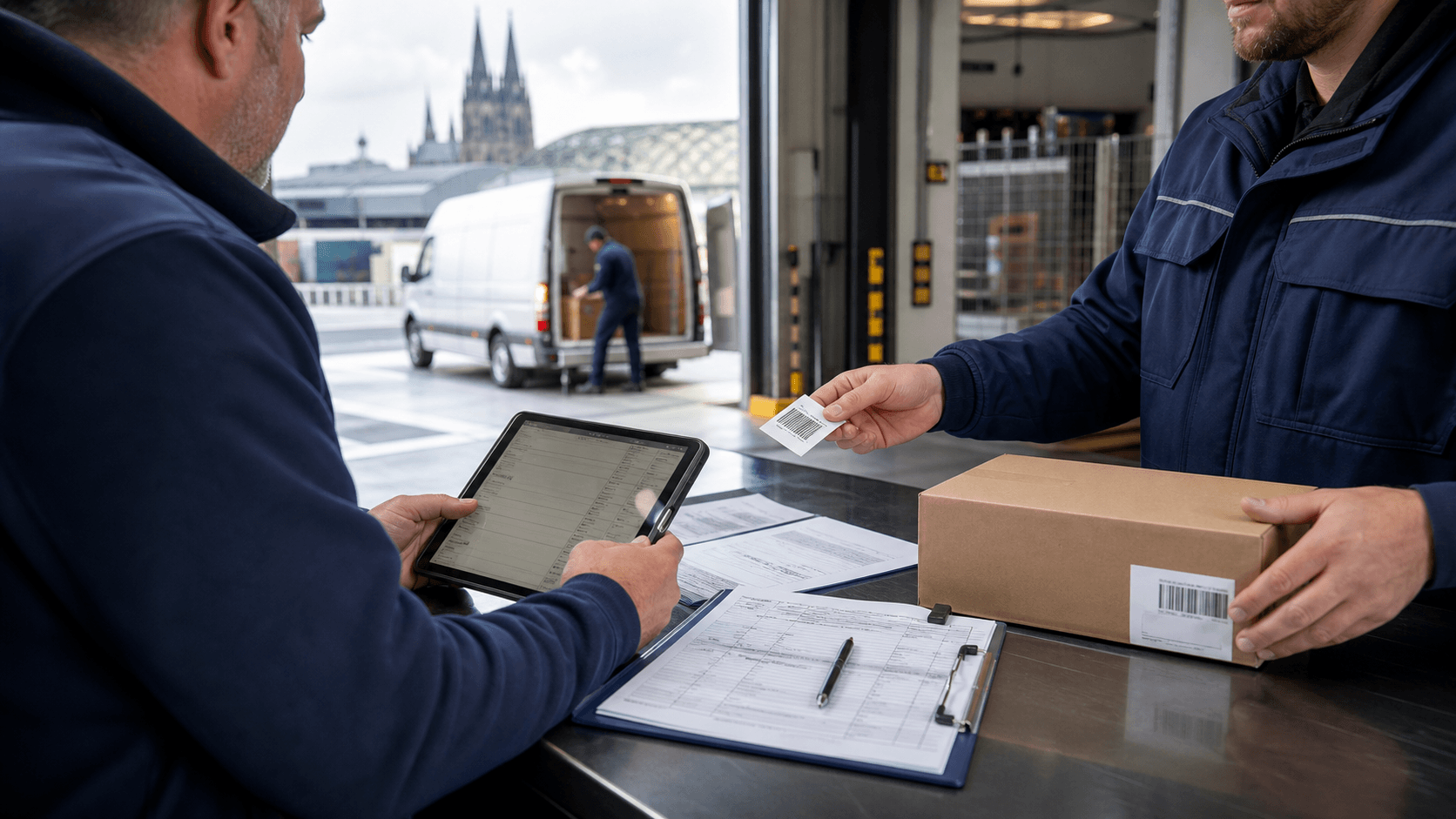
| Does the customer need auditable proof? | claim, RMA, billing, B2B SLA | define photo, signature, name, timestamp or internal reference text |
The table does not replace a technical check. It prevents the most common booking errors: too small a vehicle, too little payload, missing loading help, wrong access assumptions and unclear handover.
Vehicle Classes by Typical B2B Case
| Case | Typical class | Why |
|---|---|---|
| Documents, samples, small spare parts | car or compact van | lower cost, short walking distances, little loading time |
| Cartons, IT equipment, one small furniture item | mid-size van | more load space than a car, still city-friendly |
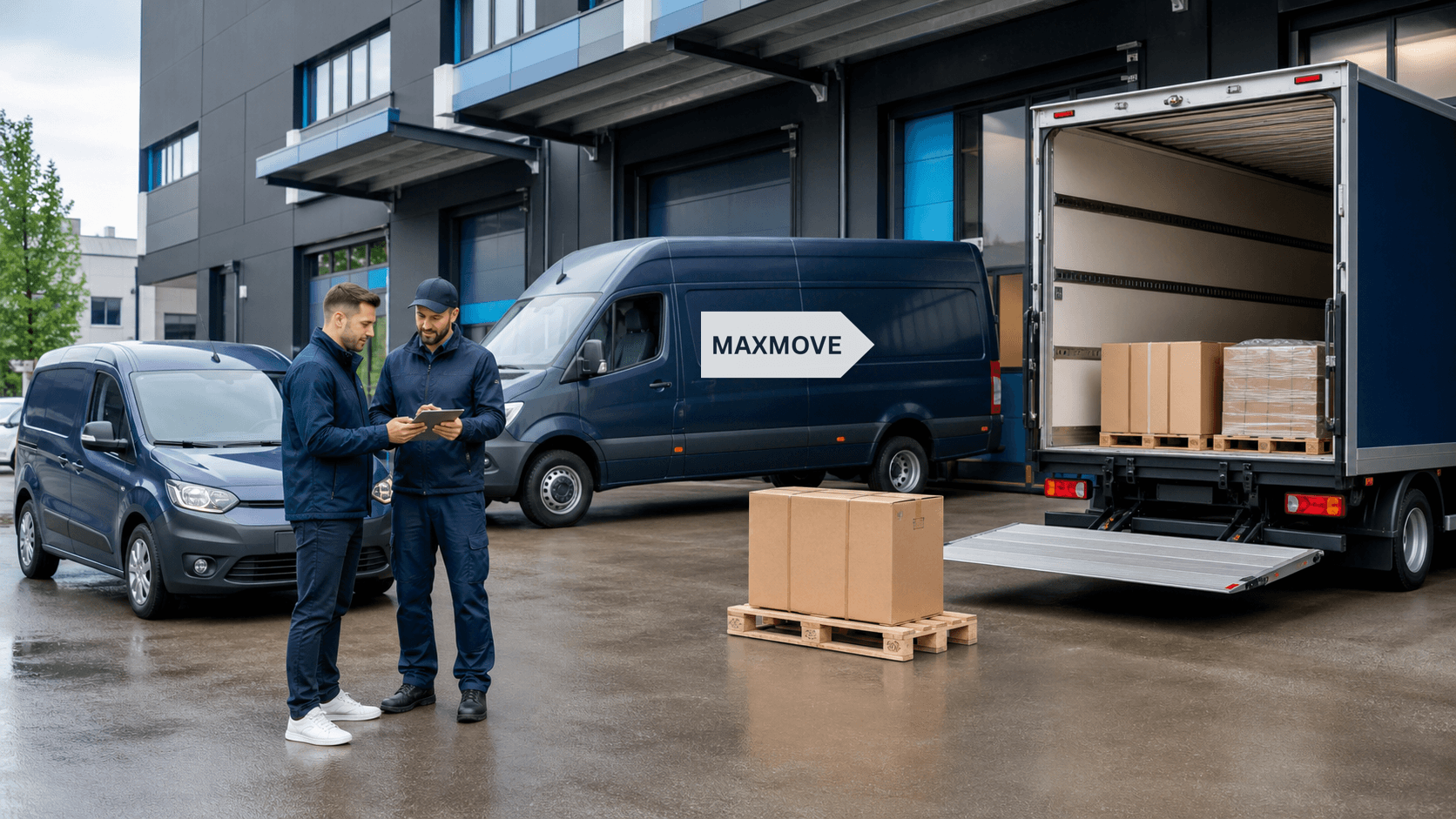
| 1-3 pallets, long cartons, store stock | Sprinter/Crafter class | useful balance of load length, height and availability |
| 4-8 pallet slots, bulky freight, roll containers | 3.5-tonne box body | straight cargo area, better stackability, often available with tail lift |
| heavy machinery, many pallets, high single-item weights | 7.5 t or larger | payload, tail lift capacity, ramp height and axle loads become relevant |
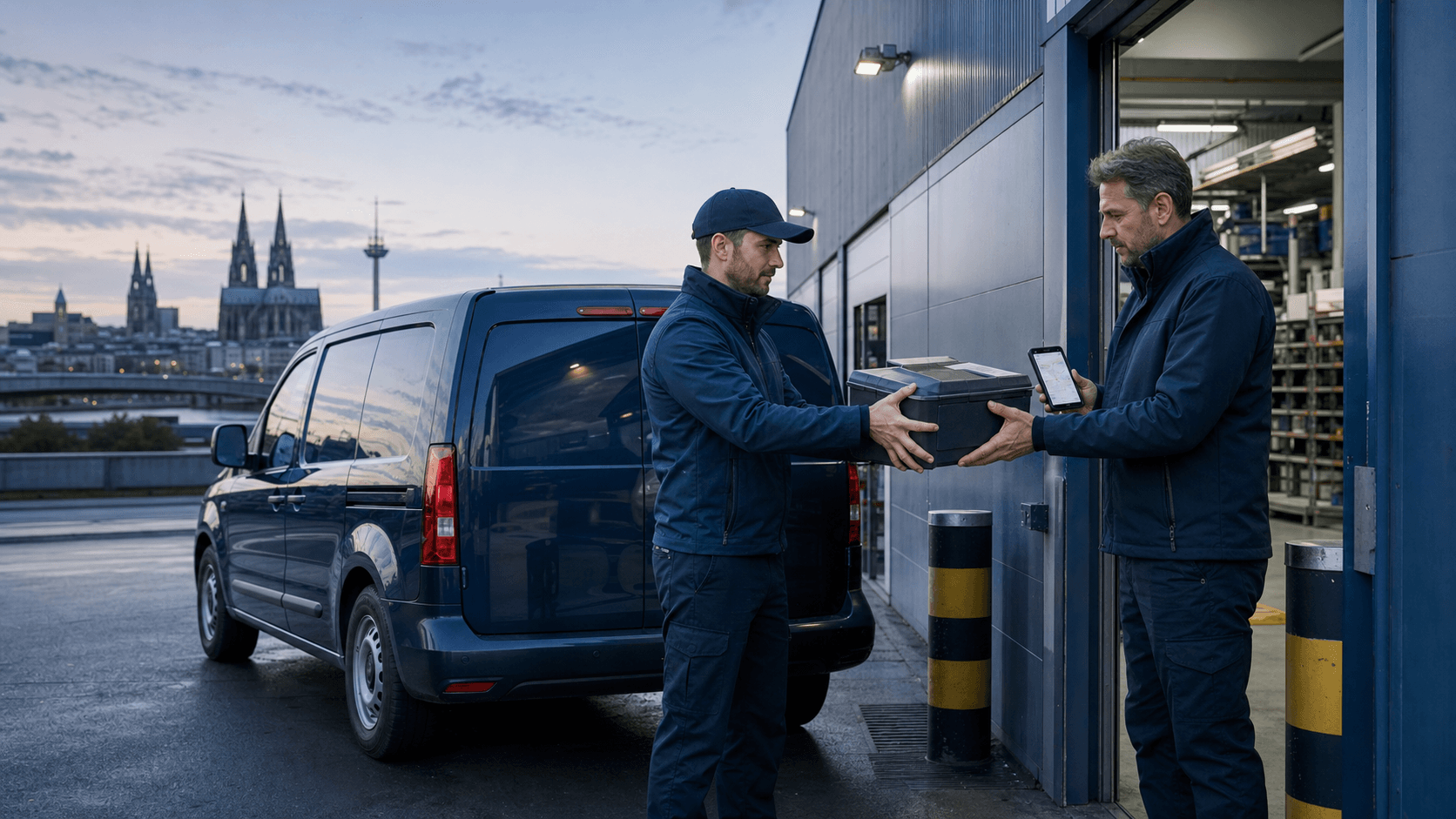
| sensitive single shipment with a deadline | exclusive vehicle as direct delivery | less handling, clear chain of custody, controllable status |
The classes are intentionally written as operating logic. Model names are only orientation: a Mercedes Sprinter, VW Crafter, Ford Transit or Fiat Ducato can vary widely by length, roof, bodywork and permissible gross weight.
Dimensions: Not Just Load Space, but Opening and Access
Four measurements matter for booking:
- Item dimensions: length, width and height of the largest piece.
- Load-space dimensions: usable length, width and height, not brochure volume.
- Opening dimensions: rear door, side door, box-body portal or tail lift.
- Destination access: gate, ramp, lift, hallway, stairs, kerb.
An item can fit inside the cargo area and still fail at the rear door. A pallet can fit on the floor and still be impossible to unload when the destination is kerbside with no pallet truck. For bulky goods, the narrowest point in the chain often matters more than the largest vehicle.
For reference dimensions and payload ranges, see the Sprinter and van dimensions guide. For pallet dimensions and slot logic, use the euro pallet guide.
Weight: Check the 3.5-Tonne Trap Before Booking
In Germany, category B driving licences are relevant for motor vehicles up to 3,500 kg permissible gross mass. The Federal Ministry of Transport lists this limit in its overview of licence classes. For dispatch, the operational point is simple: a 3.5-tonner does not have 3.5 tonnes of payload.
The basic calculation is:
Payload = permissible gross mass - kerb weight - driver - bodywork - equipment
A box body, tail lift, shelving, blankets, sack truck, pallet truck and full tanks all reduce remaining payload. That is why two jobs can look similar and still require different vehicle classes:
- 6 empty shelves: volume decides.
- 6 pallets of paper: weight decides.
- 2 machines on pallets: weight, centre of gravity and unloading decide.
- 1 sofa in the city: length, carrying route and time window decide.
For heavy freight, the real weight should come from a delivery note, scale, bill of materials or manufacturer data. Guessing is risky because overloading affects more than fines: controls, braking distance, tyres, suspension and load securing all depend on the real loaded weight.
Access and Loading Help: the Cheapest Error Is the One You Ask About First
Many failed bookings are created at the ramp or door, not on the road:
- Pickup at a warehouse with forklift, delivery to a courtyard with no ramp.
- The shop says "one pallet" but means a non-standard pallet that cannot be moved with a regular pallet truck.
- The recipient accepts goods until 15:00, not until close of business.
- A construction site needs registration, high-vis clothing or a named contact.
- Goods are on the second floor although kerbside delivery was booked.
- A tail lift is required but there is not enough space to lower it safely.
For B2B orders, "from A to B" is not enough. A reliable order names contacts, opening times, loading aids, floor, lift, carrying route, restricted times, reference number and required proof.
Direct Delivery, Route or Consolidated Load?
Vehicle class is only half the decision. The operating model is the other half.
| Flow | Fits when | Not ideal when |
|---|---|---|
| Direct delivery | time window is tight, freight is sensitive, chain of custody matters | the only goal is lowest possible cost and timing is flexible |
| Planned route | several owned stops, recurring route, predictable volumes | a single shipment must leave immediately |
| Consolidated load | time is flexible, goods are stackable, deadline is soft | proof, access or runtime is critical |
Maxmove keeps this distinction in the order: with a direct delivery, route, vehicle class, status and proof of delivery sit in one workflow. Teams planning many orders can use vehicle data and capacity in Maxmove TMS for dispatch. If you want to estimate first, use the transport cost calculator.
Proof Requirements Belong in the Vehicle Decision
Proof changes the operating flow. If "delivered" is enough, a simple status may work. If claims, warranty, RMA, cost centres or SLAs are involved, proof should be defined before the driver starts:
- photo of the goods at pickup.
- photo of the drop-off location or point of use.
- recipient name and signature.
- timestamp and status history.
- internal reference, purchase order, ticket number or RMA.
- note on visible damage to packaging or goods.
Digital proof of delivery only helps when the driver knows what to document. For sensitive or dispute-prone shipments, that is part of order quality, not a detail at the end.
Keep Safety Limits Transparent
External sources set boundaries that no booking system can optimise away:
- Germany's Federal Ministry of Transport describes the 3,500 kg limit for category B and the higher classes above it.
- Germany's Federal Office for Logistics and Mobility points to VDI 2700 technical rules for proper load securing.
- BG ETEM summarises for cars and vans that cargo must be stowed and secured so it cannot slide, tip, roll around or fall even under emergency braking.
- Market pages such as Lalamove show why booking flows expose vehicle classes, weight limits, dimensions, extra services and tracking: the choice affects both price and feasibility.
That is the honest boundary: Maxmove can structure vehicle selection, price, status and proof. It does not replace the need to provide dimensions, weight, access details and special risks truthfully.
Pre-Booking Checklist
- Measure the largest item: length, width, height.
- Verify or calculate total weight.
- State item count, pallet type, stackability and sensitivity.
- Describe pickup and delivery with contact, time window and access.
- Clarify loading help: ramp, forklift, tail lift, pallet truck, carrying help.
- Choose the vehicle class by the tightest limit, not by gut feel.
- Define proof: photo, signature, reference, damage note.
- When uncertain, choose a larger class, more loading help or manual clarification.
Takeaway
The right vehicle class is an operating decision across dimensions, weight, access, time and proof. Teams that capture those five points before booking avoid second attempts, waiting time, overloading, claims and phone chains.
For individual time-critical orders, start with a direct delivery. For recurring B2B orders and fleet control, vehicle logic belongs directly in the TMS, so dispatch, driver and customer work from the same order data.