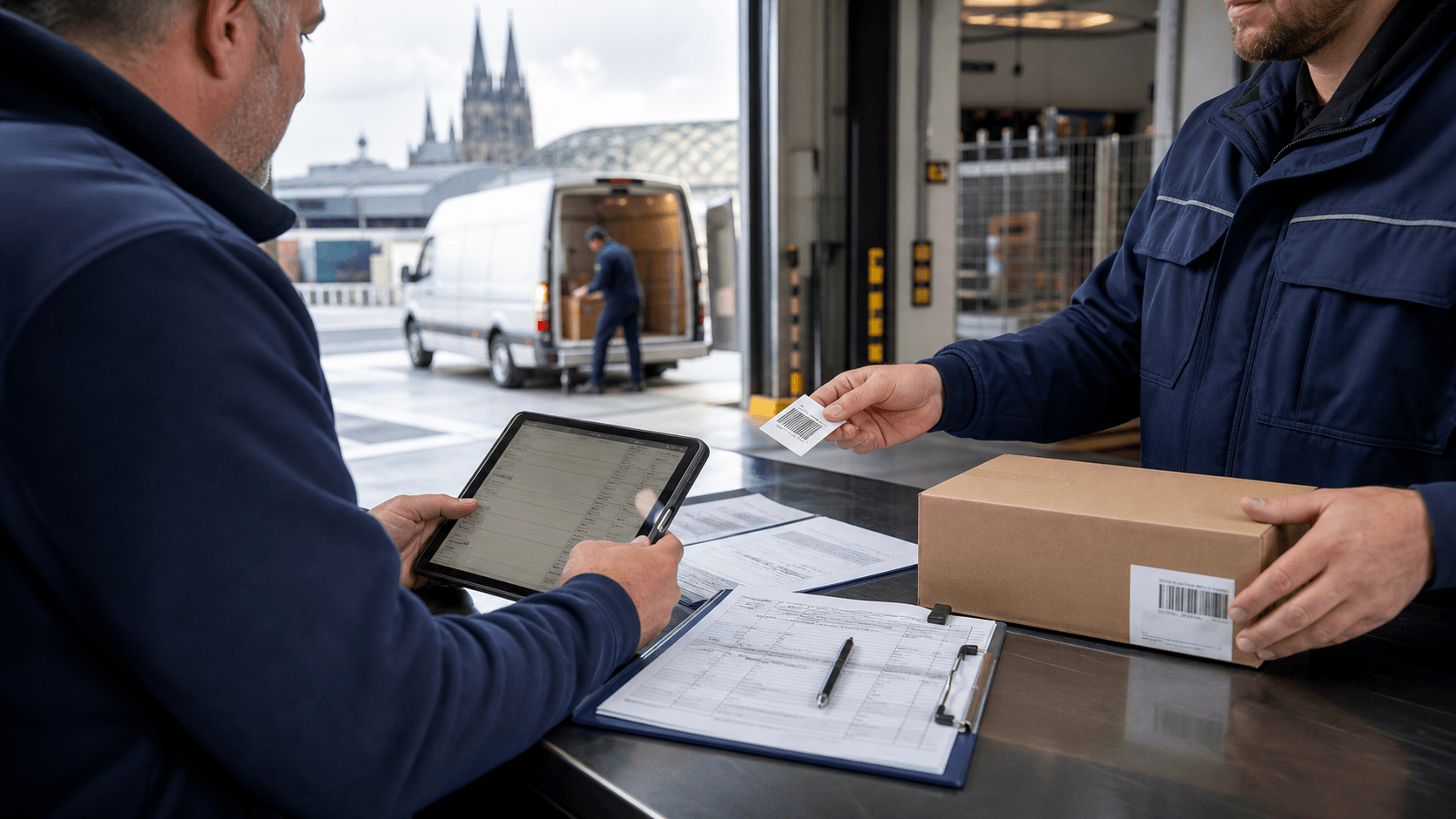


Short answer: Pallet exchange should not live only on a delivery note. Document per stop how many pallets were collected, exchanged, not exchanged or rejected, what condition they were in and which order triggered the movement. In a digital transport workflow, this belongs on the order: status, photos, signature, driver note and reference stay together.
The operational mistake rarely happens at counting alone. It happens later, when warehouse, driver, customer and accounting look at different records. A pallet slip is with the driver, the delivery note is in the ERP, the photo is in a chat and the pallet debt is added to Excel afterwards. As soon as one pallet is missing or damaged, the search starts.
What pallet exchange actually means
Pallet exchange means: the recipient returns equivalent empty pallets for delivered exchangeable pallets, or the difference is recorded as debt, credit, charge or later return.
For the transport order, four questions matter:
| Question | Why it matters |
|---|---|
| How many pallets were collected? | The driver starts with a documented quantity. |
| How many were exchanged at destination? | Warehouse and customer see the actual return. |
| Why was there no full exchange? | Missing empties, rejected quality or a special agreement need a reason. |
| Which pallets were not exchangeable? | Damage has to be documented at the stop, not days later. |
EPAL describes the Euro pallet as a standardised load carrier with clear dimensions and quality requirements (EPAL). For teams, that does not mean every local order automatically needs a formal exchange process. It means: when pallet value and return flow matter, condition must be documented visibly.
When a delivery note is not enough
A delivery note usually describes the goods. Pallet exchange also describes the load-carrier flow.
That is a different process:
- Goods: item, quantity, packages, order number.
- Load carriers: pallet type, quantity, condition, exchange quantity, difference.
- Proof: photo, name, signature, timestamp, driver note.
If everything is signed on one paper record, that can work for a few trips. It breaks down once multiple drivers, warehouses, partial deliveries or later billing steps are involved.
A dedicated pallet slip or a digital pallet section on the order therefore does not answer "what was delivered?". It answers "what happened to the pallets?".
Minimum data for clean pallet exchange
A practical record must be short enough for the loading bay and exact enough for later clarification.
| Field | Recommendation |
|---|---|
| Order or delivery note | One clear reference that warehouse and accounting also know. |
| Stop | Capture pickup, delivery, intermediate warehouse or return separately. |
| Pallet type | Euro pallet, disposable pallet, industrial pallet or customer-owned carrier. |
| Quantity loaded | Quantity at collection. |
| Quantity handed over | Quantity left with the recipient. |
| Quantity received | Empty or exchanged pallets taken back by the driver. |
| Difference | Open pallet debt or non-exchanged quantity. |
| Condition | Exchangeable, damaged, wet, dirty, incorrectly loaded or rejected. |
| Evidence | Photo, signature, name and timestamp. |
| Reason for exception | No empty pallets, quality rejected, acceptance refused, different agreement. |
These fields do not prevent every dispute. They prevent the dispute from starting without a shared data basis.
Exchangeable or not exchangeable?
The hardest decision at the stop is often not the count, but the quality.
Typical exceptions:
- Top board is broken or heavily splintered.
- Block is missing or loose.
- Pallet is dirty, wet or contaminated.
- Different pallet format is provided instead of the agreed one.
- Pallet is loaded in a way that makes condition impossible to check.
- Recipient has no empty pallets ready.
Cargoboard separates exchangeable pallets from cases where exchange is excluded or handled separately in its help content (Cargoboard Help Center). TIMOCOM also describes pallet exchange as a process in which identical or equivalent load carriers are returned (TIMOCOM glossary).
For Maxmove, the relevant process rule is simple: the driver should be able to document the exception directly on the order. A photo of the affected load carrier is often more useful than a long free-text note.
Document pickup and delivery separately
Many pallet clarifications become harder than necessary because only delivery is considered.
A clean workflow separates the stations:
- At pickup: driver checks quantity, visible condition, package relation and reference.
- Before departure: sender confirms handover or records an exception.
- At delivery: recipient confirms goods and pallet flow.
- On return: empty pallets are counted, photographed or marked as an open difference.
- After completion: dispatch and accounting see the same status.
The last point matters most. Pallet exchange is not done when the vehicle leaves. It is done when it is clear whether pallet debt remains open.
How Maxmove frames the workflow
Maxmove should not treat pallet exchange as an isolated slip. The process belongs on the transport order.
A suitable workflow looks like this:
- Create the order with goods reference, pickup address and destination address.
- Capture pallet type and expected quantity as order information.
- Driver documents pickup and delivery in the app.
- Photos and signature are saved on the relevant stop.
- Exceptions become visible as driver notes or order exceptions.
- Support, dispatch and customer work from the same status.
For single trips, the process starts with booking. For recurring B2B routes or warehouse flows, it belongs in Maxmove TMS, so references, driver status and proof are not maintained in several files. When pallet movements come from a shop, ERP or warehouse process, the Partner API is the right entry point for automated orders and status callbacks.
Decision matrix: paper, template or digital order?
| Situation | Suitable proof |
|---|---|
| A rare direct trip with a few pallets | Delivery note plus a short pallet note may be enough. |
| Recurring deliveries to the same recipient | Digital pallet proof on the order, so differences do not disappear into email. |
| Multiple drivers or changing warehouses | Mandatory fields for quantity, condition and exception reason. |
| Exchange is billed | Exportable proof with reference, photo and signature. |
| Damaged or rejected pallets | Photo and exception record directly at the stop. |
| International or regulated transports | Clarify first which freight, customs or CMR documents also apply. |
A pallet slip template is a useful starting point when a team does not yet have consistent fields. Once pallet movements are recurring, billing-relevant or dispute-prone, the proof should be digital and attached to the order.
Practical example: regional B2B delivery
A wholesaler delivers six pallets of goods to a branch in NRW. The expected exchange is six empty Euro pallets.
Clean workflow:
- The order contains delivery note number, six pallets, destination address and contact.
- The driver photographs the loaded pallets at pickup if condition or quantity may be disputed.
- At delivery, the branch confirms the goods.
- The branch returns only four exchangeable empty pallets.
- The driver selects "difference: 2 pallets", records the reason and gets the stop confirmed.
- Dispatch and accounting later see not just "delivered", but the open pallet difference.
Without this workflow, the same question becomes more expensive three days later: Did the driver miscount? Did the branch have no pallets? Were two empty pallets damaged? Was there a special agreement?
What should not live in driver chat
Messenger photos are better than no proof. They are not a durable process.
Problematic patterns:
- Photos without order number.
- Chat messages without recipient confirmation.
- Screenshots that cannot be exported.
- Later manual Excel corrections without original evidence.
- inconsistent wording such as "pallet", "Euro", "empty", "not good".
Digital proof does not have to be complicated. It only has to be created close to the event and clearly belong to the order.
In short
Pallet exchange is a small process with a lot of follow-up work when it is not documented cleanly. Counting alone is not enough. Teams need quantity, condition, difference, reason and proof per stop.
Maxmove fits when transport order, driver status, photos, signature and exceptions should be brought together. That does not make pallet exchange automatically conflict-free, but it makes it clear enough to resolve.