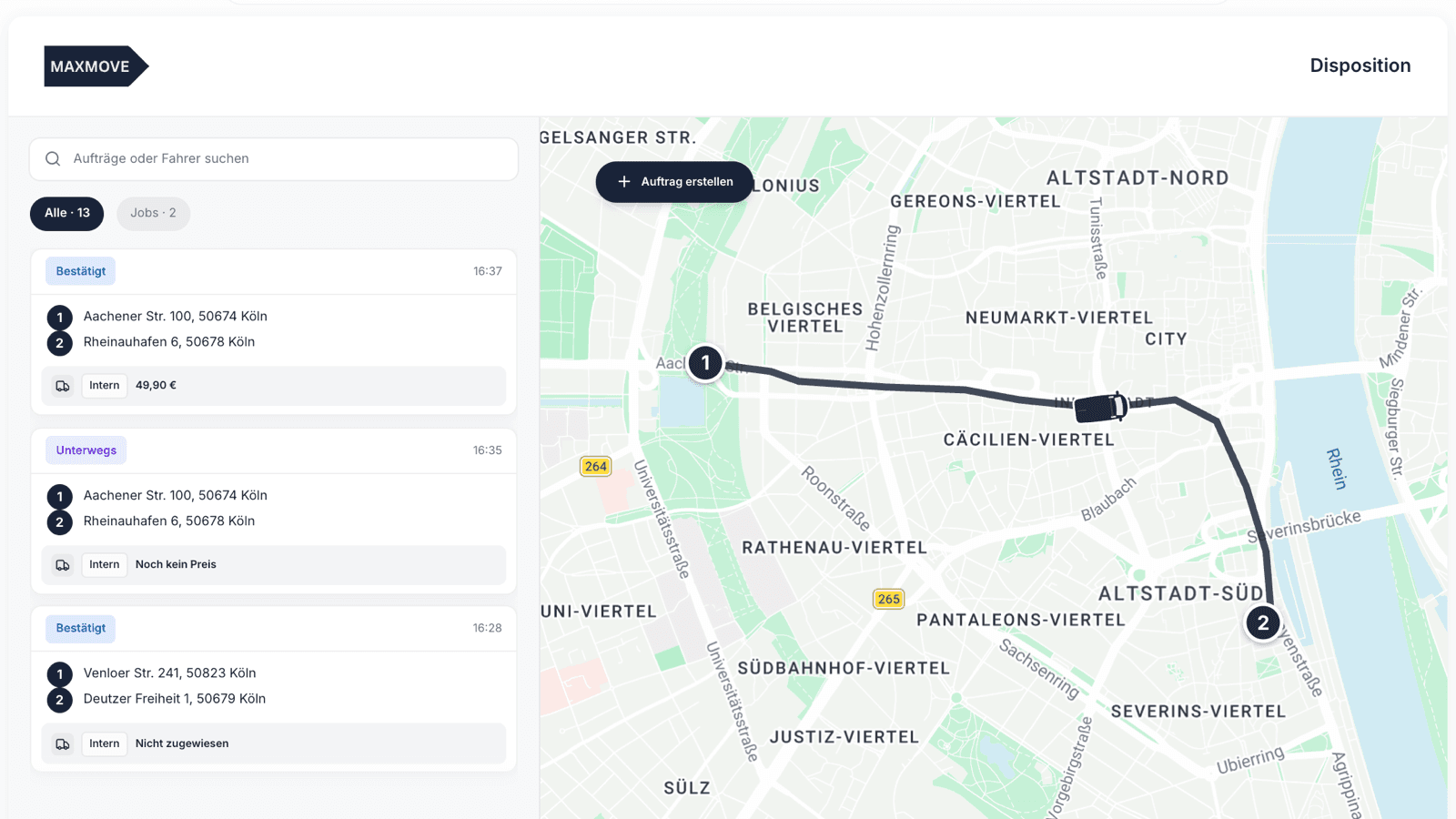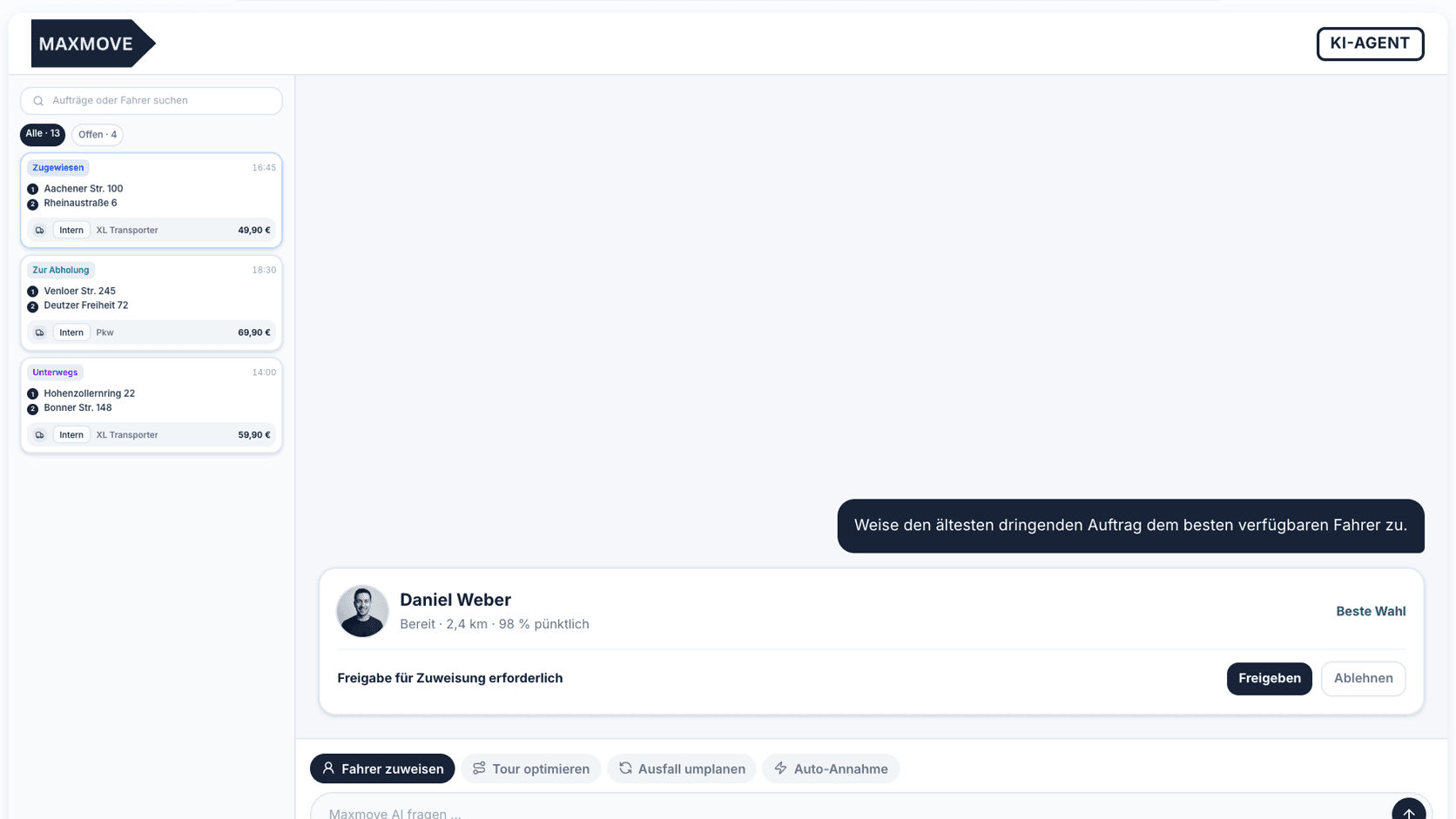


A transport order is dispatch-ready only when the driver, warehouse, recipient, support team and finance team understand the same job. Complete does not only mean pickup address, delivery address and price. Goods, dimensions, weight, time windows, contacts, references, vehicle requirements, proof rules and an exception path must be clear before a driver is assigned.
The short answer: if dispatch still has to call someone after order placement to clarify packages, loading help, access, reference number or proof of delivery, the order was not ready for dispatch yet.
The Dispatch Readiness Matrix
| Area | Must be clear before driver assignment | Why it matters operationally |
|---|---|---|
| Parties | Client, sender, recipient, contact people | The driver needs a reachable person on site; finance needs the contractual reference. |
| Places | Pickup, dropoff, access, floor, ramp, parking note | Wrong access details can cost more time than many driving minutes. |
| Goods | Description, quantity, dimensions, weight, packaging, condition | Vehicle class, loading help and liability questions depend on this. |
| Time | Pickup window, delivery window, deadline, blocked times | Same-day deliveries often fail because time windows were not reachable. |
| Service | Direct drive, route, intermediate stop, return, exchange | The driver needs to know whether the job is really finished after delivery. |
| Proof | Photo, signature, name, PIN, scan, pickup proof | Completion evidence must match the risk of the shipment. |
| References | Order number, PO, delivery note, package ID | Without a stable reference, support and accounting become manual later. |
| Exception | Damage, failed delivery, partial quantity, wrong address | A defined path prevents improvised photos in chat threads. |
This matrix is not bureaucracy. It is the minimum quality needed to turn a requested transport into an executable order.
1. Contract Data: Who Commissions Whom?
In German freight law, section 407 of the Commercial Code defines the freight contract: the carrier transports the goods to the destination and delivers them there; the sender pays the agreed freight. Under section 453 HGB, a forwarder organizes the shipment.
For the operating order, that means:
- Who is the client and invoice recipient?
- Who is the sender at the loading point?
- Who is authorized to receive the goods?
- Who may approve changes?
- Is there a framework contract, terms clause or individual price?
For ad-hoc runs, a clean single order is often enough. For recurring routes, store transfers or subcontractors, the order should also reference the framework agreement, cost center or customer number.
If you still start with PDF or email, the free transport order template helps standardize the fields. Once status, driver assignment and proof are needed during the job, the same logic belongs in dispatch software or a TMS.
2. Place Data: An Address Is Not the Same as Deliverability
An address alone rarely describes the real stop.
Dispatch also needs:
- contact person with phone number
- time window and receiving hours
- ramp, gate, yard, floor or goods-in area
- parking and stopping instructions
- loading aids: pallet truck, tail lift, second person
- access restriction: gatehouse, bell, code, registration
- notes for city centers, pedestrian zones or trade fair sites
Many errors look small in the system: a missing floor, a ramp closed at lunch, a recipient without a phone number. For drivers, these gaps are expensive because they become visible only at the stop.
Maxmove orders keep stop data, driver workflow, status and tracking on the order. That matters because the driver should not have to work from separate emails, PDF attachments and chat notes.
3. Goods Data: Vehicle Class and Risk Depend on It
Goods data decides whether the delivery is realistic with a car, compact van, panel van, Sprinter, tail lift or two-person handling.
At minimum, the order needs:
- number of packages
- length, width and height
- weight per package or total weight
- packaging and stackability
- sensitive, bulky or high-value goods
- dangerous goods, temperature control or other special rules
- condition at pickup, where relevant
External market pages focus on the same inputs. Cargoboard names pickup and delivery locations, dimensions and weight among the information needed for pricing. Lalamove lets business customers select pickup and dropoff points, capacity and add-on services. The common point: without shipment data, price, vehicle and execution cannot be planned reliably.
For Maxmove, no weight, price or SLA statement should come from gut feel. If dimensions, weight or loading help are uncertain, the order should be treated as needing clarification.
4. Time Data: Same-Day Needs Hard Edges
Same-day sounds like speed. Operationally, it is mostly time-window discipline.
A dispatch-ready order distinguishes:
- earliest pickup time
- latest pickup time
- earliest delivery time
- latest delivery deadline
- receiving breaks, blocked times and ramp appointments
- buffer for loading, traffic and clarification
If the order only says “today”, that is not a schedule. Urgent B2B deliveries need a real priority: does a spare part have to arrive before shift end? Must a store be supplied before opening? Is a direct drive necessary or does a route work?
This belongs before driver assignment. After acceptance, tracking should show the real progress, not cover up the original uncertainty.
5. References: The Order Must Stay Findable Later
Many transports run well operationally and still create rework because references are missing.
Typical references are:
- internal order number
- customer purchase order
- delivery note or packing-list number
- shop or ERP ID
- cost center
- route, stop or package ID
- phone number or email for status notifications
The reference must travel through the chain: quote, order, driver view, tracking, proof of delivery and invoice. If support can later search only by recipient name or approximate date, the order was not modeled cleanly.
In a transport management system, this is the core value: order, route, driver, proof and billing do not sit next to each other as loose records.
6. Proof Rules: Not Every Delivery Needs the Same Proof
Tracking answers “where is the order now?”. Proof of delivery answers “what happened at handoff?”.
Before dispatch, the required proof must be clear:
- photo at pickup
- photo at delivery
- signature or name of the receiving person
- PIN, QR code or barcode scan
- photo of the dropoff location
- damage photo or delivery under reservation
- separate proof for return, exchange or intermediate stop
Uber Direct documents proof-of-delivery options such as photo, signature, barcode, identity check or PIN. Lalamove also positions status, tracking and completion receipt as part of digital business delivery. Those are market observations, not Maxmove guarantees. They do show that B2B customers no longer treat proof as a paper slip created after the fact.
Maxmove can keep status, photos, signatures and timestamps on the order. The important decision happens earlier: teams must define which proof is sufficient for which goods, customer group or route.
7. Exception Path: The Driver Should Not Have to Improvise
An order is robust only when the failure case is described too.
Clarify in advance:
- What happens if nobody is present?
- May the driver hand over to an alternate person?
- May the goods be left at a defined place?
- Who decides when visible damage is found?
- What happens with partial quantities or wrong goods?
- Should the driver wait, return or contact support?
- Which photos or notes are required?
“Please call” is rarely enough. A concrete decision model is better: driver reaches the stop, recipient is absent, defined waiting time passes, photo of the location is captured, status becomes “not delivered”, support or the client is informed.
That protects the customer, but it also protects drivers and dispatch because the decision is traceable later.
Paper Order, Template or TMS?
| Workflow | Fits when | Critical point |
|---|---|---|
| Phone or chat | very rare, simple trips | Agreements are hard to prove and not structured. |
| PDF transport order | fixed partners and little status need | Status, proof and changes often live outside the document. |
| Spreadsheet | internal planning with few orders | Driver view, permissions and proof are usually missing. |
| Dispatch software | several drivers, many individual jobs, live status | Master data and references must be maintained cleanly. |
| TMS | recurring customers, routes, subcontractors, billing | Rollout pays off only when processes are actually standardized. |
A template is useful for learning the required fields. A TMS is useful when those fields must continue into driver assignment, tracking, proof and billing every day.
Checklist: Is the Order Ready for Dispatch?
- Client, sender and recipient are captured separately.
- Both stops have contacts, phone numbers and time windows.
- Goods, packages, dimensions, weight and packaging are plausible.
- Vehicle class and loading help match the goods.
- Price or pricing logic is clear before driver release.
- References from shop, ERP, warehouse or customer are on the order.
- Proof requirements are marked as mandatory or optional.
- Pickup and delivery have separate status points.
- Exception paths for damage, failed delivery and partial quantity are clear.
- The driver sees only the information needed for execution and proof.
- Support and finance can find the order later through the same reference.
In Short
A good transport order is not a pile of forms. It is the operational source for dispatch, driver, recipient, support and finance.
Before driver assignment, contract data, places, goods, time windows, references, proof rules and exception paths must be complete. Maxmove connects this data in the order workflow: businesses book transports, dispatch drivers, share tracking and keep digital proof on the order.
If you still jump between PDF, email and phone, start with the transport order template. If that needs to become a repeatable dispatch process, Maxmove dispatch software is the next step.