
Overflow delivery jobs should not be handed out through a phone list. A fleet can use external drivers or partner carriers when the order, pricing logic, time windows, status, tracking, proof and exception path are clear before acceptance. Otherwise the business does not gain flexible capacity; it creates a second shadow dispatch process beside the real one.
The short answer: subcontractors fit the workflow when dispatch keeps the same order alive instead of rebuilding it as a PDF, chat message or voice note. The customer should not have to notice later whether the job was executed by an owned driver, a fleet driver or a partner.
Where overflow really happens
Overflow is not just “too many orders”. Transport teams see it in repeatable patterns:
- several same-day requests in the same time window
- local B2B runs outside the planned route
- bulky goods that need a larger vehicle
- returns or exchange runs that do not fit the day route
- driver illness, vehicle maintenance, traffic after the first stop
- a new customer wants to test the service before a framework process exists
For these cases, the team does not need platform language. It needs a clear operating answer: what data must a partner see to execute the job without breaking service, proof and billing apart?
The core: one order, several execution paths
The order stays the source of truth. Whether a job runs internally or externally should be an execution decision, not a new workflow.
| Area | Clear before partner release | Why it matters |
|---|---|---|
| Price | Fixed price, pricing logic or approval limit | The partner should not guess later what is billable. |
| Time | Pickup window, delivery window, deadline | Overflow is often time-critical; unclear windows destroy planning. |
| Goods | Packages, dimensions, weight, loading help | Vehicle class and risk depend on the same data as owned drivers need. |
| Status | Required status for pickup, en route, delivery, exception | The customer expects a traceable chain, not isolated updates. |
| Proof | Photo, name, signature, PIN, damage photo | Completion needs to be auditable, especially with external drivers. |
| Exception | Failed delivery, waiting time, damage, wrong goods | Drivers need a decision path instead of improvising. |
If one of these points is missing, the order is not yet ready for a partner.
Market signal: tracking and proof are no longer extras
External providers show where expectations are moving. Uber Direct positions local business delivery with live tracking and proof of delivery. The Uber Direct API documentation describes proof of delivery as its own retrieval flow. Dispatch describes overflow capacity for owned fleets with end-to-end orchestration and proof on its delivery management page. PTV treats proof of delivery as part of transport visibility.
These are market observations, not Maxmove service promises. The practical conclusion is still clear: if a customer is used to status and completion evidence, proof should not get weaker when a subcontractor executes the run.
When subcontractors help and when they do not
| Situation | Subcontractor useful? | Operating condition |
|---|---|---|
| One extra panel van for a local direct run | Yes | Goods, time window, price and proof are complete. |
| Recurring route with many stops and fixed customer rules | Yes, after onboarding | The partner must know stop logic, contacts and proof rules. |
| Unclear shipment without dimensions or weight | Not yet | Clarify first, then release. |
| High-damage-risk job with special handling | Only with a suitable partner | Vehicle, experience and documentation must fit. |
| Customer requires a fixed SLA or integration | Only with a verified process chain | Do not promise availability, SLA or integration unless it is evidenced. |
The most important filter is not “who has time?”. The real filter is “can this partner execute this exact order under the same rules?”.
Dispatch keeps three control points
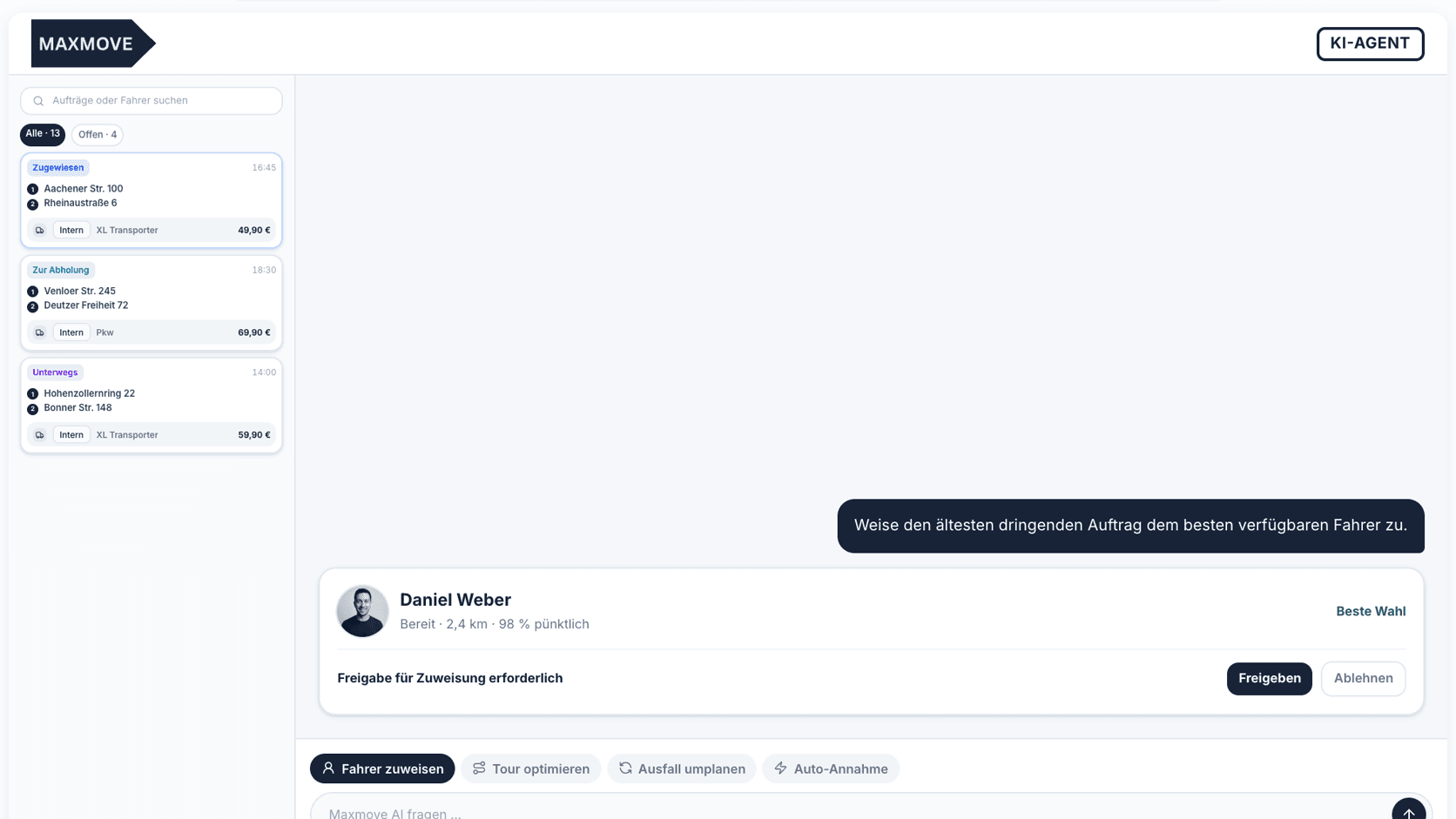
1. Acceptance before execution. The partner sees the order, route, goods, time window and compensation before accepting. No run should start while price or service scope is still open.
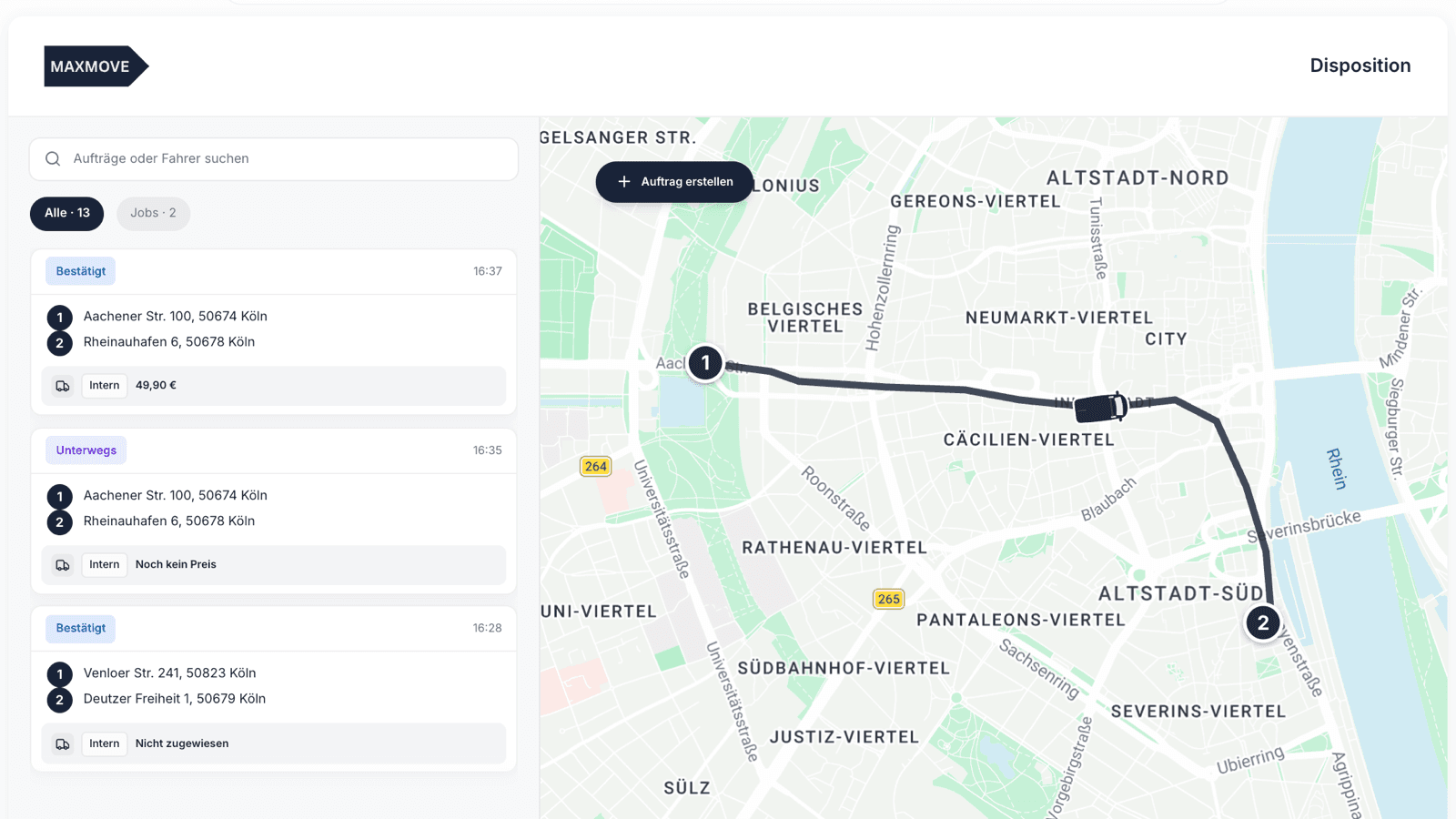
2. Status during the run. Pickup, en route, delivery and exception states must remain visible on the order. Live tracking matters especially when the customer does not know which driver will arrive.
3. Proof after completion. Photo, name, signature or another proof type must return to the order. A chat photo without a reference is weak later.
Maxmove is built for this connection: order, dispatch, driver workflow, tracking and digital proof stay together. Single transports can start through booking; recurring fleet and partner workflows belong in Maxmove TMS or in a business workflow.
Checklist: is the order partner-ready?
- Client, sender, recipient and reference are captured separately.
- Pickup and delivery have clear time windows.
- Packages, dimensions, weight and loading help are plausible.
- Vehicle class and driver requirements are defined.
- Price, compensation or approval limit is clear before acceptance.
- Required statuses are visible to the partner and dispatch.
- Proof type is specified: photo, name, signature, PIN or scan.
- Exception path for damage, failed delivery and waiting time is described.
- Customer and support see the same status, regardless of who executes.
- Billing can audit the job later through the same order reference.
How Maxmove fits the workflow
Maxmove does not replace the fleet’s operating responsibility. It reduces the breaks between request, driver assignment, status, tracking and proof.
For one overflow run, a digitally created order is often enough. For recurring partner processes, the team needs templates, roles, driver and vehicle context, required statuses and clear proof rules. That is where a TMS becomes useful: the partner joins the workflow without dispatch rebuilding the order outside the system.
If peak demand still sends your team between phone calls, WhatsApp and spreadsheets, start with one concrete overflow scenario: one vehicle class, one service area, one proof type, one exception path. From there you can decide whether the process should become a recurring Maxmove TMS workflow or begin as a single transport booking.