
Since 1 January 2025 Germany requires electronic invoices for sales between domestic businesses. For transport operators this means every freight invoice to a business customer will sooner or later become a structured file instead of a PDF. This guide explains the deadlines, the formats and a concrete rollout plan that lets forwarders and courier companies handle the switch from inside their TMS — without a special project.
What counts as an e-invoice — and what does not
An e-invoice under § 14 of the German VAT Act is an invoice in a structured electronic format that complies with the European standard EN 16931 and can be processed by machines. A PDF sent by email does not qualify — not even a digitally signed one. Since 2025, PDF, paper and image invoices are classed as "other invoices".
Two formats are established in Germany:
- XRechnung: pure XML with no visual layer. The public-sector standard; municipal clients, state-owned operators and federal agencies have required it since 2020.
- ZUGFeRD 2.x (EN 16931 or XRechnung profile): a PDF/A-3 with embedded XML. People see the familiar invoice, systems read the XML. The more practical format for B2B traffic between carrier and shipper.
Both are legally compliant. A TMS should generate both, because the customer dictates the format.
Deadlines for transport operators
| From | Obligation | What it means for forwarders and couriers |
|---|---|---|
| 1 January 2025 | Receive e-invoices | Incoming invoices from subcontractors, fuel cards and workshops must be processable as XML; an email inbox is enough, but archiving must be GoBD-compliant. |
| 1 January 2027 | Issue e-invoices for companies with prior-year revenue above €800,000 | Freight invoices to business customers must be generated as structured data. |
| 1 January 2028 | Issue e-invoices for all companies | Even a single owner-driver with a van issues e-invoices. |
Exemptions: low-value invoices up to €250, tickets, and invoices to private customers (B2C). Couriers serving consumers may keep using PDFs there — but the B2B share is almost always the larger one.
The Leitweg-ID: mandatory only for public-sector clients
The Leitweg-ID routes an invoice inside the German public administration (e.g. 04011000-1234512345-06). It is required only for XRechnung invoices to authorities and is stated in the tender or purchase order. Anyone driving for municipal utilities, publicly owned hospitals or municipal depots needs this field in the customer master; for private shippers it stays empty.
Mandatory fields that transport invoices often miss
The standard demands more structured fields than a typical freight invoice carries. Check whether these sit on the order in your TMS:
- Service period (pickup and delivery date, not just the invoice date)
- The customer's purchase or order number as a reference
- Line items with quantity, unit and unit price — "Transport Cologne–Dortmund, flat rate" needs quantity 1, unit piece
- VAT rate per line item — relevant on mixed invoices with tax-exempt international freight
- Bank details and payment terms as structured fields, not a footer
- Surcharges (waiting time, tolls, second delivery attempt) as separate line items
Rollout in five steps
1. Sort out receiving (now)
Set up a central invoice address (e.g. invoices@…) that accepts XML and ZUGFeRD files, and archive the original file unchanged. An XRechnung viewer (the free Quba viewer, for instance) makes pure XML invoices readable.
2. Extend the customer master
Per customer: preferred format (XRechnung, ZUGFeRD, or PDF until the deadline), delivery channel (email, portal, Peppol), Leitweg-ID for authorities, whether a purchase order number is mandatory.
3. Derive line items cleanly from the order
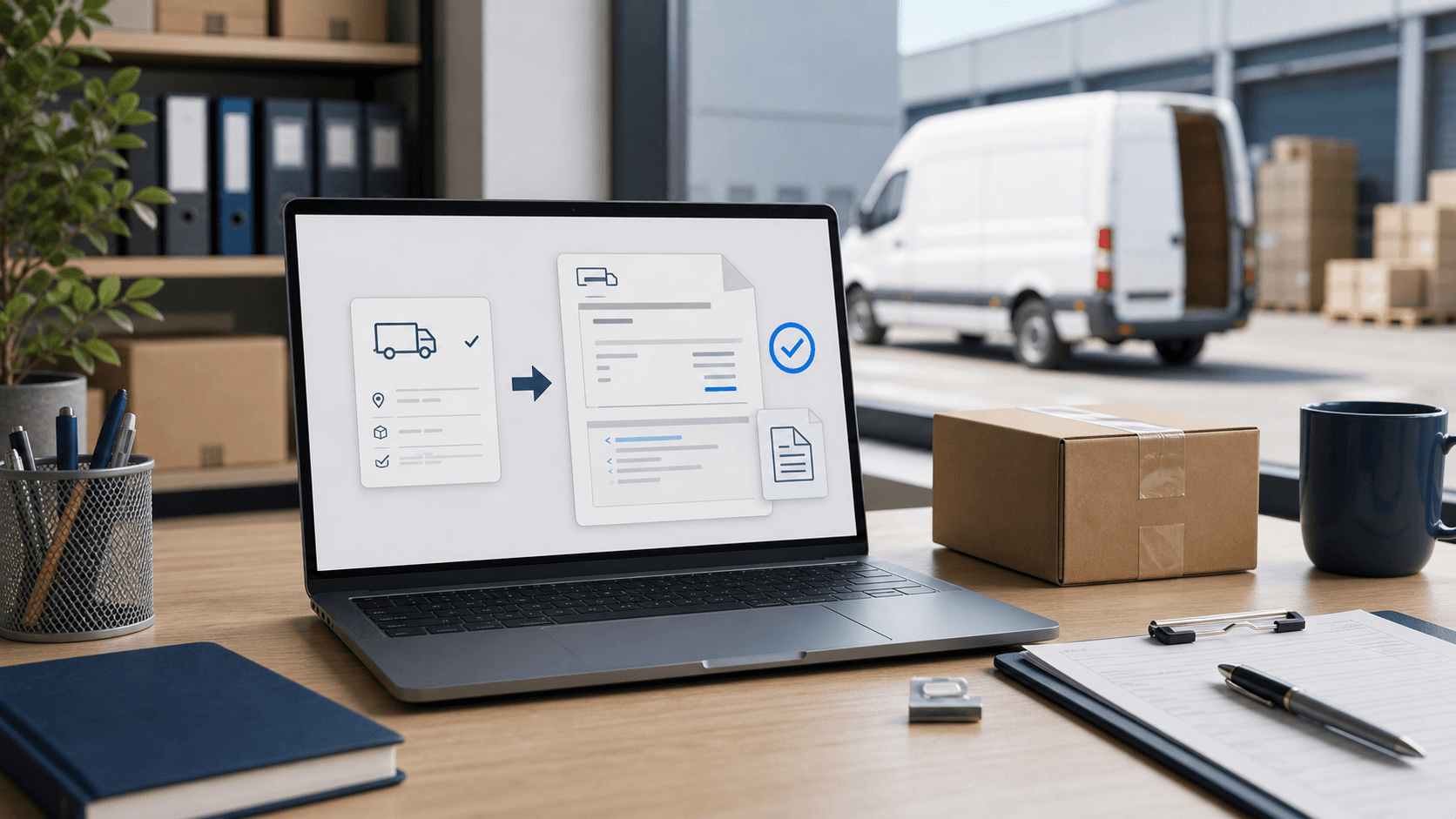
The biggest effort arises when invoices are assembled afterwards in Excel. A TMS that generates invoices directly from completed orders already holds service period, reference, surcharges and proof on the record. With Maxmove the e-invoice is created after delivery from order, tariff and proof of delivery — photo, signature and GPS timestamp stay linked as evidence.
4. Validate test invoices
Before the first real invoice goes out, check the XML against the KoSIT validator (the German coordination office for IT standards). Common errors are missing unit codes, rounding differences between line items and totals, and a wrong profile in the ZUGFeRD PDF.
5. Switch outgoing invoices — customer by customer
Start with the customers who already demand e-invoices (usually industry and the public sector) and move the rest before the deadline. Consolidated monthly invoices remain possible; each shipment becomes one line item.
What a TMS needs to provide
- XRechnung and ZUGFeRD export, configurable per customer
- Invoicing straight from the completed order, including surcharges
- Consolidated invoices with one line per shipment
- Invoice linked to the proof of delivery
- Credit notes (cancellation invoices) in the same format
- Receiving and archiving of subcontractor invoices
- Export to DATEV or your accounting system
How Maxmove, Soloplan CarLo, LIS WinSped and other systems differ in billing and interfaces is covered in the TMS comparison.
Frequently asked questions
Do I have to issue e-invoices as a one-person courier business? Receiving: yes, since 2025. Issuing: from 2028 (from 2027 if revenue exceeds €800,000). Until then you may keep using PDFs if the customer agrees.
Is ZUGFeRD enough, or do I need XRechnung? For business customers ZUGFeRD (EN 16931 profile) is sufficient. Authorities and many public enterprises require XRechnung, often via a portal such as ZRE or OZG-RE.
What happens if I keep sending PDFs after the deadline? The invoice is deemed non-compliant; the customer may lose the input-VAT deduction and will reject it. There is no direct fine, but there will be payment delays.
Do I have to replace my TMS? Only if it cannot produce EN 16931-compliant invoices and the vendor offers no update. Check for the update first; only then consider a new system.
How do I archive e-invoices correctly? The XML file is the original and must be kept for ten years unchanged, machine-readable and GoBD-compliant — a printout does not replace it.