
When a store sells a washing machine, sofa or large TV, "delivery" is not a precise enough promise. Before checkout or a support confirmation, the team must know whether the goods go only to the curb, behind the first door, to the room of use in an apartment or office, or whether two people, carrying equipment, lift access, appointment notice and digital proof are required. Without that decision, one order becomes a dispute about stairs, waiting time, damage or responsibility.
For Maxmove, this is a transport order with a defined service scope: pickup address, destination, vehicle class, packages, carrying route, contacts, status and digital proof of delivery belong together. Single deliveries can start as a small transport or through booking; recurring large-appliance or furniture flows belong in a business or TMS process.
The short answer
Promise the delivery level only when location, access and handling are checkable.
| Question | Curbside is enough | Room-of-choice or two-person handling needs review |
|---|---|---|
| Goods | packaged, movable by the recipient, accessible by pallet jack or hand truck | heavy, sensitive, assembled or hard to grip |
| Destination | flat curb, street edge or loading ramp is accepted | apartment, office, basement, floor, sales area or technical room |
| Access | short route, no steps, parking close to destination | stairs, narrow lift, long route, courtyard, critical door widths |
| People | recipient handles unloading or carrying | driver is expected to carry, second person or equipment is needed |
| Time | flexible receiving is enough | appointment notice or a fixed window is required |
| Proof | simple status update is enough | photo, signature, name, damage note or serial number matters |
The decision is not just "parcel or freight". The real question is which handover point was sold and whether the transport order can execute it.
Why this distinction matters operationally
"Curbside" and "room-of-choice" create different customer expectations. Verbraucherzentrale Brandenburg notes that curbside delivery should be agreed clearly and that customers may otherwise expect transport to the desired place (Verbraucherzentrale Brandenburg). That does not mean every product should automatically be carried to the top floor. It means the delivery condition in the store, order confirmation and driver job must match.
In B2B transport, German commercial law also shows why loading and unloading responsibilities should not be guessed: Section 412 HGB assigns loading and unloading to the sender unless circumstances or agreements say otherwise (§ 412 HGB); Germany's BALM summarizes the same basic logic for road freight (BALM). For operations, the practical rule is simple: if the driver should carry, unload, bring goods inside or place them at the room of use, it must be part of the order.
Products where the delivery level must be decided
These cases are especially exposed to wrong promises:
- washing machines, dryers, fridges and large household appliances.
- sofas, armchairs, wardrobes, mattresses, carpets and shelves.
- large TVs, fitness equipment, bicycles and garden furniture.
- B2B equipment, trade fair goods, displays or bulky spare parts.
- exchange deliveries where new goods go out and old goods come back.
- returns where condition must be documented before the reverse flow.
DHL positions its two-person handling visibly for furniture and large electrical appliances to the desired place of use, including services such as appointment coordination, tracking and return handling (DHL two-person handling). Hermes also describes two-person handling for furniture, large household appliances and sensitive goods, with assembly and installation available as booked services (Hermes two-person handling). The market separates these products clearly: standard transport, delivery to the place of use and added services are different offers.
Decision logic for stores and dispatch
Use this matrix before a delivery option is shown or confirmed.
| Situation | Better process |
|---|---|
| Goods are palletized, destination has a ramp, recipient unloads | Label B2B freight or curbside/ramp delivery clearly |
| Goods are large, but ground-level access is confirmed | Check small transport with clear handover and photo |
| Goods must go to an apartment, office or practice | Capture room-of-choice, carrying route, floor and lift |
| Weight, dimensions or packaging are missing | no automatic promise; clarify product data first |
| Stairs, narrow door or long walking route | check carrying help, second person and service time |
| Old appliance, return or exchange item comes back | plan delivery and pickup as one order with reference |
| Assembly, connection, disassembly or disposal is expected | promise only when a responsible specialist process exists |
Cargoboard's bulky-goods flow shows that dimensions, weight, pickup, delivery time, tracking and optional services belong before booking (Cargoboard bulky goods). Local deliveries need the same data quality even when the order is not classical general cargo.
Data that belongs in the order before confirmation
A large-appliance or furniture transport should include at least these fields:
- Product data: item, packages, dimensions, weight, packaging and sensitivity.
- Handover point: curbside, front door, apartment, room, warehouse, ramp or room of use.
- Carrying route: floor, lift, door widths, stairs, walking distance, courtyard, parking.
- People: driver alone, customer helps, second person booked, equipment required.
- Contact: phone number, doorbell name, receiving time, pickup and destination contact.
- Reference: order number, delivery note, RMA, serial number or cost centre.
- Proof: photo, signature, name, timestamp, damage note, return confirmation.
These fields are not admin overhead. They decide whether the driver brings the right vehicle, whether the goods can be moved safely and whether support can later explain what actually happened.
How Maxmove represents the workflow
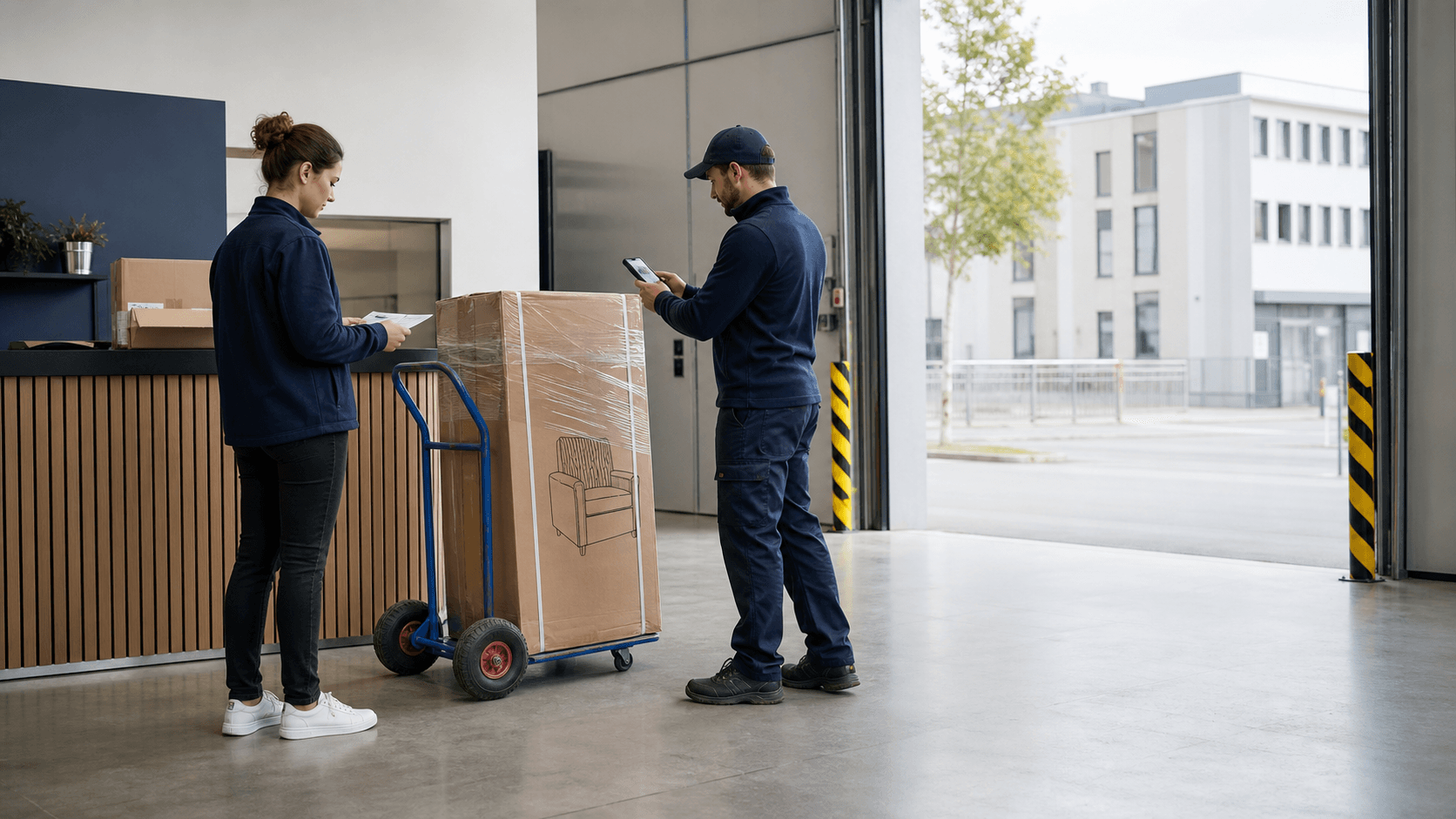
Maxmove fits local and regional deliveries where transport should be controlled digitally: choose the right vehicle class, add carrying-route notes, follow status and document completion. If a second person or special carrying service is needed, that information belongs in the booking before the order starts, not as a late comment for the driver.
A clean workflow:
- Store or support checks product data and destination address.
- The delivery level is named clearly: curbside, front door or room-of-choice.
- Carrying route, floor, lift, parking note and phone number are entered.
- The right vehicle class and additional service are selected.
- The customer receives status or tracking information.
- The driver documents handover, exception or damage.
- Proof stays attached to the order and can be processed internally.
For one-off cases, Maxmove booking is enough. For stores with recurring deliveries, Maxmove TMS, e-commerce workflows or API-adjacent processes are useful so order, transport status and proof of delivery do not drift apart in separate systems.
Tracking solves status, proof solves evidence
For large appliances and furniture, customers do not only ask "Where is the delivery?". They also ask:
- Will the team arrive before or after the evening window?
- Will the drivers really bring the goods into the apartment?
- What happens if the lift is out of service?
- Will the old appliance be taken back?
- Who documents a visible dent in the carton?
Tracking reduces calls during the route. Proof of delivery reduces discussion after handover. The proof-of-delivery Help Center article explains typical proof elements such as photo, signature and timestamp; for room-of-choice deliveries, the order should also define whether proof documents the destination room, the goods or only the handover at the address.
Where Maxmove should not be used as a blanket promise
A local transport process does not fix unclear service promises. Review manually when:
- assembly, water connection, electrical connection or old-appliance disposal is expected.
- dangerous goods, cooled goods or permit-relevant goods are involved.
- the goods are not packaged for transport.
- the stairwell is too narrow or the goods are too heavy for the planned team.
- no reachable person is named at the destination.
- the fixed time window is extremely tight.
- liability, damage or return conditions are unclear.
The right answer is not "Maxmove will handle it". It is a qualified promise after the data has been checked.
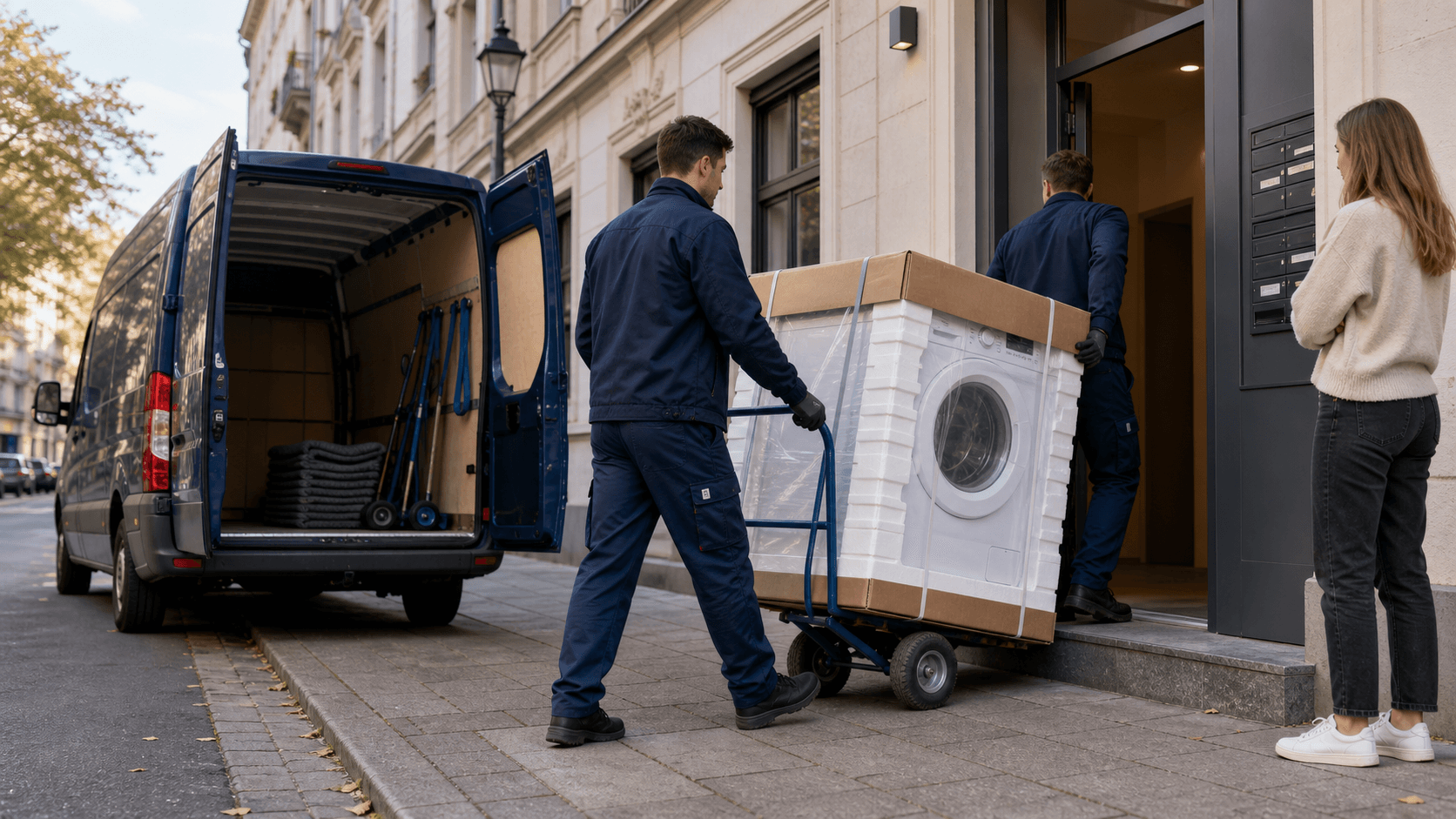
Practical example: washing machine from an online store
A customer orders a washing machine from a store in Cologne. Checkout only says "delivery today". That is not enough.
A reliable workflow looks like this:
- Product data includes dimensions, weight and packaging condition.
- The store asks whether the delivery should be curbside, front door or room-of-choice.
- The customer enters floor, lift, doorbell name and phone number.
- Operations checks whether a second person is required.
- The order contains order number and delivery level.
- The customer sees status information.
- The driver documents handover and visible exceptions.
That turns a vague delivery wish into a controllable transport order.
In short
Curbside, front door and room-of-choice are not synonyms. Stores that sell large appliances, furniture or other bulky goods should define the delivery level before the customer promise and represent it in the transport order. Product data, access, people, time window, contact and proof are the decisive fields.
Maxmove helps with local and regional deliveries when those data points are available: create the order digitally, choose the right vehicle class, follow status and document handover. Start with a single booking, or evaluate Maxmove TMS for recurring large-appliance and furniture flows.