

An urgent B2B delivery makes sense when the operational cost of waiting is higher than the extra cost of a direct transport. Typical cases are spare parts, production material, store replenishment, trade fair goods, replacement devices or critical documents. The deciding factor is not "as fast as possible" as a feeling, but a short operational check: what is blocked, when must the goods arrive, which vehicle fits, who receives them, and what proof will be needed later?
For Maxmove, that is a good same-day case: a clear order, the right vehicle class, live status, tracking and digital completion proof. If the goods are not clearly packed, require special permits or depend on a heavy truck, feasibility needs to be checked first.
The short answer
Plan an urgent delivery like a small operational incident, not like a normal shipping task.
| Decision | Good urgent delivery | Poor urgent delivery |
|---|---|---|
| Business reason | A machine, customer, installation team or store is concretely waiting for the goods. | "Maybe faster" without measurable damage. |
| Time window | Same-day receipt is reachable and confirmed. | Destination is unstaffed or vaguely reachable. |
| Shipment | Dimensions, weight, item count and handling are known. | "Something in the warehouse" without loading details. |
| Vehicle | Vehicle class fits the goods and access. | Goods may fit or require special equipment. |
| Communication | Pickup and destination contacts can be reached. | Driver must work out ownership on site. |
| Proof | Photo, signature or reference is defined before dispatch. | Proof is searched for only after a dispute. |
If four or more points are on the left, a same-day run is often sensible. If several points are on the right, clarify the order first.
Where urgent B2B delivery creates real value
Urgent deliveries are expensive when they only compensate for poor planning. They are valuable when they solve a concrete operational bottleneck.
Practical examples:
- A service technician is waiting for a spare part and cannot finish the job without it.
- A store sells an item that is physically available in another branch.
- A B2B customer needs goods before shift end so a team can keep working.
- A replacement device must go out today and the faulty unit must come back.
- Trade fair or event material is missing before setup.
- A return blocks repair, credit note or replacement delivery.
In these cases, speed is not the only thing that matters. The right goods must reach the right recipient, and completion must be documented.
The 10-minute operational check
Before booking an urgent delivery, clarify seven points. That takes less time than a long phone chain after a mistake.
- What exactly is being transported? Number of items, dimensions, weight, sensitivity, packaging.
- When must it arrive? Hard deadline, receiving cutoff, shift end, customer appointment.
- Who is reachable at pickup and delivery? Name, phone number, site details.
- Which vehicle fits? Car, estate car, van or larger vehicle; choose conservatively for bulky goods.
- Are there access constraints? Ramp, gate, yard, floor, lift, security check-in, parking.
- Which reference must travel with it? Purchase order, cost centre, RMA, ticket, serial number or delivery note.
- Which proof is required? Photo, signature, recipient name, return handover record.
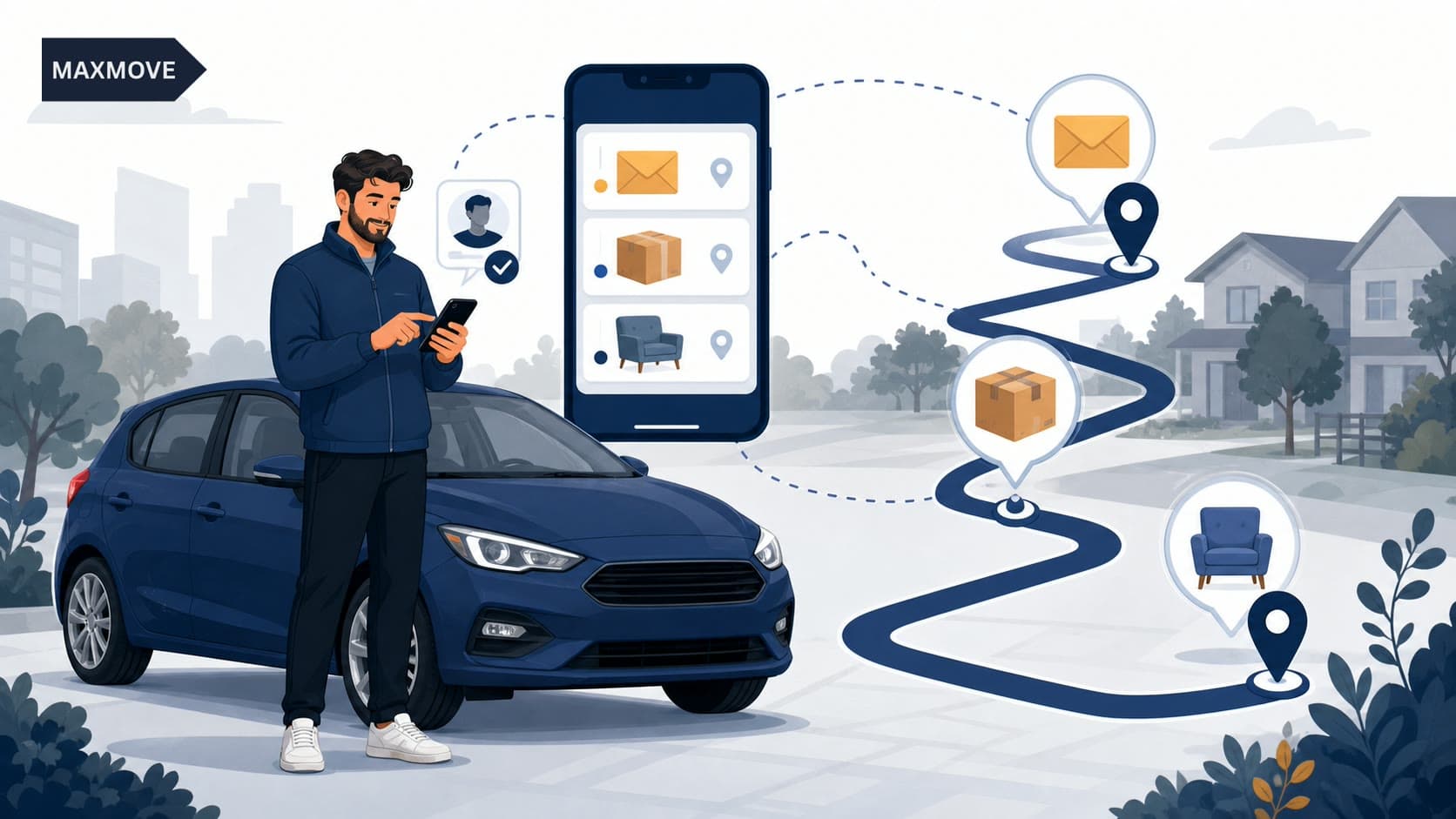
Maxmove can represent these orders digitally: enter addresses, choose a suitable vehicle size, book transport, follow status and receive proof. One-off orders start through booking; recurring workflows belong in a business workspace.
Urgent delivery or regular freight forwarding?
The key difference is not "small versus large", but "direct versus planned".
| Situation | Urgent delivery | Planned shipping / forwarding |
|---|---|---|
| Spare part blocks service job | sensible | too slow if the deadline is today |
| Pallet freight without same-day pressure | usually unnecessary | usually easier to plan |
| Branch-to-branch transfer today | sensible | only fits if there is a planned route |
| Heavy specialist goods | only after feasibility check | often better with a specialist provider |
| Customer needs live status | sensible | depends on the provider |
| Weekly return batch | rarely | better planned or recurring |
Heavy goods can also bring additional constraints. Germany's Federal Ministry for Transport describes the Sunday and public-holiday driving ban for HGVs from 00:00 to 22:00; those limits do not affect every van, but they matter for heavy vehicles and special cases (BMV). That is why an urgent delivery should never consist only of "please send immediately", but of an order that can be checked.
How Maxmove fits into the process
Maxmove is suitable for local and regional same-day cases where the shipment can be moved with a matching vehicle class and the handover should be documented cleanly.
The workflow:
- Create the order with pickup and destination address.
- Choose the vehicle class based on goods and access.
- Add contact and handover instructions.
- Confirm price and order.
- Use transport status and tracking link.
- Check completion through digital proof.
For teams with their own shop, ERP or TMS, the Maxmove Partner API is relevant as well: deliveries can be quoted, created and tracked; webhooks return status updates. That fits when urgent deliveries should not remain phone exceptions but originate from a system process.
What belongs in the order
Urgent deliveries often miss exactly the data that later costs time.
Put at least this into the order:
- pickup location with contact person and phone number
- destination with contact person, opening or receiving time
- goods, item count, dimensions and weight
- vehicle preference or vehicle requirement
- reference number for warehouse, service or accounting
- loading and access instructions
- required proof
- note whether something must be returned
If a spare part needs to go back to a service partner, treat outbound delivery and return flow as one operational process. Otherwise the delivery becomes a clean order, while the return becomes another improvised call.
Tracking is not proof
Tracking answers one question during the trip: where is the order now?
Proof of delivery answers another question after handover: what was handed to whom?
For urgent B2B delivery, you often need both. The recipient wants to know when the goods are arriving. Operations, support or accounting need evidence later. Maxmove separates those jobs: the tracking link helps during transport; Digital POD and the Help Center's PoD explanation show which proof elements such as photo, signature and timestamp can be attached to the order (proof of delivery explained).
When not to book immediately
Not every urgent request is immediately bookable.
Pause the process briefly when:
- goods are unpacked, damaged or not ready for transport.
- weight or dimensions are unknown.
- access requires registration, ID, forklift or ramp.
- hazardous goods, temperature-controlled goods or special permits may be involved.
- the recipient is not reachable.
- delivery would arrive outside normal receiving hours.
- the time window is so tight that even pickup is risky.
In these cases, the better urgent delivery often starts five minutes later but with clean information.
Daily checklist
Use this short version before someone says "send it now":
- Deadline: Which time is actually critical?
- Damage: What does waiting cost operationally?
- Goods: Do they fit the planned vehicle class?
- Contact: Can both sides be reached?
- Access: Are there loading or security constraints?
- Reference: Which number must appear on the order?
- Proof: What must be provable after delivery?
- Alternative: Would tonight, tomorrow morning or the next planned route be enough?
If deadline, damage, goods and contact are clear, same-day urgent delivery can be very pragmatic. If those four points are unclear, the transport only accelerates the chaos.
In short
A good urgent B2B delivery is not panic transport. It is a clearly defined order with a hard deadline, suitable vehicle class, reachable contacts, tracking and proof.
Maxmove helps teams book, follow and close those orders digitally. Start with a single urgent transport through booking, or evaluate a business workflow with API and clear runbooks for recurring same-day operations.