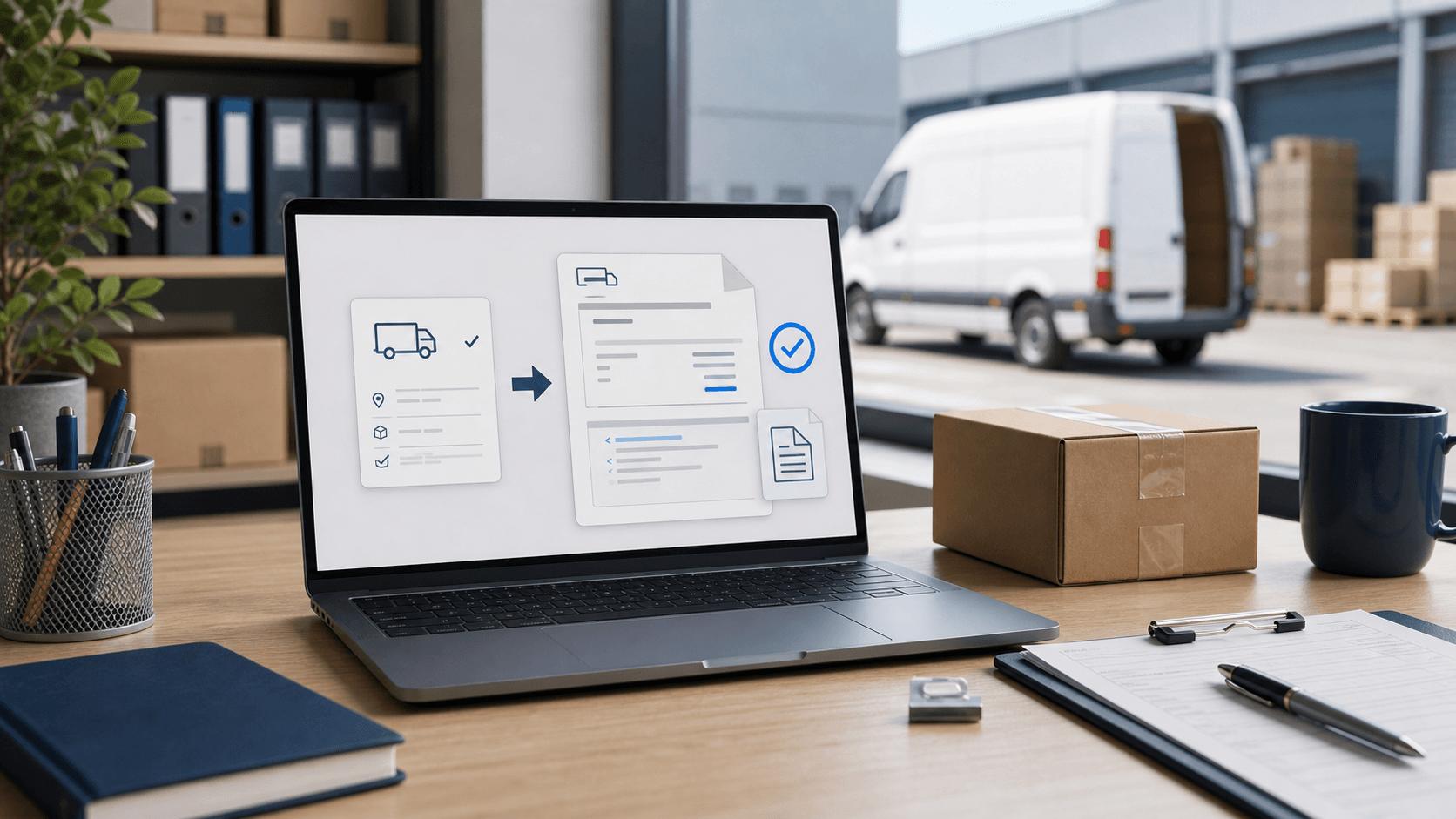

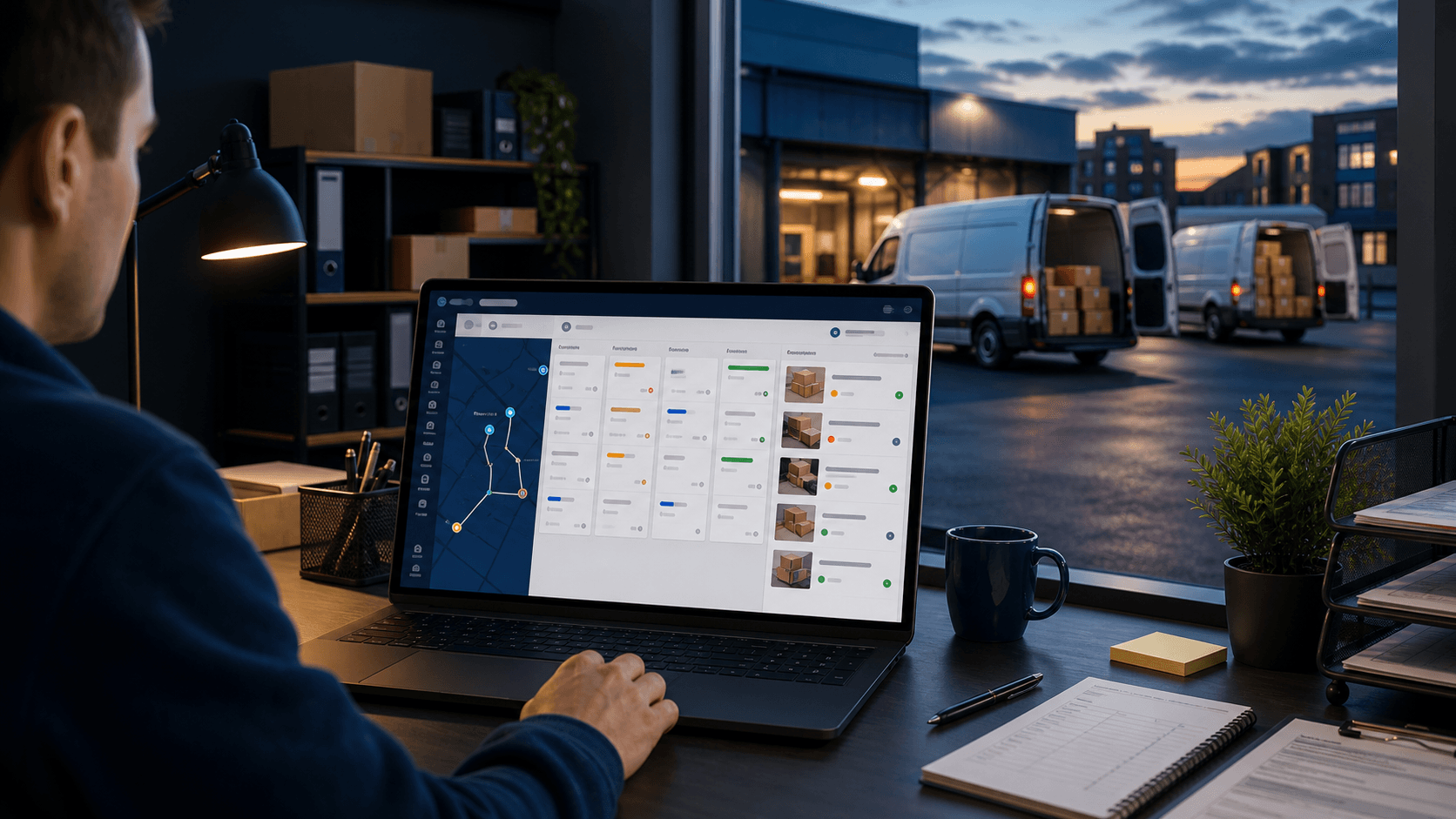
TMS order management for courier teams must make every order controllable from request to proof of delivery. Putting addresses onto a route is not enough. The deciding factor is that dispatch, driver app, status, customer messages, pricing logic, proof and billing all work from the same order data.
For small and mid-sized courier services, that is the real question: when are Excel, WhatsApp and phone calls still fast enough - and when does that way of working cost more time than a transport management system?
The short answer
A good TMS for courier and transport teams answers six operational questions for every order:
| Question | Why it matters |
|---|---|
| What is being transported? | Vehicle class, loading help, weight, dimensions and risk depend on it. |
| When does the order need to run? | ASAP order, time window, planned tour and recurring route are different dispatch cases. |
| Who drives? | Availability, vehicle, location, permission and experience must fit together. |
| What does the customer see? | Status, tracking link and follow-up questions cannot live only in the dispatcher's head. |
| What does the driver see? | Address, contact, cargo, stop order, navigation and special instructions must be available on mobile. |
| What proves delivery? | Photo, signature, timestamp, status and reference number must be findable later. |
If software solves only part of this, it is not complete TMS order management. It is more likely a route planner, driver chat, tracking tool or document folder.
Why route planning alone is not enough
Route planning answers one question: in which order should we drive stops most efficiently?
Order management starts earlier and ends later:
- A request arrives through a form, email, phone call, API or repeat-customer process.
- The order needs a price, vehicle requirement, time window and internal reference.
- Dispatch must decide whether the order fits an existing tour or needs a direct run.
- The driver needs all details without calling back.
- The customer expects status instead of "I'll quickly call the driver."
- After delivery, the team needs proof for support, invoicing and claims.
Public market examples point in the same direction: Uber Direct documents API, dashboard, tracking and proof of delivery; Lalamove describes business features such as reports, e-signature and analytics; Cargoboard emphasizes shipment tracking, customer portal and digital proof of delivery. The shared pattern is not a nicer route map, but an end-to-end order flow.
What belongs in the order model
The order is the core of the TMS. If data is missing there, dispatchers repair the process later with chat messages, screenshots and phone calls.
A robust order model includes at least:
- pickup and destination address with contact person
- time window, priority and required service type
- vehicle class, load area, weight, dimensions and item count
- loading help, floor, lift, access restrictions and waiting-time risks
- customer reference, purchase order or internal cost centre
- price, payment method and billing status
- driver, vehicle, planned stop order and status history
- proof of delivery with photo, signature or documented handover
For courier services, one point matters especially: orders must remain fast to create. A TMS must not turn a simple local transport into a freight-forwarding form with 40 required fields. Required fields belong only where missing data would create a real error later.
Dispatch: from order to decision
Dispatch is not a calendar. It is a decision under time pressure.
A TMS should show the dispatcher:
| Dispatch signal | Operational decision |
|---|---|
| Driver status and location | Who can realistically take the job? |
| Vehicle type and loading ability | Does the shipment fit without a second vehicle? |
| Existing tours | Can the order be bundled sensibly? |
| Time window | Does the order put other promises at risk? |
| Proof or identity requirement | Does the driver need photo, signature, PIN, barcode or ID check? |
| Customer priority | Should the order be moved up or reviewed manually? |
At Maxmove, this work area lives in the dispatch software: orders, drivers, vehicles, live status and digital documentation belong together. For teams that sell transport work themselves and also want to fill unused capacity, it also matters that the TMS and order marketplace are not separate worlds.
Driver app: fewer calls, better data
The biggest difference between "we have a tool" and "the operation runs digitally" shows up with the driver.
A driver app should not only show an address. It must guide the work on site:
- show the next action clearly: pick up, en route, deliver, report issue
- provide navigation and stop order
- show contact details and instructions in a controlled way
- send status changes back to the order in real time
- capture photos, signatures or other proof
- report issues such as "no one there", wrong address or damaged goods in a structured way
That does not remove every question. But it prevents every question from becoming a private chat thread. For support and billing later, what matters is not who wrote what in WhatsApp, but which status and proof are attached to the order.
Customer communication: tracking instead of phone chains
Customers usually do not want complex tracking for local transports. They want to know:
- Has the order been accepted?
- Is the driver on the way?
- Will the delivery arrive in the agreed window?
- Was it delivered?
- Is there proof?
A TMS should derive this information from order status. The dispatcher should not have to send the same updates manually to the shop, end customer and driver.
For B2B customers, the reference matters as well. If purchase order, cost centre or delivery number is missing from the order, the delivery may still be done cleanly, but the invoice or claim becomes slow later.
When TMS order management pays off
A TMS does not start paying off only at 100 vehicles. It pays off when operational friction keeps repeating.
| Day-to-day signal | What the TMS should solve |
|---|---|
| Orders are spread across emails and chats | central order list with status and owner |
| Drivers call about every address | driver app with stop details, contact and navigation |
| Customers keep asking for updates | tracking link or clear status communication |
| Proof of delivery is hard to find | digital POD data directly on the order |
| Dispatchers do not know who is free | driver and vehicle status in the same system |
| Invoices need manual cleanup | references, prices and proof stored in a structured way |
If these problems happen once a month, a clean process is often enough. If they happen every day, it is no longer an organization problem. It is a system problem.
Selection checklist
Before choosing software, courier services should not start with feature lists. They should start with their own order types.
Check:
- Which orders arrive today: ASAP, planned, recurring, B2B, private, return?
- Which data is missing most often?
- Which questions keep landing with dispatch?
- Which proof does support, accounting or the customer need later?
- Which driver and vehicle data must be checked before assignment?
- Which customers need tracking, references or recurring workflows?
- Which existing systems should connect: shop, ERP, API, email or manual booking?
The best TMS software is not the one with the longest module list. It is the one that moves your real orders from intake to proof with the fewest handoffs.
What Maxmove covers
Maxmove connects order management, dispatch, driver app, live status, digital proof and fleet functions in one transport management system. Customer orders can run through digital booking, API-adjacent workflows or internal dispatch. For deliveries, digital proof of delivery is central, so support, customer and billing work from the same facts.
The limit is just as important: if you need highly complex multi-depot optimization with thousands of stops every night, you need a specialized enterprise optimizer. But if you want to manage courier orders, local transports, drivers, vehicles and proof in one system, solve order management first.
Operational next step: list ten typical orders from last week and mark where questions, missing data or manual status updates appear today. That is where your TMS needs to help first.