
Proof of delivery: why digital records make transports easier to manage
Digital proof of delivery helps teams, drivers, and customers work from the same record once pickup or delivery is complete.
 Max Valjan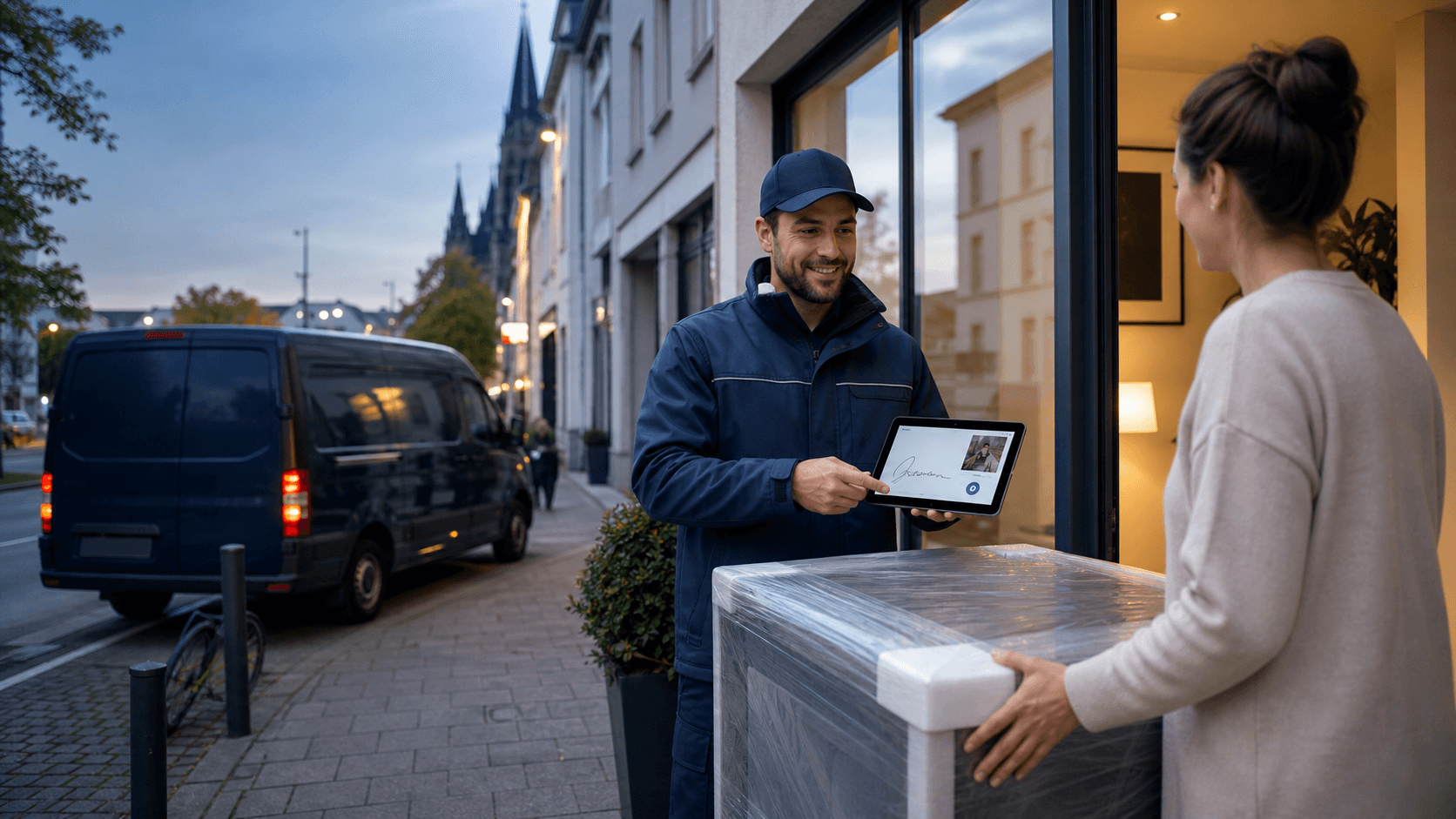
A transport is not finished just because the vehicle leaves the destination. For stores, business customers, and support teams, it is finished when the handoff is documented clearly.
That is why proof of delivery is not a paperwork detail. It decides whether a team still needs to make calls, collect photos, or compare different versions after delivery.
Where missing proof creates friction
Many deliveries run well operationally and still create follow-up work:
- A customer asks whether the goods really arrived.
- A shop team needs a photo for a claim.
- A store wants to know who accepted the delivery.
- A driver completed the job, but the status is still open.
- A business customer needs the record for internal filing.
- At pickup, it is unclear whether every package was collected.
The larger or more valuable the goods are, the more important this moment becomes. A parcel often works with a scan. Furniture, appliances, spare parts, and B2B goods need the actual handoff to be documented.
What digital proof of delivery needs to cover
Good proof does not only answer "delivered or not". It records the operational context.
Useful signals include:
- photo at pickup or delivery
- signature at the handoff point
- recipient name
- barcode or reference scan
- goods description
- timestamp and related order
- separate proof for pickup and dropoff
Maxmove treats proof of delivery as part of the transport workflow. Drivers document the relevant steps digitally. Order owners see the status, and available proof can be exported as an evidence bundle.
Why this matters for stores and retailers
With local delivery, pressure often appears after the purchase.
The customer has paid. The goods are large. A normal parcel status does not fit. At the same time, the customer expects a concrete answer when they ask for an update.
Digital proof changes how the team can respond:
- Support can see whether the order was completed.
- The store can document the handoff.
- Returns and exchange deliveries are easier to audit.
- Drivers do not need to prove delivery through messenger apps or phone calls.
- Claims start with facts instead of memory.
This does not remove every question. It makes questions shorter because the most important record is attached to the order.
Why pickup matters as much as dropoff
Many transport issues start at the origin, not the destination.
Were the right goods collected? Were there two packages or three? Was the washing machine already damaged before loading? Did the driver receive the spare part from the right contact?
If only delivery is documented, half of the story is missing. For bulky goods, returns, spare parts, and B2B transports, pickup proof can be just as important as dropoff proof.
Maxmove can keep proof across the order: pickup, delivery, and multiple stops belong to the same digital workflow. That means teams see more than the final status; they can understand the steps before it.
What drivers gain from it
Digital proof does not only protect the order owner.
It is useful for drivers too:
- Completion is documented directly on the order.
- Photos and signatures do not sit privately on the driver's phone.
- Handoffs can be checked later.
- If questions come up, the proof is tied to the right order.
- Documentation and status update happen in the same workflow.
That matters when drivers handle several jobs in one day or work for different customers. The record reduces loose communication after the route.
Decisions teams should make before the first order
Not every transport needs the same proof.
A document delivery has different requirements than a furniture handoff. An internal stock transfer may need less proof than a customer delivery. A delivery with age verification, barcode checks, or special goods needs more structure.
Useful questions before the first order:
- Is a photo enough, or is a signature required?
- Does the recipient name need to be captured?
- Is a barcode or reference checked?
- Should proof start at pickup?
- Who can download the record later?
- How long does the case need to stay traceable internally?
Maxmove turns these requirements into an order policy. Teams can use standard proof settings and adjust them per order when needed.
Tracking answers a different question
Live tracking shows where an order is right now. Proof of delivery shows what happened at the handoff.
Both belong together, but one does not replace the other.
Tracking helps during the route:
- Where is the driver?
- Will the delivery arrive soon?
- Does someone need to be ready at the destination?
Proof of delivery helps after the event:
- Who accepted the delivery?
- Is there a photo?
- Was the signature captured?
- Was the correct stop completed?
- Can the record be exported?
For customer communication, tracking is often the visible signal. For operations, support, and finance, proof is the quieter record in the background.
In short
Digital proof of delivery does not make transports more spectacular. It makes them easier to verify.
Maxmove connects order, status, driver app, proof, and document export in one workflow. Teams spend less time reconstructing what happened and can answer customers with concrete information faster.