
Panel Transport – Cut Parts, Worktops and Glass Safely to the Workshop
Maxmove moves wood-based panels, fronts, kitchen worktops, glass on racks and long goods up to 4.3 m between panel merchants, finishers, glaziers and workshops. As a direct drive in a closed vehicle, booked by size and weight, for businesses in North Rhine-Westphalia.
- Instant price before booking
- Live tracking on every drive
- Insured transports
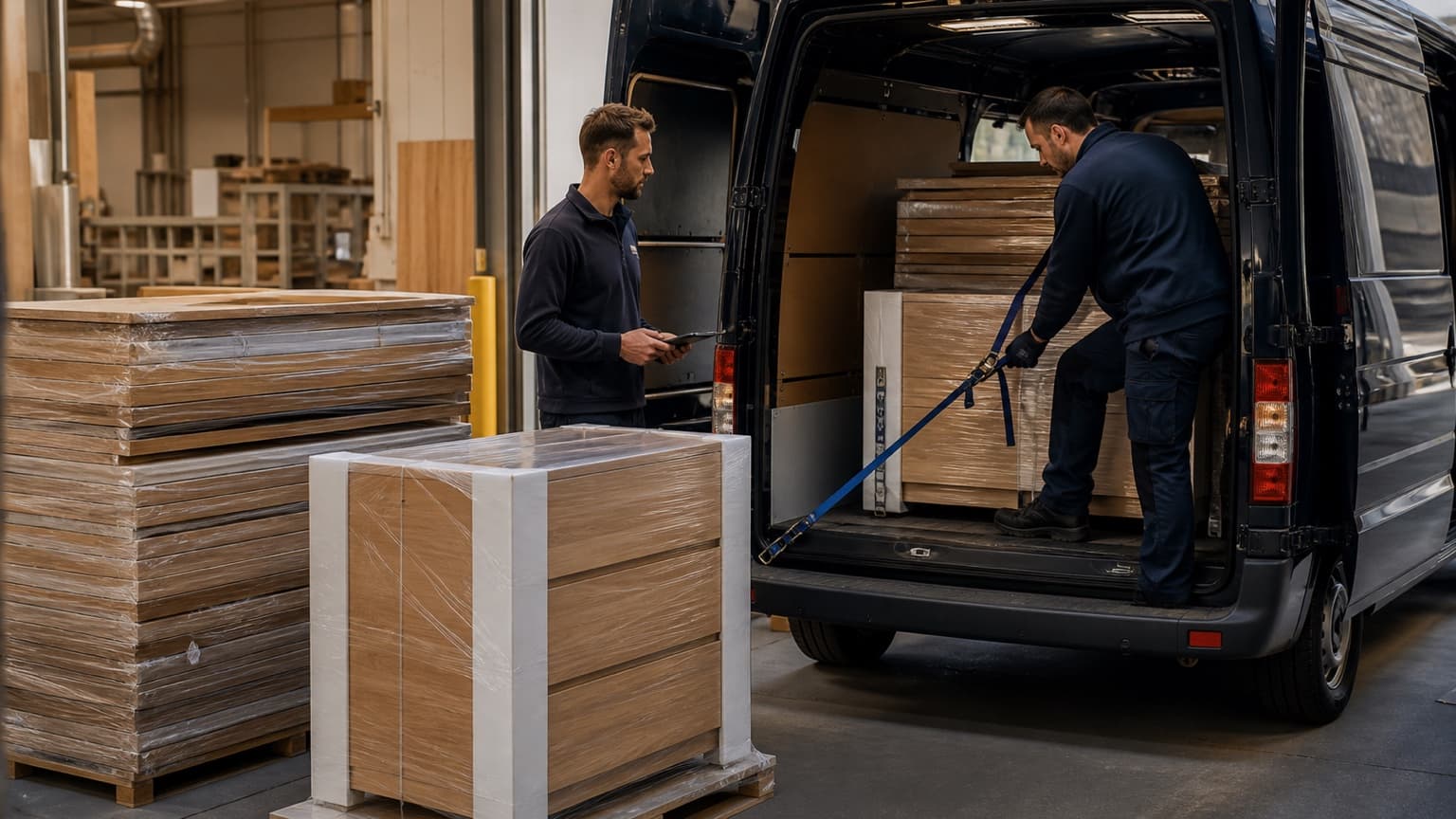
Panel transport: formats, weights and breakage risk
Panels are the raw material of furniture making, interior fit-out and kitchen installation – and one of the most awkward loads there is. Chipboard often leaves the mill in sheets of 2,800 × 2,070 mm, kitchen worktops come in 4.1 m lengths, and glass and natural stone pack a lot of weight into a small area. In between sits the daily business: cut parts from the panel merchant to the joinery, coated fronts from the finisher to assembly, edging and fittings to the bench. In East Westphalia-Lippe, the centre of the German furniture industry, this traffic between suppliers and plants runs every day.
What goes wrong is usually predictable. The vehicle is too short for the worktop or too narrow for the full sheet. A glass pane lies flat and breaks at the first pothole; a stone slab is carried only at its ends and cracks in the middle. Lacquered fronts rub against each other because there are no interleaves.
Maxmove drives panels as a direct drive in a closed van or 3.5-tonne box van: no transshipment at a depot, with lashing straps and blankets on board. You enter length, width, thickness and weight when booking and see which vehicle fits – up to 4.3 m load length. Longer formats and whole panel packs loaded by forklift run as a special run.
Which panels we move between plant and workshop
From cut parts for the joinery to glass panes on a rack – the goods of the supply chain before the showroom.
- Full-size chipboard and MDF panels
- Cut parts and job batches
- Kitchen worktops up to 4.1 m
- Lacquered and veneered fronts
- Float glass, toughened glass, mirrors
- Natural stone and ceramic slabs
- HPL and compact panels
- Edging, fittings and semi-finished parts
- Battens, profiles, long goods to 4.3 m
- Empty glass racks on the return leg
Three typical drives between plant, merchant and workshop
How panel transport runs in East Westphalia-Lippe and the Ruhr – with the vehicle that fits the format.
Carcass parts and lacquered fronts to Bielefeld
A furniture workshop in Bielefeld-Sennestadt is building a shop interior. The carcass parts come from a panel cutting service in Gütersloh; the same vehicle collects the lacquered fronts from a finisher in Bielefeld-Brackwede – two stations on one order. A Sprinter with 3.2 m load length is enough. The fronts stand on edge against the side wall, separated by foam interleaves, and the carcass parts lie on battens. The workshop checks the edges while unloading and signs in the app.
Kitchen worktops for an installation in Bielefeld
A kitchen studio in Bielefeld needs two 4,100 mm worktops from a timber merchant in Gütersloh for an installation the next morning. They do not fit a Sprinter with a 3.2 m load area, so the 3.5-tonne box van with 4.2 to 4.3 m load length is booked. The worktops are supported along their full length, corners and the postformed edge are protected, and everything is strapped down. Because two people have to carry them, carrying help is booked too.
Glass panes on an L-rack in Dortmund
A glass merchant in Dortmund's port area sends toughened glass panes for a glass partition to a glazier in Dortmund-Hörde. The panes stand on the glazier's L-rack, on hard rubber pads rather than steel. The driver straps rack and panes down at the lashing points of a Sprinter with 1.8 m load height; the straps only come off once the rack stands securely at the destination. The empty rack from the last job travels back to the merchant on the outbound leg.
What has to be settled before panels are loaded
Dimensions, glass, stone, load securing and surfaces: what the sender provides and what the driver takes care of.
Load length decides the vehicle
The load area sets the limit: 2.6 m in the van, 3.2 m in the Sprinter, 4.2 to 4.3 m in the 3.5-tonne box van. Full chipboard sheets of 2,800 × 2,070 mm are wider than a Sprinter's 1.7 m load area; whether a full sheet can travel on edge in a box van depends on the body. 4,100 mm kitchen worktops only fit the box van. Request longer goods and forklift-loaded panel packs as a special run.
Glass travels upright on a rack
Flat glass weighs about 2.5 kg per square metre per millimetre of thickness, so an 8 mm pane of 2 m² weighs 40 kg. Germany's VBG accident insurer describes A- and L-shaped transport racks for flat glass: the glass stands on hard rubber or hardwood pads, never directly on steel, and is secured for transport with straps, tension battens, stanchions or clamps. The securing only comes off once the rack stands safely. As the sender you provide rack and edge protection; the driver straps the rack down in the vehicle.
Stone and ceramic slabs on edge, never unsupported
Granite 3 cm thick weighs around 80 kg per square metre. Carried flat and supported only at its ends, a stone slab sags and breaks. Manufacturer guidelines for stone and ceramic slabs therefore have slabs stood on edge on protected supports and secured on A-frames with two ratchet straps. For cut-outs for hob or sink, ask your stonemason for a transport brace. Book a second person for carrying – see two-person handling.
Load securing: who is responsible for what
Section 22 StVO requires loads not to slip, tip over or fall even under emergency braking or a sudden swerve. Guideline VDI 2700 Part 16 describes how to achieve that in vehicles up to 7.5 tonnes. Under section 412 HGB, the sender loads in a transport-safe way unless circumstances or custom say otherwise. In practice: you provide packed panels and stable racks, the driver straps everything down and checks before setting off. More in our glossary under load securing.
Protect surfaces, report damage straight away
Lacquered, veneered and high-gloss fronts need foam or cardboard interleaves and edge protection; glass and stone must not touch metal directly. Under section 411 HGB, that packaging is the sender's job. Under section 438 HGB, visible damage is reported at handover at the latest and concealed damage in text form within seven days. The photos in the proof of delivery record the condition of every panel at the recipient.
Which vehicle suits which panel format
Edging, fittings and small cut parts travel in the compact van with up to 400 kg. Cut parts up to 2.6 m fit the van, up to 3.2 m the Sprinter with 1,000 kg payload. 4.1 m kitchen worktops and long goods up to 4.3 m need the 3.5-tonne box van or long-wheelbase Sprinter, which carries up to 1,200 kg. With glass and stone it is usually weight, not area, that sets the limit.
| Vehicle | Макс. тегло | Евро палети | Макс. размер на товара | Price | Book |
|---|---|---|---|---|---|
| Small VanПобира напр. Washing machine, armchair, moving boxes | 400 kg | 1–2 | 160 × 120 × 120 cm | from €94.05Base fare €29.90 | Book |
| VanПобира напр. Sofa, 1–2 room move, moving boxes | 900 kg | 2–3 | 270 × 160 × 130 cm | from €112.95Base fare €44.90 | Book |
| Large VanПобира напр. Wardrobe, 2–3 room move, bulky furniture | 1000 kg | 3–4 | 330 × 180 × 170 cm | from €130.05Base fare €54.90 | Book |
| 3.5t Box LorryПобира напр. Retail goods, tail lift, large furniture | 1200 kg | 6–8 | 430 × 210 × 210 cm | from €211.24Base fare €129 | Book |
| 7.5t LorryПобира напр. Full house move, bulky retail goods, site material | 3000 kg | 12–15 | 610 × 245 × 240 cm | from €366.72Base fare €249 | Book |
Published examples for Köln → Düsseldorf, weekdays at 10:00 (Berlin time). The binding price for your addresses is shown before booking.
Bigger, open-bed or heavier than 3 t? On request as a special run
How a panel transport works
- 01
Enter dimensions and weight
Enter length, width, thickness, quantity and weight, and note whether the panels are loose, on a pallet or on a rack. You see the matching vehicle, the instant price and the earliest pickup window.
- 02
Loading at the merchant or plant
The driver takes over panels or rack, puts in blankets and interleaves and straps the load down at the lashing points. Your handling notes are in the driver's app beforehand.
- 03
Direct drive without reloading
The panels stay in the same vehicle from pickup to destination. Stops at the finisher are added to the same order, and you follow every leg in live tracking.
- 04
Unloading with proof
Unloading is done together at the destination, with booked carrying help for heavy panels. Signature, timestamp and photos of the goods go into the digital proof of delivery.
Why Maxmove for Panel & long-goods transport
Vehicle by format, not by guesswork
You book by length, width and weight: a van for cut parts, a Sprinter for 3.2 m, a 3.5-tonne box van for worktops up to 4.1 m. You see which vehicle fits when booking – not when the driver is already at the dock.
The supply chain, not the final delivery
This page covers the stages before the showroom: panel stock from the merchant to the joinery, fronts from the finisher to assembly, glass to the glazier. Delivering finished furniture to buyers is covered on our furniture retail page.
Several stations, one vehicle
Cutting service, finisher, workshop: you add the stations to one order and the vehicle drives exclusively for your panels. Fixed runs, such as daily from the panel store to the workshop, are set up as recurring orders and billed through your business account.