
Goods Transport for Retail Chains – Replenishment and Transfers by Direct Drive
Maxmove moves goods between central warehouse, branches and points of sale – for stock gaps, transfers, returns and store openings. No transhipment at a depot, with proof at every stop.
- Instant price before booking
- Live tracking on every drive
- Insured transports
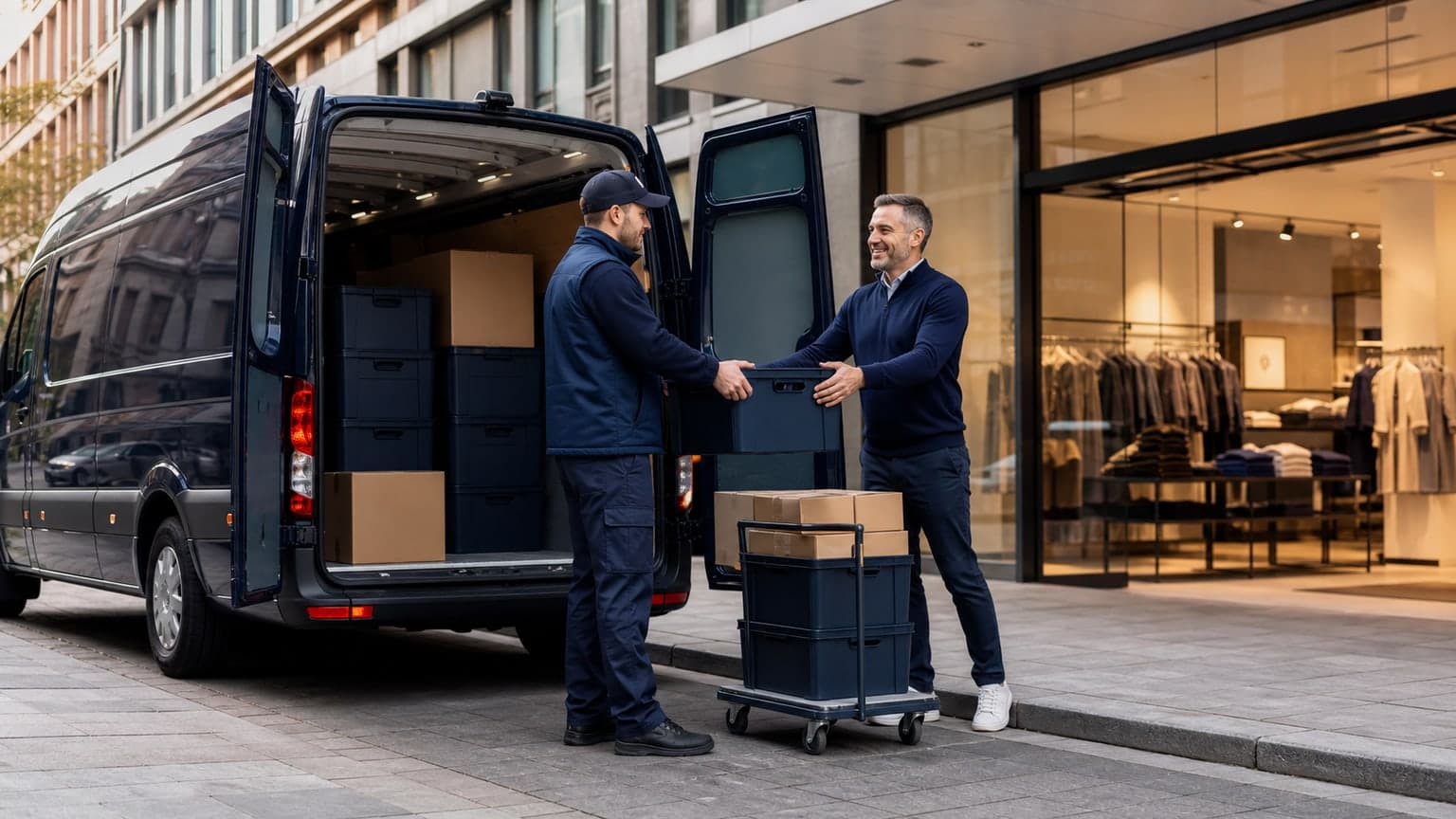
Goods transport between warehouse and branch: groupage or direct drive
Retail chains usually supply their stores on a fixed rhythm: the central warehouse picks, a freight forwarder or the company's own fleet serves the stores on set days. That works until a size sells out in Essen while it sits on the shelf in Bochum, a promotional display is missing for an opening, or stock has to go back to the warehouse for a stocktake. Then the goods exist – just in the wrong place.
There are two ways to move them. As groupage freight, the consignment runs through a network: collection, transhipment at a depot, linehaul, delivery within the standard transit time, usually the next or the following working day. As a direct drive, one vehicle loads at your site and drives to the branch without transhipment – within NRW often the same day. Which is cheaper depends on distance, quantity and urgency; the honest comparison is below.
Where store deliveries go wrong is usually the handover: delivery only before opening, a pedestrian zone with delivery hours, a shopping centre's goods-in with fixed receiving windows. These details belong on the order. The proof of delivery records who accepted what at every handover – the basis for clean stock postings between branches.
What travels between warehouse and branches
Typical consignments for retail chains in fashion, electronics, sport and specialist retail.
- Clothing and shoes in cartons
- Size runs for stock transfers
- Promotional stock and displays
- Merchandise fixtures and shop fittings
- Electronics and household appliances
- Till systems and IT hardware
- Point-of-sale material and posters
- Returns and stocktake goods
- Carrier bags, labels and till rolls
Three branch runs in the Ruhr area
Typical orders between Essen, Bochum and Oberhausen – and what matters at the handover.
Stock transfer from Ruhr Park to Essen
A fashion chain has sold out of a popular jacket at its branch in the Limbecker Platz shopping centre in Essen, while its branch at the Ruhr Park in Bochum still has two size runs. A compact van collects the cartons in Bochum and drives them straight to Essen. The order states the centre's goods-in and its receiving hours, the contact at the branch and the item list; the proof of delivery confirms the handover for the stock posting.
Opening stock for central Bochum
For a store opening on Kortumstraße in Bochum, a 3.5-tonne box van brings displays, fixtures and the initial stock from the central warehouse in Oberhausen. Kortumstraße is a pedestrian zone; vehicles may only enter where an additional sign allows it, for example delivery traffic at certain times. So the pickup is timed for the vehicle to arrive within the permitted window before opening. The store team helps unload.
Returns from Essen back to Oberhausen
After the season change, two branches in Essen-Rüttenscheid and Essen-Steele collect returns and remaining stock. A Sprinter L2 calls at both stops in turn and takes the cartons to the central warehouse in Oberhausen. Each branch labels its cartons and adds a returns note; at the warehouse, goods-in confirms receipt digitally with photos. That way any discrepancies can be traced to the right branch.
Local courier service:EssenBochumOberhausen
What matters for goods transport between warehouse and branch
The honest trade-off between groupage and direct drive – and the rules that trip up store deliveries.
Groupage or direct drive: the honest maths
Groupage networks bundle consignments from many shippers: collection, transhipment at a depot, linehaul, delivery – with a standard transit time of usually 24 to 48 hours. The price depends mainly on weight, dimensions and distance. For a single, non-urgent pallet over a long distance, that is generally the cheaper option. With a direct drive you pay for vehicle and route. It pays off when time is short, the route is regional, the goods do not tolerate transhipment or several pallets go to the same recipient.
Pedestrian zones and shopping-centre goods-in
Only vehicles permitted by an additional sign may enter a pedestrian zone (sign 242.1), for example delivery traffic at set times. What counts is the sign on site, not the branch's habit. Shopping centres receive goods through their own goods-in with receiving hours. In a restricted no-stopping zone, loading and unloading is allowed as long as it happens without delay. Put receiving window, access and contact on the order; the driver follows the signage.
Packaging, roll cages and load securing
Under Section 411 of the German Commercial Code (HGB) the sender packs goods securely, and under Section 412 HGB loads them safely for transport. For store goods that means stackable, closed cartons labelled by branch and electronics in original packaging. Roll cages can only sensibly be loaded and unloaded with a dock or tail lift; state a tail lift when booking – it is available depending on the vehicle. Before setting off, the driver checks that the load is secured as Section 22 StVO requires.
Stock, paperwork and damage
Send a document with every transfer – delivery note or transfer note listing items and quantities. The proof of delivery adds recipient, time stamp and photos. Under Section 438 HGB, the branch must report visible damage at the latest on handover and non-visible damage within seven days; otherwise delivery in good order is presumed. If pallets travel too, agree the pallet exchange in advance – there is no statutory obligation to exchange.
Which vehicle for which branch run
Single cartons between two city-centre branches go by cargo bike. Several cartons and displays fit the compact van; size runs, till hardware and up to three pallets the van. The Sprinter L2 takes whole transfers of up to four pallets, the 3.5-tonne box van opening stock and shop fittings up to 1,200 kg.
| Vehicle | Greutate maximă | Euro paleți | Dimensiune maximă încărcătură | Price | Book |
|---|---|---|---|---|---|
| Small VanÎncap de ex. Washing machine, armchair, moving boxes | 400 kg | 1–2 | 160 × 120 × 120 cm | from €94.05Base fare €29.90 | Book |
| VanÎncap de ex. Sofa, 1–2 room move, moving boxes | 900 kg | 2–3 | 270 × 160 × 130 cm | from €112.95Base fare €44.90 | Book |
| Large VanÎncap de ex. Wardrobe, 2–3 room move, bulky furniture | 1000 kg | 3–4 | 330 × 180 × 170 cm | from €130.05Base fare €54.90 | Book |
| 3.5t Box LorryÎncap de ex. Retail goods, tail lift, large furniture | 1200 kg | 6–8 | 430 × 210 × 210 cm | from €211.24Base fare €129 | Book |
| 7.5t LorryÎncap de ex. Full house move, bulky retail goods, site material | 3000 kg | 12–15 | 610 × 245 × 240 cm | from €366.72Base fare €249 | Book |
Published examples for Köln → Düsseldorf, weekdays at 10:00 (Berlin time). The binding price for your addresses is shown before booking.
Bigger, open-bed or heavier than 3 t? On request as a special run
How a branch run with Maxmove works
- 01
Book the transfer
Enter collecting branch or warehouse, receiving branch, number of cartons, weight and receiving hours. Add several branches as stops on the same order; you see the instant price and earliest pickup window straight away.
- 02
Collection with paperwork
The branch hands over the labelled cartons together with a delivery or transfer note. The driver checks the load securing before setting off.
- 03
Drive without transhipment
The goods stay in the same vehicle until the receiving branch, with no depot and no reloading. Head office and branch follow the status in live tracking.
- 04
Proof at the receiving branch
Signature, time stamp and photos for every handover – the basis for the stock posting in your merchandise management system and for later queries.
Why Maxmove for Goods transport & store replenishment
Save the sale instead of reordering
If the stock is in the wrong branch, a direct drive takes it the same day to where it will sell – without staff using their own cars or the goods spending days in a groupage network.
Fixed rounds alongside ad-hoc drives
Recurring routes between warehouse and branches, such as before opening on set weekdays, can be set up as recurring orders. Business customers book through a [business account](/business) with invoicing.
Every stop traceable
With several locations involved, the proof of delivery shows recipient, time and photos for every handover. Stocktake discrepancies can then be traced to the right branch.