
Building Material Transport for Roofing and Facades – Depot to Site Direct
Maxmove moves tiles, slate, insulation, sheet metal and accessories from the merchant, your depot or the last site to the next one – for roofers, facade contractors, carpenters and roofing plumbers in North Rhine-Westphalia.
- Instant price before booking
- Live tracking on every drive
- Insured transports
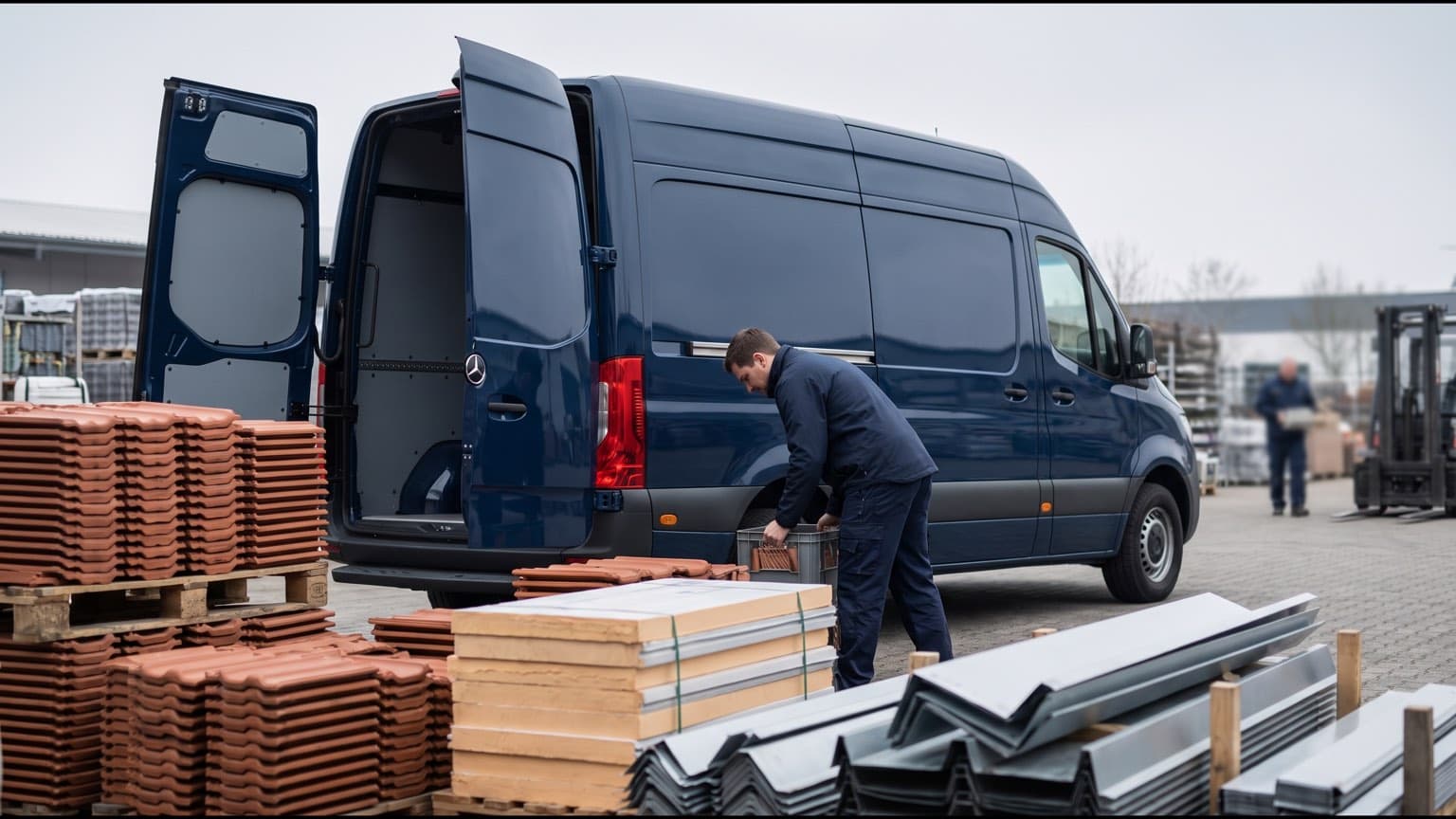
Site logistics in roofing and facade work
On a roofing or facade job, the main material usually arrives as planned: the merchant delivers tiles and insulation on pallets, often by crane lorry straight onto the scaffold or to the hoist. What sets the pace, though, are the small runs afterwards – the special tiles that run short while laying, a bundle of flashings from your own workshop, leftover insulation that has to go from the finished site to the next one. If a roofer takes the company car for that, the crew is one person down.
Maxmove takes over exactly these runs as a direct drive: from the merchant, from the depot or from site to site. You enter weight, quantity and the longest item and see the instant price and earliest pickup window before booking. The site manager follows the delivery live and knows when someone needs to be at the foot of the scaffold.
On roofing sites, things usually go wrong at the unloading point: narrow old-town lanes, nowhere to stop in front of the scaffold, nobody at the hoist when the vehicle arrives. That is why access, unloading point and contact person belong on the order. If you are a merchant delivering bagged goods, boards and profiles to customers, see building-material retail.
What roofing and facade sites need topped up
Material for pitched roofs, flat roofs and facades on its way between merchant, depot and site.
- Clay tiles, concrete tiles and fittings
- Slate in crates for roofs and facades
- Mineral wool or PIR insulation boards
- Roofing underlays and vapour control layers
- Bitumen torch-on membranes for flat roofs
- Folded flashings, parapet and verge trims
- Gutters, downpipes and gutter brackets
- Roof windows in original packaging
- Facade panels and substructure
- Roofing battens and counter battens
Three runs between the Bergisches Land and Düsseldorf
Typical building-material transports for roofers and facade contractors in Wuppertal, Remscheid and Düsseldorf.
Slate for a facade in Remscheid-Lennep
Renovating a slate-clad house in Lennep's old town, a roofer runs short of slate and slate nails and has both collected from his merchant in Wuppertal. Slate comes in crates and is heavy, so the number of crates and the weight go on the order. Because the lanes in Lennep are narrow, a van goes instead of a lorry; the order notes where the vehicle can briefly stop in front of the scaffold and who takes the crates.
Leftover material from site to site in Düsseldorf
A flat roof in Düsseldorf-Oberkassel is finished, leaving PIR insulation boards, two rolls of vapour control layer and accessories. Instead of taking everything back to the depot, the material goes straight to the next site in Düsseldorf-Benrath. Insulation is light but bulky – load space is what counts, so the 3.5-tonne box van goes. The foreman on the receiving site sees the arrival in live tracking and takes the boards at the site hoist.
Flashings from the workshop in Wuppertal
A roofing plumber in Wuppertal-Oberbarmen has folded parapet and verge flashings for an apartment building in Wuppertal-Vohwinkel. Long flashings need load length: up to 3.2 m fits the Sprinter L2, up to 4.2 m the 3.5-tonne box van. The sheets lie flat on timber bearers, are wrapped in protective film and secured against shifting so edges and coating arrive intact. A fitter takes them on site and signs digitally.
Local courier service:WuppertalRemscheidDüsseldorf
What applies to roofing and facade material transport
Weight, load securing, dangerous goods and the unloading point – each with who is responsible.
Weight from the delivery note, not estimated
Tiles and slate are heavy; what counts is the weight on the manufacturer's or merchant's delivery note. Bookable payloads are 400 kg in the compact van, 900 kg in the van, 1,000 kg in the Sprinter L2, 1,200 kg in the 3.5-tonne box van and 3,000 kg in the 7.5-tonne truck. A full pallet of roof tiles can exceed the box van's limit on its own – it then belongs in the 7.5-tonne truck or, if a crane has to unload it, on the merchant's crane delivery or a special transport. Top-ups in part quantities, on the other hand, fit well in the van and Sprinter.
Securing membranes, sheet metal and battens
Section 22 StVO requires loads to be secured so that they do not slide, tip over, roll about or fall off even under full braking or a sudden evasive manoeuvre; the VDI 2700 guideline series counts as the recognised rules of practice. Membrane rolls are therefore secured against rolling, sheets laid flat on bearers, battens bundled. Under Section 412 HGB, loading safely for transport is the sender's job – at the depot, that means your team. The driver checks the securing before setting off.
Gas cylinders and bitumen products
Propane cylinders for torching bitumen membranes are ADR class 2 dangerous goods, and solvent-based primers can be flammable liquids. Contractors may carry limited quantities of such goods to site themselves under the so-called tradesman exemption (ADR 1.1.3.1 c); it covers transport in connection with their main activity, not supply runs. If Maxmove is to carry such goods, declare them in advance in text form under Section 410 HGB – without review, they do not travel.
Unloading point, scaffold and hoist
Maxmove does not provide lifting equipment. Note whether a forklift, telehandler or site hoist is available or unloading is by hand, and who receives the goods. In a restricted no-stopping zone, loading and unloading is allowed as long as it happens without delay. If you need more time or space in front of the scaffold, a no-stopping zone must be applied for with the city – in Cologne, at least 21 days ahead. For a same-day top-up that is not an option, so plan a reachable unloading point.
Which vehicle for which roofing and facade material
Special tiles, slate nails, roof windows and accessories go in the compact van. Slate in crates, gutters and membrane rolls fit the van with a 2.6 m load length and 900 kg. The Sprinter L2 takes flashings and downpipes up to 3.2 m and up to four pallets. Large volumes of insulation, battens and sheets up to 4.2 m and loads up to 1,200 kg belong in the 3.5-tonne box van, full tile pallets up to 3,000 kg in the 7.5-tonne truck; loads over 3,000 kg or crane unloading are a [special transport](/sonderfahrten).
| Vehicle | Greutate maximă | Euro paleți | Dimensiune maximă încărcătură | Price | Book |
|---|---|---|---|---|---|
| Small VanÎncap de ex. Washing machine, armchair, moving boxes | 400 kg | 1–2 | 160 × 120 × 120 cm | from €94.05Base fare €29.90 | Book |
| VanÎncap de ex. Sofa, 1–2 room move, moving boxes | 900 kg | 2–3 | 270 × 160 × 130 cm | from €112.95Base fare €44.90 | Book |
| Large VanÎncap de ex. Wardrobe, 2–3 room move, bulky furniture | 1000 kg | 3–4 | 330 × 180 × 170 cm | from €130.05Base fare €54.90 | Book |
| 3.5t Box LorryÎncap de ex. Retail goods, tail lift, large furniture | 1200 kg | 6–8 | 430 × 210 × 210 cm | from €211.24Base fare €129 | Book |
| 7.5t LorryÎncap de ex. Full house move, bulky retail goods, site material | 3000 kg | 12–15 | 610 × 245 × 240 cm | from €366.72Base fare €249 | Book |
Published examples for Köln → Düsseldorf, weekdays at 10:00 (Berlin time). The binding price for your addresses is shown before booking.
Bigger, open-bed or heavier than 3 t? On request as a special run
How a building-material transport with Maxmove works
- 01
Enter material and unloading point
Enter the pickup point – merchant, depot or site – the destination site, weight, quantity and longest item. Add access, where to stop and who receives at the scaffold or hoist.
- 02
Collection
At the merchant with the picking reference, at the depot or on site from the named contact. Goods are loaded safely for transport and the driver checks the securing.
- 03
Direct drive with live tracking
No detour via a depot. The site manager sees when the material will arrive and plans the hoist or people to unload.
- 04
Handover with photos
Foreman's signature, time stamp and photos of the unloaded goods at the unloading point – as evidence towards merchant and client.
Why Maxmove for Building-material transport – roofing & facade
The crew stays on the roof
No roofer has to fetch missing special tiles, leftover insulation or flashings in the company car any more. The drive runs in parallel while work carries on up top, and you know the price before booking.
Site to site instead of via the depot
Leftover material goes straight to the next site. That saves the detour via the depot and loading everything twice. Recurring runs, for example between depot and a large site, can be set up as standing orders.
Proof for merchant and client
Time stamp, signature and photos show which material was at which site and when. That helps if it later has to be settled from when work could proceed or what quantity actually arrived.