
Transporting a Motorcycle – Strapped Down Safely
Block the front wheel, four straps crosswise over the triple clamp and frame, lightly preload the suspension – or book a van with driver and skip ramp and trailer altogether.
- Instant price before booking
- Insured transports
- Carrying help bookable
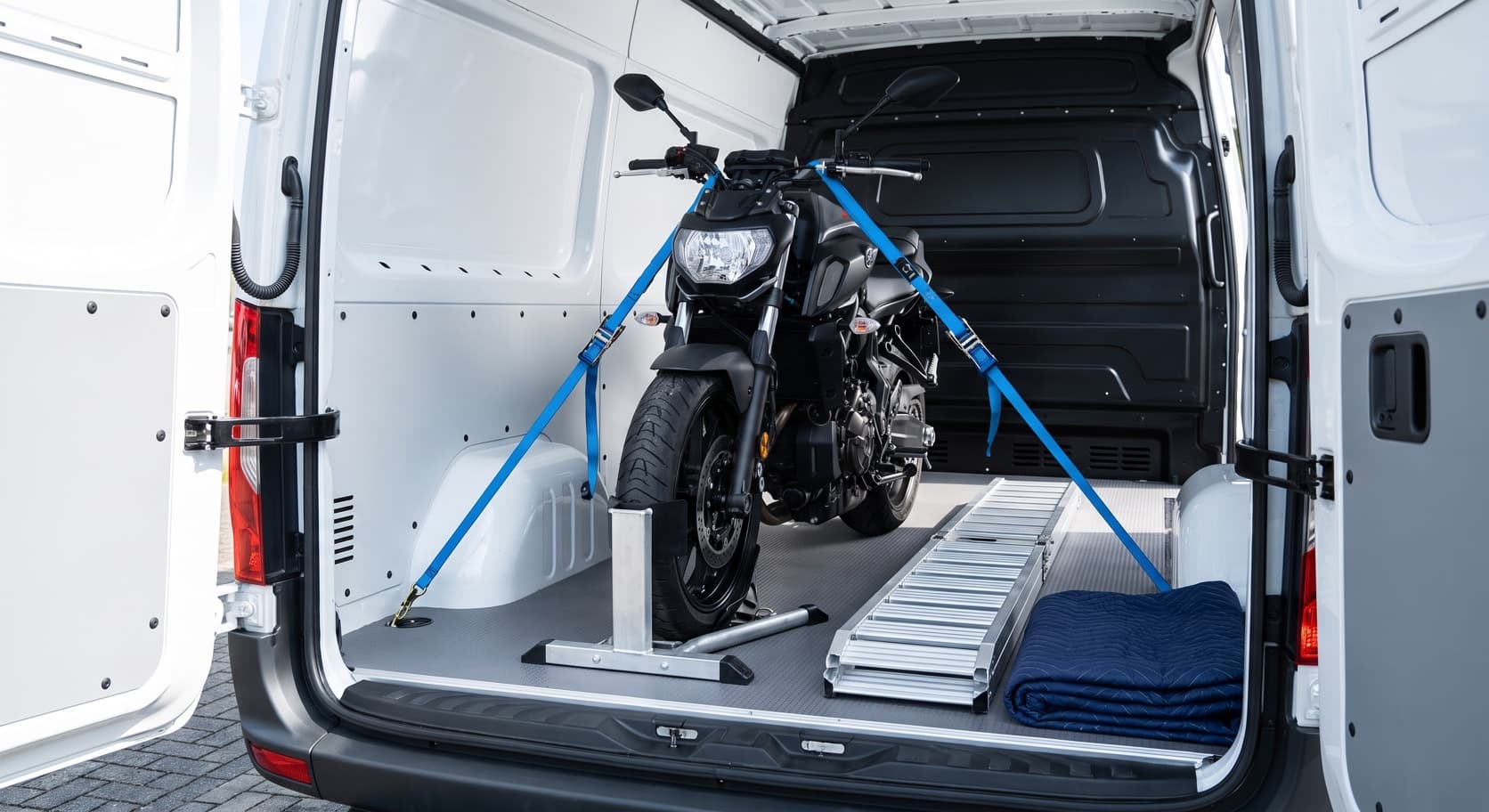
How to Transport a Motorcycle Properly
Prepare the machine
Remove cases, tank bag, and loose parts, fold in the mirrors, switch off the alarm. On older machines, close the fuel tap. Photos of the condition before handover are worthwhile – especially when collecting a machine after a purchase.
Load it over the ramp
Push it up a sturdy, non-slip ramp with the engine off, working in pairs – don't ride it up. The front wheel goes into a wheel chock or against the bulkhead so the machine can't roll while you strap it down.
Strap down crosswise
Tension four straps crosswise to the front and rear – on the triple clamp and frame, never over levers, fairings, or plastic. Lightly preload the suspension so the straps can't loosen en route; unload the side stand.
Which vehicle do you need?
A motorcycle weighs 150–300 kg and needs a panel van with lashing points. Bikes up to about 1.30 m tall fit the 2.7 m class; taller ones such as adventure tourers go in the Sprinter with about 1.80 m of interior height. Agree the ramp and wheel chock before booking. All dimensions and payloads in the van guide →
Transporting a Motorcycle: The Right Preparation
Depending on the class, a motorcycle weighs 150 to 300 kilograms – too heavy to improvise, too valuable for loose straps. Before loading, remove cases, tank bag, and all loose parts, fold in the mirrors, and switch off the alarm so it doesn't trigger at every bump. On older machines with a fuel tap: close it.
The typical occasion is collecting a machine after a purchase – often unregistered, so riding it isn't an option. Take photos of the condition at pickup and briefly note the mileage and handover in writing; with used purchases that prevents later arguments.
Strapping a Motorcycle Correctly – the Four-Point Rule
The core of every motorcycle tie-down: four straps, tensioned crosswise to the front and rear, attached to the triple clamp and frame – never to levers, indicators, fairing parts, or plastic. The front wheel sits in a wheel chock or firmly against the bulkhead so the machine can't creep forward.
While tensioning, lightly preload the suspension – roughly a third of the travel, never to the stop. That keeps the straps taut even when the suspension works during the drive. The side stand is unloaded and the machine stands vertically on both wheels. Our glossary article on load securing explains how straps and anchor points work in general.
Trailer, Van, or Freight Forwarder?
The motorcycle trailer is common but has prerequisites: a towing vehicle with a hitch, the right license class depending on total weight – and on open trailers the machine travels exposed to weather and stone chips.
In a closed van, the motorcycle stands weather-protected, discreet, and secured to proper lashing points. A freight forwarder pays off mainly for long distances with lead time, such as a purchase at the other end of Germany – but with a delivery window rather than your preferred date. For short-notice transports and regional collections, the van is the most flexible solution.
Loading Without Damage: Ramp, Weight, Second Person
Most transport damage happens not on the road but at the ramp. So: use a sturdy, non-slip loading ramp, push the machine up with the engine off, and work in pairs – one person steering at the handlebar, the second supporting and pushing at the rear.
Don't ride up the ramp: on narrow rails, a moment's hesitation is enough for a fall, and nobody holds on to 250 kilograms. Once up, the machine is immediately blocked in the chock or against the bulkhead before the straps go on.
Freight Forwarder, Courier, or Van with Driver?
If you own neither trailer nor ramp and chock, there's no need to tool up for a single transport: a van with driver handles the whole trip – with Maxmove same-day on request, and a second person for loading as a bookable extra. That's especially practical for collecting a machine after a purchase, when it isn't registered yet.
You see the binding price in advance in the transport cost calculator – depending on distance and vehicle class, with no quote loop by phone.
Which van fits? With motorcycles, height is what counts
When choosing a van, many people look at the load length – with a motorcycle, height usually decides. The bike stands vertically on both wheels during transport, and its highest points are the mirrors, handlebar or windscreen. A naked bike like the Yamaha MT-07 is around 1.10 m tall according to its spec sheet, an adventure tourer like the BMW R 1250 GS around 1.43 m.
With Maxmove, the 2.7 m class van has a load floor of 2.6 × 1.6 m and around 1.35 m of interior height. That is enough for scooters, naked bikes and many sports bikes, often with the mirrors folded in. For tall bikes with a windscreen – adventure bikes and tourers – the 3.3 m class Sprinter with around 1.80 m of interior height is the right choice. Weight is not critical in either class: even a heavy tourer stays well below the bookable payload.
Before booking, measure the height over the mirrors or screen and the overall length, and state the model and year. Also check the height of the rear opening: the bike has to fit through the doors handlebar first before it stands on the load floor.
Bringing a bike home after purchase: temporary plate or transport
Anyone buying a used motorcycle faces the question: ride it home or have it transported? To ride on its own wheels, a deregistered bike needs a short-term number plate (Kurzzeitkennzeichen). Under § 42 of the German Vehicle Registration Ordinance (FZV), it is valid at most until the end of the fifth day after issue and requires motor liability insurance and a valid roadworthiness test (HU). If the HU has expired, the bike is not roadworthy or the distance is long, transport is the simpler solution – no registration office and no risk on the first ride.
For the handover at the seller's, the checklist is: written purchase contract, registration certificate parts I and II, all keys, service book and receipts. Note the mileage and photograph the bike all round before it is loaded. Our vehicle handover report gives you a template.
With a Maxmove direct drive, the driver collects the bike from the seller and brings it to you or the workshop without reloading; the handover is documented digitally with a timestamp and photos. When booking, state whether the bike is roadworthy and can be pushed.
Frequent Questions About Motorcycle Transport
How much does the transport cost?
Enter the route, choose the vehicle, add loading help if needed – the price for your motorcycle transport is fixed in seconds.
Calculate the price in seconds