
Transporting a Dryer – Upright, Secured, No Hidden Damage
Empty the condensation tank, tape the door, load heat-pump dryers upright – and if you'd rather not carry it yourself: a van with driver and carrying help is booked in minutes.
- Instant price before booking
- Insured transports
- Carrying help bookable
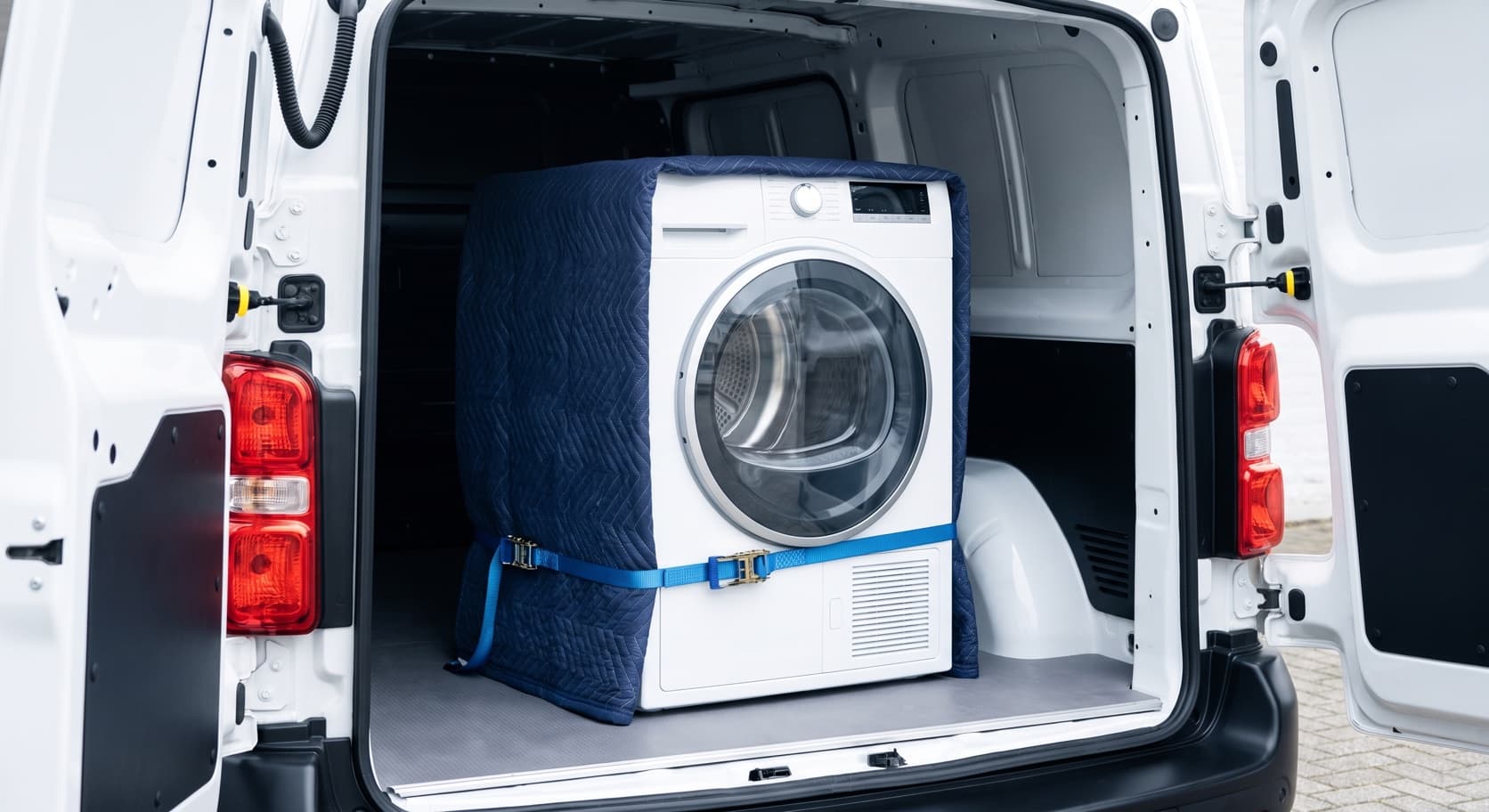
How to Transport a Dryer Properly
Empty the condensation tank
Pull out the condensation tank and empty it completely; on condenser dryers, also shake out the lint filter. Otherwise, residual water runs into the housing and electronics during the drive.
Secure the door and loose parts
Tape the drum door shut with masking tape and fix the power cable to the housing. There is no transport lock like on a washing machine – the dryer drum has no concrete counterweight and needs no bolts.
Load upright and strap down
Dryers belong upright on the load floor, secured with lashing straps. This especially applies to heat-pump dryers: their refrigerant circuit tolerates tilting and lying down as poorly as a fridge's.
Which vehicle do you need?
A dryer weighs 40–60 kg and fits upright in any compact van; with a hand truck and a second person it is loaded in minutes. If a washing machine and dryer move together, the 2.7 m class is worth it. All dimensions and payloads in the van guide →
Transporting a dryer: the right preparation
At 40 to 60 kilograms, a dryer is lighter than a washing machine but just as bulky – and the widespread heat-pump dryer carries a sensitive refrigerant circuit inside its housing. Preparation is quick: empty the condensation tank, clean the lint filter, tape the power cable to the housing, secure the drum door with masking tape.
Unlike a washing machine, there are no transport bolts: the dryer drum sits in the appliance without a concrete counterweight and survives the drive without a lock. What matters instead is the appliance's position – more on that below. Before carrying, check the route: measure door widths, clear tripping hazards, have a hand truck ready.
Transporting a dryer lying down: off limits for heat-pump models
Whether a dryer may lie down depends on its type. Vented and simple condenser dryers are uncritical: laid briefly on their side, they usually take no damage as long as no residual water remains inside. The heat-pump dryer is the special case – it runs a refrigerant circuit with a compressor, just like a fridge. Lying down, oil can flow from the compressor into the refrigerant lines; switch the appliance on too early afterwards and you risk compressor damage.
So the rule is: always transport heat-pump dryers upright, secured with straps and without tilting them sharply while carrying. The type plate or manual tells you which type you own – when in doubt, treat the appliance as a heat-pump dryer. Our glossary article on load securing shows how lashing straps should sit in the vehicle.
After the move: waiting time before the first cycle
After an upright transport, a heat-pump dryer is ready to run after about two hours of standing – that is how long the compressor oil needs to settle. If the appliance was tilted or lay down for a while, give it considerably longer: many manufacturers recommend up to 24 hours upright before plugging it in.
Vented and condenser dryers without a heat pump can be connected right after the move – just check that the lint filter and condensation tank are seated correctly. The waiting time costs nothing; a broken compressor often costs more than a used replacement appliance.
Carrying a dryer up or down stairs
At 40 to 60 kilograms, a dryer is manageable for two people – but the smooth housing without handles still makes stairs the critical stretch. One person guides above, one supports below the appliance; set it down briefly on every landing. A hand truck with stair climbers or carrying straps distributes the weight and keeps the appliance upright – the decisive point for heat-pump dryers.
Secure the dryer on the hand truck with a strap and tilt it only as far as the hand truck requires. If a washing machine is on the list too, carry the heavier appliance first while your strength is fresh.
Freight forwarder, courier, or van with driver?
A classic freight forwarder rarely pays off for a single dryer: consolidated loads have long delivery windows, and delivery often ends at the curb. For a single appliance, a van with driver is the faster solution – with Maxmove same-day on request, with carrying help down to the basement or up to the third floor, loaded upright and strapped down.
You see the binding price in advance in the transport cost calculator. If the dryer moves as part of a full move, our moving checklist helps you plan from disconnecting to the first drying cycle.
Shipping a dryer: why a parcel is out
Anyone who wants to ship a tumble dryer hits a fixed limit at the parcel service: DHL carries parcels up to 31.5 kg, bulky-item service included. A dryer weighs 40 to 60 kg, more with packaging. That leaves two routes.
A freight forwarder takes the dryer as general cargo on a pallet. It has to be packed for transport and secured to the pallet – a heat-pump dryer upright, because its refrigerant circuit does not tolerate tilting or lying well. On the way, the shipment is transshipped at a depot and usually delivered only to the kerb. That suits long distances without time pressure.
A direct drive brings the appliance to its destination without packaging or reloading. The driver collects the dryer where it stands, loads it upright and straps it down; if you like, a second person helps carry it, up from the basement or up to the third floor. Within NRW, collection is often possible the same day.
The preparation is the same either way: empty the condensate container, clean the lint filter, tape the door shut and fix the cable. What turns a shipment into bulky goods is explained in our logistics glossary.
Stacked units and heat pumps: two special cases when disconnecting
If the dryer stands on top of the washing machine, it is usually fixed with a stacking kit, also called an intermediate frame. In use, it keeps the dryer from wandering at high spin speeds. For transport, the stack is separated: lift the dryer off, detach the stacking kit from the washing machine and take it along, then load both appliances separately. They never travel stacked – the washing machine needs its transport bolts, the dryer its own upright spot with straps.
With a heat-pump dryer it is worth checking the rating plate or the manual, because that is where the refrigerant is named. Miele, for example, uses R290 in heat-pump dryers – propane, a flammable gas that is heavier than air. So no pipes of the refrigerant circuit may be kinked or damaged while carrying and loading. If you notice damage after transport, do not switch the appliance on, keep ignition sources away, ventilate the room and have it checked by customer service.
At the new location, the stacking kit goes back in between before the dryer is placed on the washing machine again – only then may the washing machine spin again.
Frequent Questions About Dryer Transport
How much does the transport cost?
Enter the route, choose the vehicle, add carrying help if needed – the price for your dryer transport is fixed in seconds.
Calculate the price in seconds