Own-account transport: what German law requires and when to outsource
Werkverkehr is road haulage for a company's own purposes – with its own staff, as an ancillary activity, without a licence. Here is what the law covers, and when parts, tools and gauges are better moved between plants, suppliers and subcontractors by a Maxmove direct drive.
- Instant price before booking
- Live tracking on every drive
- Insured transports
What is own-account transport (Werkverkehr)?
Under Section 1(2) of the German Road Haulage Act (GüKG), Werkverkehr is road haulage for a company's own purposes. A typical example is a manufacturer that takes blanks to a heat treater in its own truck with its own driver, or a wholesaler that delivers to its customers itself. Anything that is not Werkverkehr counts as commercial road haulage (Section 1(4) GüKG) – carrying goods for others.
The distinction matters: own-account transport needs no haulage licence and no liability insurance under Section 7a GüKG (Section 9 GüKG). If it runs with trucks above 3.5 t gross vehicle weight, however, the company must register with the Federal Office for Logistics and Mobility (BALM) before the first run (Section 15a GüKG). Commercial haulage, by contrast, requires a Community licence (Section 3 GüKG). For vehicles up to 3.5 t including trailer, neither set of rules applies (Section 2(1) No. 10 GüKG), unless EU law provides otherwise.
In day-to-day operations, own-account fleets are often poorly utilised: the truck goes to the heat treater full and comes back empty, an urgent part does not fit the fixed round, the driver is off sick. For these runs, companies book a direct drive in a van – with an instant price, live tracking and a digital proof of delivery.
What moves in plant and supplier traffic
The everyday traffic around production – parts, tools and documents between plants, suppliers and subcontractors.
- Blanks and semi-finished parts to machinists
- Parts to the heat treater and back
- Parts to plating or coating
- Tools and fixtures for assembly
- Gauges for calibration
- First-off samples with inspection reports
- Small load carriers in circulation
- Production documents and drawings
- Spare parts from the central store
- Prototypes and development samples
Outsourcing plant runs: three drives from NRW
Runs that your own truck cannot cover sensibly – too urgent, too small or too irregular.
Heat-treatment loop in Solingen
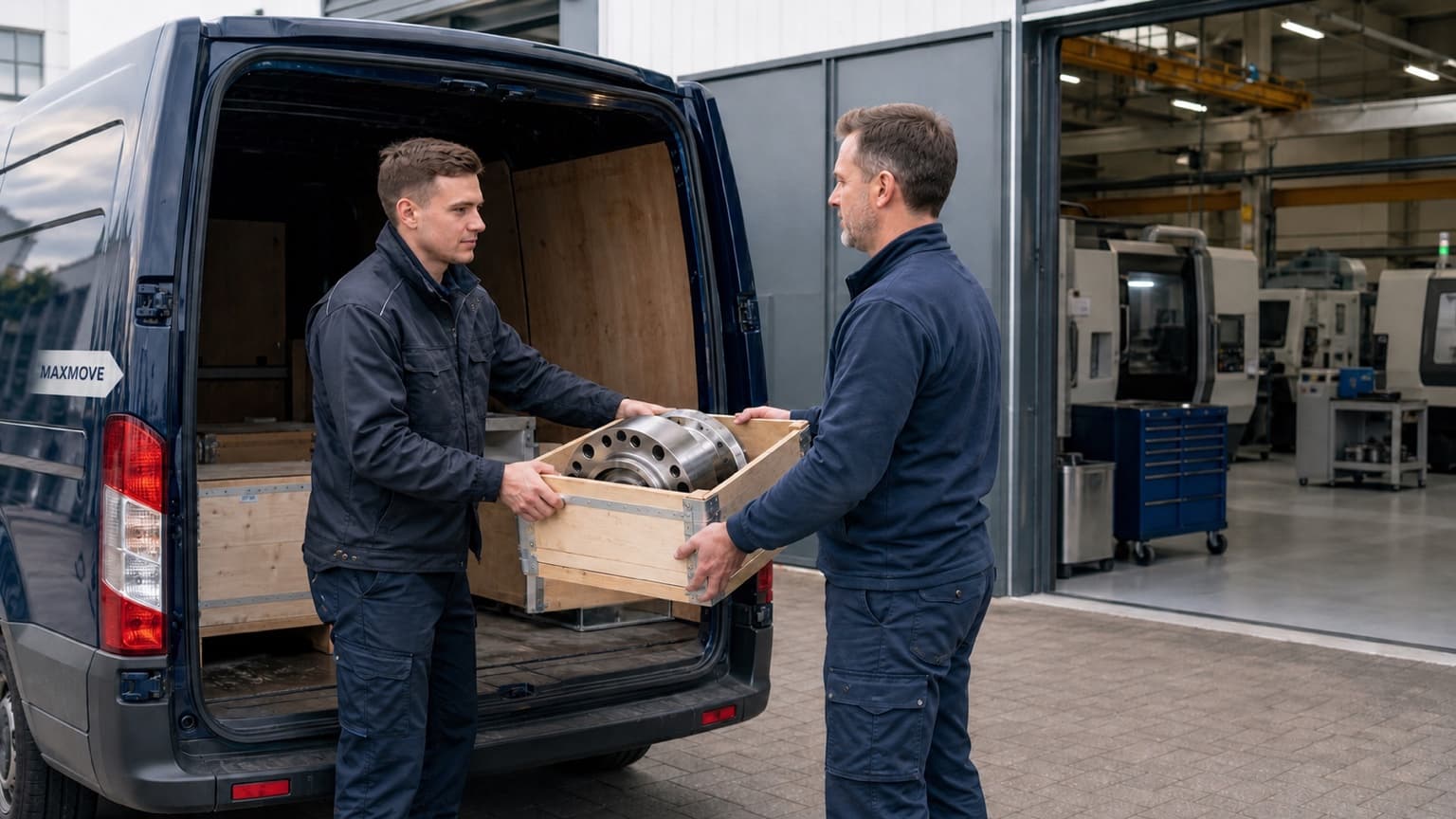
A cutlery manufacturer in Solingen-Ohligs sends turned blanks in small load carriers to a subcontract heat treater in the Bergisches Land and collects the hardened parts a few days later. For three to four Euro pallets, its own 7.5-tonne truck is not worth it; the Sprinter or 3.5-tonne box van is enough. Both legs run as recurring orders, and every handover is recorded with a timestamp and a photo of the delivery note, which helps with batch traceability.
Gauges from Hagen to the calibration lab
A cold-rolling mill in Hagen-Hohenlimburg sends plug gauges, micrometers and test equipment to a calibration laboratory. The gauges stay in their cases, travel by car secured against sliding and are never transferred between vehicles. Quality assurance follows the drive live and, with the proof of delivery, has a record of when each gauge was handed over – matching the documentation for test equipment management.
Shuttle between plant and outside store in Neuss
A supplier with a plant at the port of Neuss and an outside store elsewhere in the city needs a run with assembly parts on Euro pallets at the same time every day. Instead of keeping a truck for it, the round runs as a recurring order with a Sprinter, and several stops can be added to one drive. On days with more goods, you simply choose the 3.5-tonne box van.
Own-account transport under the GüKG: the rules at a glance
What the law means by Werkverkehr, what it allows – and what applies as soon as a service provider drives.
The four conditions in Section 1(2) GüKG
Own-account transport only applies if all four conditions are met. First, the goods belong to the company or were sold, bought, hired out, hired, produced, processed or repaired by it. Second, the run serves delivery to the company, dispatch from it, or movement within it – or, for its own use, outside it. Third, the vehicles are driven by the company's own staff or staff provided to it under contract. Fourth, the transport is only an ancillary activity.
No licence, but registration above 3.5 t
Own-account transport needs no haulage licence, and there is no insurance obligation under Section 7a GüKG (Section 9 GüKG). Companies running it with trucks, combinations or articulated vehicles above 3.5 t gross vehicle weight must register with BALM before the first run and report changes (Section 15a GüKG). Separately, vehicles above 3.5 t technically permissible maximum mass have been subject to the German truck toll since 1 July 2024, with a craft-business exemption below 7.5 t – see our truck toll entry.
The 3.5-tonne threshold in the GüKG
For transport with motor vehicles whose permissible gross weight, including any trailer, is no more than 3.5 t, the GüKG sections on commercial road haulage and own-account transport do not apply (Section 2(1) No. 10 GüKG) – unless EU law or international agreements provide otherwise. For domestic runs in a van or 3.5-tonne box van, GüKG licensing and registration questions therefore do not arise.
Once a service provider drives, freight law applies
If you hire a transport company, the run is no longer own-account transport but a contract of carriage under Section 407 of the German Commercial Code (HGB). The carrier is then liable for loss and damage from acceptance to delivery (Section 425 HGB), capped at 8.33 Special Drawing Rights per kilogram (Section 431 HGB). Unless agreed otherwise, the sender must load safely for carriage (Section 412 HGB). If only drivers are provided to drive your own vehicles, it can remain own-account transport.
Load securing applies either way
Own-account or contracted: under Section 22 of the German Road Traffic Regulations (StVO), the load must be secured so that it cannot slide, tip or fall under emergency braking or evasive manoeuvres. For vans up to 7.5 t gross vehicle mass, guideline VDI 2700 Part 16 describes the methods. Stacks of small load carriers need strapping or stretch film, mesh pallet boxes need blocking, and gauges travel in their cases. At Maxmove, the driver secures ready-to-load goods in the vehicle.
Which vehicle for which plant run
Gauges, samples and documents travel by car. Tools, fixtures and single stacks of small load carriers fit into the high-roof compact van, which takes two Euro pallets. For heat-treatment and plating loops of up to four Euro pallets, the Sprinter is the standard vehicle; for larger loops up to 1,200 kg, the 3.5-tonne box van, and up to 3,000 kg, the 7.5-tonne truck. Anything beyond that is a job for your own truck or a [special run](/sonderfahrten).
| Vehicle | Maks. težina | Euro palete | Maks. dimenzije tereta | Price | Book |
|---|---|---|---|---|---|
| CarNpr. staje Moving boxes, small furniture, classifieds pickups | 100 kg | – | 100 × 70 × 50 cm | from €79.86Base fare €18.90 | Book |
| Small VanNpr. staje Washing machine, armchair, moving boxes | 400 kg | 1–2 | 160 × 120 × 120 cm | from €94.05Base fare €29.90 | Book |
| Large VanNpr. staje Wardrobe, 2–3 room move, bulky furniture | 1000 kg | 3–4 | 330 × 180 × 170 cm | from €130.05Base fare €54.90 | Book |
| 3.5t Box LorryNpr. staje Retail goods, tail lift, large furniture | 1200 kg | 6–8 | 430 × 210 × 210 cm | from €211.24Base fare €129 | Book |
| 7.5t LorryNpr. staje Full house move, bulky retail goods, site material | 3000 kg | 12–15 | 610 × 245 × 240 cm | from €366.72Base fare €249 | Book |
Published examples for Köln → Düsseldorf, weekdays at 10:00 (Berlin time). The binding price for your addresses is shown before booking.
Bigger, open-bed or heavier than 3 t? On request as a special run
How to outsource plant runs
- 01
Set up a drive or round
Enter pickup, destination and load: you see the instant price, vehicle and earliest pickup window. For fixed loops, talk to us and they run as recurring orders.
- 02
Collection at the dock
The driver checks in at the gatehouse or goods-out with your reference, takes over the packages on the delivery note and secures the load in the vehicle.
- 03
Direct drive to the plant
No depot and no transloading – straight to the subcontractor, plant or store. Dispatch and the receiver see the arrival in live tracking.
- 04
Each handover documented
On multi-stop drives, every handover is recorded separately with signature, timestamp and photos in the proof of delivery – available to quality assurance, dispatch and accounts.
Why Maxmove for Plant runs & supply logistics
An urgent drive when production is waiting
If a tool, a fixture or a part from the heat treater is missing, book a direct drive with the next available pickup window. No hub, no transloading: the part travels on its own from one plant gate to the other.
Fixed loops without your own truck
Set up daily shuttles between plant and store or weekly heat-treatment loops as recurring orders. You pay per drive by invoice instead of keeping a vehicle, driver, toll account and BALM registration for a truck above 3.5 t.
Records for quality and dispatch
Every handover is documented with timestamp, signature and photos. That supports batch traceability and test equipment management, and answers the question of when a part actually left the subcontractor.