
C-Parts Management – Replenishment From Wholesaler to Plant as a Fixed Run
Maxmove moves kanban bins, fasteners, wear parts and workshop supplies from technical wholesale to your goods receiving – on a fixed schedule, with empties on the return leg and a documented handover at every plant. For purchasing, maintenance and C-parts suppliers in North Rhine-Westphalia.
- Instant price before booking
- Live tracking on every drive
- Insured transports
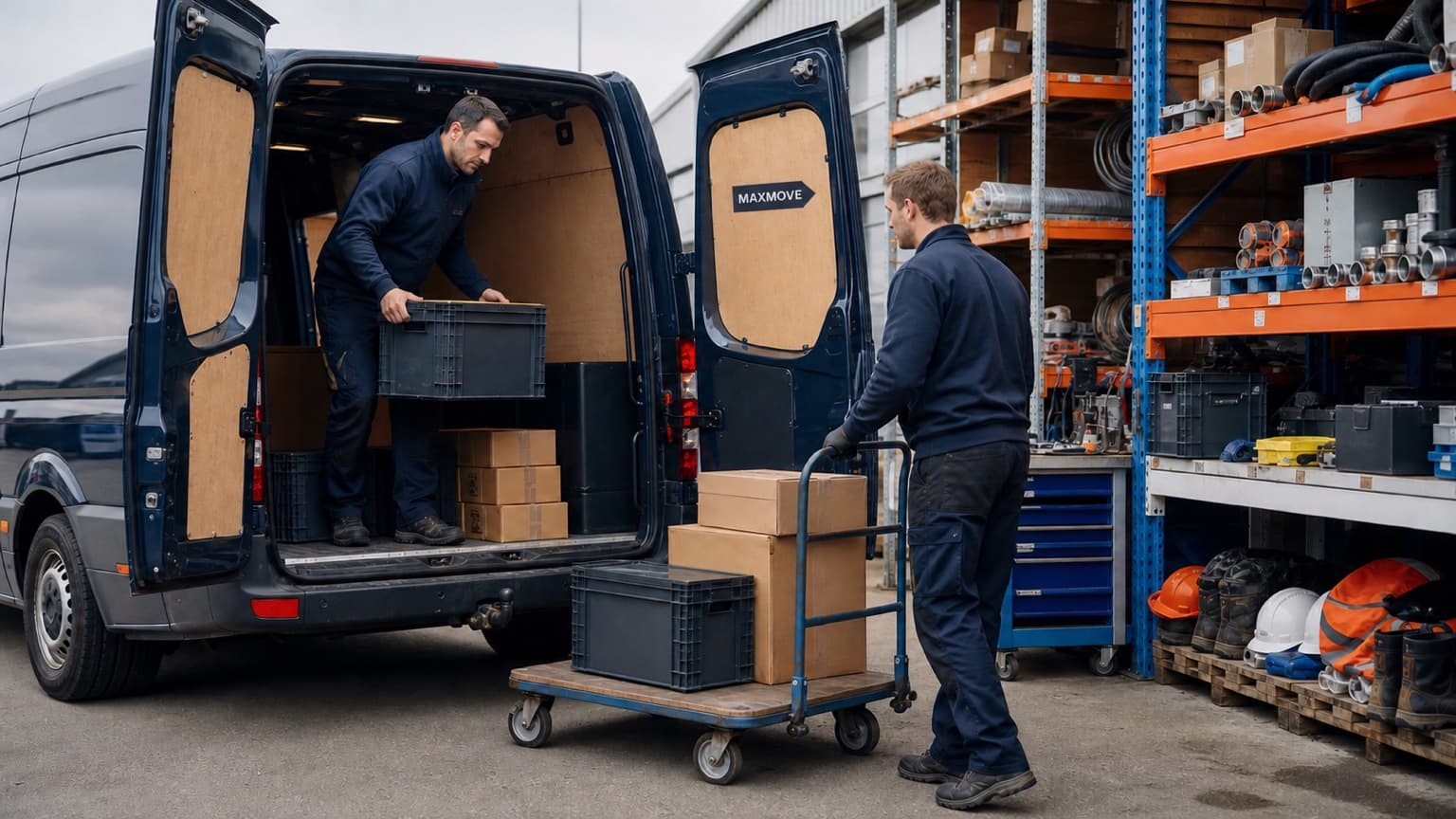
C-parts management: small parts, big process cost
In an ABC analysis, C-parts are the items with the smallest share of purchasing value: screws, nuts, washers, wall plugs, cable ties, seals, abrasives, safety gloves. In many companies they account for most of the item numbers but only a small part of purchasing spend. They still get expensive, because every order, every goods receipt and every invoice costs as much effort as for high-value material. And if a one-cent item runs out on the assembly line, the line stops.
C-parts management therefore targets the process, not the unit price. Common models are kanban shelving with a two-bin system, where an empty bin triggers the reorder; vendor managed inventory, where the supplier monitors and refills stock at the customer's site; plus consignment stock, vending machines and e-procurement catalogues. All of them have one thing in common: replenishment has to travel from supplier to plant on the agreed schedule, and the empties have to go back.
That drive is what Maxmove takes on – not the system behind it. Ordering, inventory management and shelf service stay with your C-parts supplier or your purchasing team. We drive the full bins as a direct drive from the technical wholesaler to goods receiving, take the empty bins back and document every handover with signature, timestamp and photos – as a recurring order instead of a daily one-off booking.
Which C-parts we drive into the plant
Consumables, wear parts and fasteners that are needed on a regular basis – and the bins they shuttle in.
- Screws, nuts and washers in small bins
- Wall plugs, rivets and fastening systems
- Cable ties, tapes and labels
- Seals, O-rings and rolling bearings
- Abrasives and cutting tools
- Personal protective equipment
- Greases and oils (non-hazardous)
- Workshop and cleaning supplies
- Wear parts for maintenance
- Empty kanban bins on the return leg
Three typical runs in the Bergisches Städtedreieck
Wuppertal, Remscheid and Solingen are shaped by tool, cutlery and metalworking businesses – and by their constant need for small parts.
Weekly kanban replenishment to Remscheid
A tool manufacturer in Remscheid-Lennep gets its fasteners through a two-bin kanban from a technical wholesaler in Wuppertal-Vohwinkel. Every Tuesday a compact van collects the full bins with the delivery note and takes them to goods receiving; last week's empty bins go back to the wholesaler on the same order. The run was set up once as a recurring order, and exceptions such as a public holiday are changed case by case.
Two plants in Solingen, one order
A cutlery manufacturer has plants in Solingen-Ohligs and Solingen-Wald. Its C-parts supplier in Wuppertal picks for both separately onto Euro pallets. Twice a week a van collects and supplies the plants one after the other as stops on one order. Each stop gets its own proof with signature and photos, so goods receiving at each plant can show what arrived – and purchasing can match the delivery notes cleanly.
Monthly maintenance supplies in Remscheid
The maintenance team at a metalworking firm in Remscheid-Hasten orders seals, rolling bearings, grinding discs and safety gloves from a technical wholesaler in Solingen every month. Two Euro pallets, together under 400 kg, fit the compact van. The aerosols from the same order – penetrating oil and brake cleaner – are dangerous goods and stay out; the wholesaler ships them separately. Maintenance signs at the workshop, not at central goods receiving, as noted on the order.
What should be settled for C-parts replenishment
Roles, bins, hazardous products, goods receiving and load securing: who is responsible for what when small parts travel to the plant regularly.
Clarify roles: who orders, who drives
In C-parts management, procurement and transport are separate jobs. Ordering, stock management, kanban cards and refilling the shelves at the point of use stay with your supplier or purchasing team. With vendor managed inventory the supplier is responsible for stock levels; with consignment stock the goods remain the supplier's property until they are withdrawn. Maxmove handles the drive in between: collect, transport, hand over at the agreed point, take the empties back.
Bins, labelling and delivery note
Kanban only works if the card, barcode or RFID tag stays on the bin. Hand over bins closed or covered, stackable small load carriers flush on the pallet, and add a delivery note to each pickup. Put the picking or order reference on the order: the driver presents it at the counter, and your goods receiving checks against the delivery note. Empty bins are counted on return, and the photos in the proof show the quantity.
Hazardous products in the C-parts range
Many typical C-parts are dangerous goods under ADR: aerosols such as penetrating oil, freeze spray or brake cleaner count as UN 1950 aerosols (class 2), plus some adhesives, solvents and cleaners. We do not carry dangerous goods that require labelling. Non-critical consumables in standard containers are possible – state the type of goods when booking so suitability is settled in advance, and have your supplier pick dangerous goods separately.
Goods receiving, receiving hours and handover point
Many plants only accept goods at fixed times, and factory gates have their own sign-in rules. Store receiving hours, gate, contact person and any gatehouse registration on the recurring order. If material should go straight to maintenance or to a kanban supermarket, agree that handover point in advance. Putting parts away on shelves is not part of the drive; every handover is documented with signature, timestamp and photos.
Load securing with many small bins
Small load carriers slip and tip more easily than a compact pallet, and screws weigh more than the bin suggests. Under section 22 of the German road traffic regulations (StVO), a load must stay in place even under emergency braking. Bins therefore stand tightly packed in the vehicle or wrapped on the pallet, and single cartons are strapped down. Under section 411 of the German Commercial Code (HGB), the sender packs for transport – for kanban that means bins closed or covered, nothing loose on top.
Which vehicle suits which replenishment run
A few small bins or a carton of protective equipment travel in a car with up to 100 kg. A typical weekly run for one plant – up to two Euro pallets and 400 kg – fits the compact van. Several plants or larger quantities go in the van with 900 kg and three pallets, or the Sprinter with 1,000 kg and four pallets. For fasteners, plan by weight rather than by number of bins.
| Vehicle | Maks. težina | Euro palete | Maks. dimenzije tereta | Price | Book |
|---|---|---|---|---|---|
| CarNpr. staje Moving boxes, small furniture, classifieds pickups | 100 kg | – | 100 × 70 × 50 cm | from €79.86Base fare €18.90 | Book |
| Small VanNpr. staje Washing machine, armchair, moving boxes | 400 kg | 1–2 | 160 × 120 × 120 cm | from €94.05Base fare €29.90 | Book |
| VanNpr. staje Sofa, 1–2 room move, moving boxes | 900 kg | 2–3 | 270 × 160 × 130 cm | from €112.95Base fare €44.90 | Book |
| Large VanNpr. staje Wardrobe, 2–3 room move, bulky furniture | 1000 kg | 3–4 | 330 × 180 × 170 cm | from €130.05Base fare €54.90 | Book |
Published examples for Köln → Düsseldorf, weekdays at 10:00 (Berlin time). The binding price for your addresses is shown before booking.
Bigger, open-bed or heavier than 3 t? On request as a special run
How a C-parts run works
- 01
Set the run up once
Enter the wholesaler pickup, the plant or plants, the weekday and receiving hours as a recurring order. You see the price per drive in advance and change exceptions case by case.
- 02
Collection at the counter
The driver gives the picking or order reference, takes over bins or pallets with the delivery note and secures the load in the vehicle.
- 03
Direct drive to goods receiving
The vehicle goes to the plant with no depot or reloading, visiting several plants in turn as stops. Purchasing and goods receiving see the arrival live.
- 04
Handover and empties
Goods receiving signs in the app at each stop, and the empty bins go back to the wholesaler. Photos and timestamp go into the digital proof of delivery.
Why Maxmove for C-parts management & MRO
A fixed run instead of daily dispatching
You set up the pickup at the technical wholesaler and the delivery to the plant once as a recurring order. The run then follows the agreed schedule; public holidays, extra quantities or an additional stop are changed case by case.
One proof per plant and stop
If you supply several plants, one vehicle visits them in turn. Each stop gets its own signature, timestamp and photos – so goods receiving and purchasing can match delivery notes and settle queries without a phone call.
Empties travel back
In a two-bin system the supplier needs the empty bins for the next fill. You add the return as a stop on the same order, and the photos in the proof show how many bins went back.